On the rarity of rocket-driven Penrose extraction in Kerr spacetime
作者: An T. Le
分类: astro-ph.HE, eess.SY, gr-qc, physics.comp-ph
发布日期: 2026-01-27
备注: 17 pages, 6 figures, 8 tables, submitted to Physical Review D
🔗 代码/项目: GITHUB
💡 一句话要点
通过蒙特卡洛研究揭示Kerr时空中Penrose提取的稀有性
🎯 匹配领域: 支柱八:物理动画 (Physics-based Animation)
关键词: Penrose提取 Kerr黑洞 蒙特卡洛模拟 能量提取 超相对论 黑洞自旋 天体物理
📋 核心要点
- 现有研究对Kerr黑洞中Penrose提取的成功概率缺乏系统性分析,导致对其可行性认识不足。
- 本文通过蒙特卡洛模拟方法,系统研究了Penrose提取的条件与成功概率,提供了新的理论框架。
- 研究结果表明,成功提取的概率极低,但在特定条件下可显著提高,揭示了物质提取的微调需求。
📝 摘要(中文)
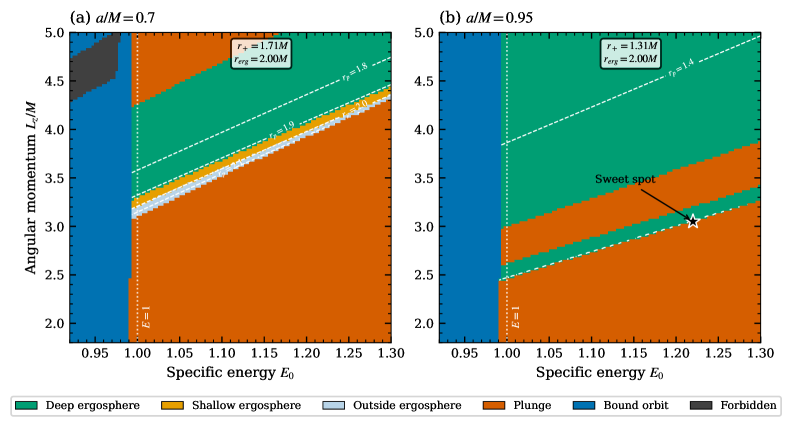
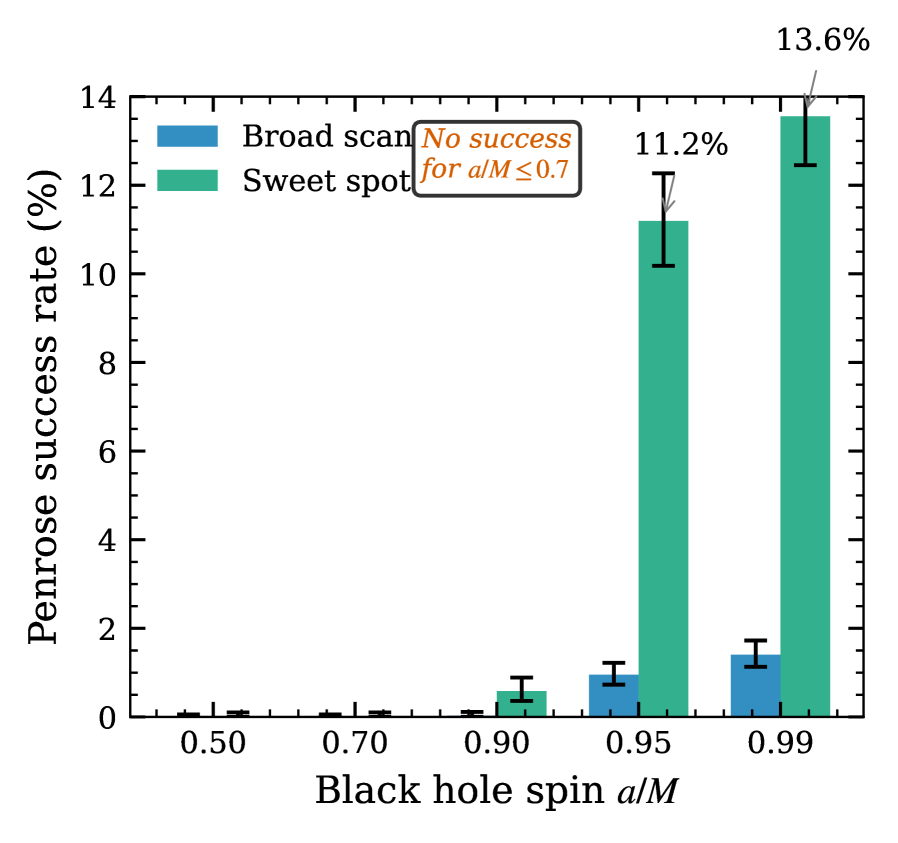
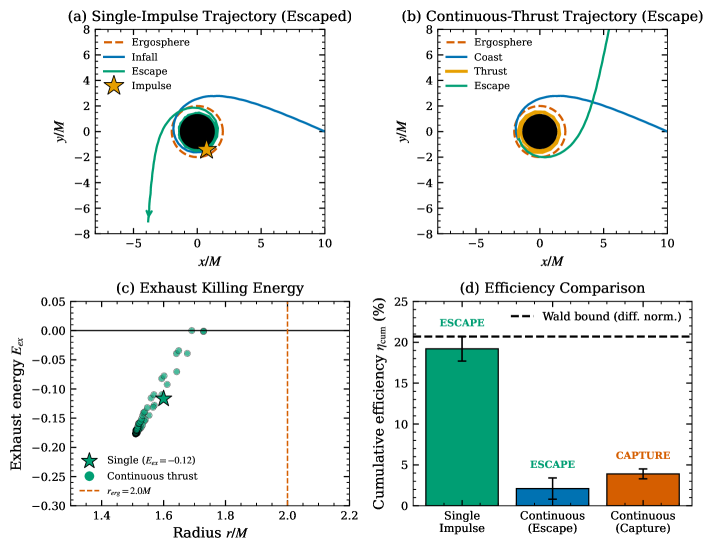
本文通过蒙特卡洛方法研究了在旋转(Kerr)黑洞中通过火箭推进实现的Penrose能量提取过程。通过超过25万条轨迹模拟,我们建立了Penrose提取成功的严格约束条件。该机制要求在ergosphere内部喷射的废气携带负的Killing能量,这在运动学上仅能通过超相对论的喷射实现。我们发现,成功提取并逃逸的概率统计上非常稀少(约1%),并受到严格阈值的控制:需要高黑洞自旋(经验值为$a/M extgreater 0.89$)和超相对论的废气速度(起始于$v_e extapprox 0.91c$)。在特定的“甜点”条件下,成功率可达88.5%,这表明提取窗口非常狭窄,而非普遍现象。此外,在近拱点的单脉冲推力相比于连续推力具有显著更高的累积效率(约19%),而连续推力的效率仅为2-4%。这些约束量化了基于物质的Penrose提取所需的极端微调,符合电磁机制在天体物理学中的主导地位。
🔬 方法详解
问题定义:本文旨在解决在Kerr时空中通过Penrose过程提取能量的成功概率及其影响因素。现有方法未能明确量化成功提取的条件与概率,导致对该过程的理解存在盲点。
核心思路:通过进行超过25万条轨迹的蒙特卡洛模拟,本文提出了一种系统化的方法来分析Penrose提取的成功条件,特别是废气的能量状态和黑洞自旋的影响。
技术框架:整体研究流程包括:1)定义Penrose提取的物理模型;2)设置模拟参数并进行轨迹模拟;3)分析成功提取的条件与概率;4)评估不同推力模式下的效率。
关键创新:本文的主要创新在于量化了Penrose提取的成功概率及其依赖的严格阈值,特别是高黑洞自旋和超相对论废气速度的要求,这与现有文献中的定性描述形成鲜明对比。
关键设计:在模拟中,关键参数包括黑洞自旋$a/M$、废气速度$v_e$及其喷射位置。通过精确调节这些参数,研究发现成功提取的概率在特定条件下可达88.5%。
🖼️ 关键图片
📊 实验亮点
实验结果显示,Penrose提取成功的概率在广泛参数扫描中仅约为1%,而在特定条件下成功率可高达88.5%。单脉冲推力的累积效率达到约19%,显著高于连续推力的2-4%。
🎯 应用场景
该研究为理解黑洞能量提取机制提供了新的视角,尤其是在高能物理和天体物理领域。未来可能推动对黑洞动力学的深入研究,并为相关技术的开发提供理论基础。
📄 摘要(原文)
We present a Monte Carlo study of energy extraction from rotating (Kerr) black holes via the Penrose process using rocket propulsion. Through over 250,000 trajectory simulations, we establish sharp constraints on when Penrose extraction with escape to infinity succeeds. The mechanism requires that exhaust ejected inside the ergosphere carries negative Killing energy, which is kinematically accessible only via ultra-relativistic ejection deep within the ergosphere. We find that successful extraction with escape is statistically rare ($\sim$1% in broad parameter scans) and is governed by strict thresholds: it requires high black hole spin (empirically $a/M \gtrsim 0.89$) and ultra-relativistic exhaust velocity (onset at $v_e \approx 0.91c$). When conditions are highly tuned to a specific "sweet spot," success rates can reach 88.5%, representing a narrow extraction window rather than generic behavior. Furthermore, single-impulse thrust at periapsis achieves significantly higher cumulative efficiency ($η_{\rm cum} \approx 19\%$) compared to continuous thrust ($\sim$2--4%) due to path-averaging penalties. These constraints quantify the extreme fine-tuning required for material-based Penrose extraction, consistent with the astrophysical dominance of electromagnetic mechanisms. Simulation code is available at https://github.com/anindex/penrose_process.