Topology optimization of decoupling feeding networks for antenna arrays
作者: Pan Lu, Eddie Wadbro, Jonas Starck, Martin Berggren, Emadeldeen Hassan
分类: eess.SY
发布日期: 2025-04-10 (更新: 2025-10-13)
备注: Accepted version of the manuscript published in IEEE Transactions on Antennas and Propagation, 2025. The final version is available at https://doi.org/10.1109/TAP.2025.3621265
💡 一句话要点
提出拓扑优化解耦馈电网络,抑制天线阵列互耦
🎯 匹配领域: 支柱八:物理动画 (Physics-based Animation)
关键词: 拓扑优化 解耦网络 天线阵列 互耦抑制 伴随场方法
📋 核心要点
- 辐射单元间的近场和辐射耦合是无线通信和主动传感应用的限制因素。
- 提出基于密度的拓扑优化方法,通过解耦网络实现辐射单元间的解耦。
- 实验结果表明,该方法设计的解耦网络能有效抑制互耦,且结构紧凑。
📝 摘要(中文)
本文提出了一种基于密度的拓扑优化方法,用于设计天线阵列的解耦网络。该解耦网络的设计基于多目标优化问题,其中辐射单元被其时域冲击响应所取代,以实现高效计算,并使用基于梯度的优化方法解决设计问题。我们使用伴随场方法来计算优化目标的梯度。此外,在优化过程中应用非线性滤波器,以对优化设计施加最小尺寸控制。我们通过设计一个双元素平面天线阵列的解耦网络来演示该概念;天线是在一个单独的优化问题中设计的。优化的解耦网络提供了一条信号路径,该路径破坏性地干扰了辐射单元之间的耦合,同时保持了它们各自与馈电端口的匹配。实验验证了紧凑型解耦网络能够在2.45 GHz附近工作的两个紧密分离的平面天线之间抑制超过10 dB的互耦。
🔬 方法详解
问题定义:天线阵列中辐射单元之间的互耦会严重影响阵列的性能,尤其是在无线通信和主动传感等应用中。现有的解耦方法可能存在尺寸较大、带宽较窄或设计复杂等问题,难以满足实际应用的需求。因此,需要一种能够设计紧凑、高效的解耦网络的方法,以抑制天线阵列中的互耦效应。
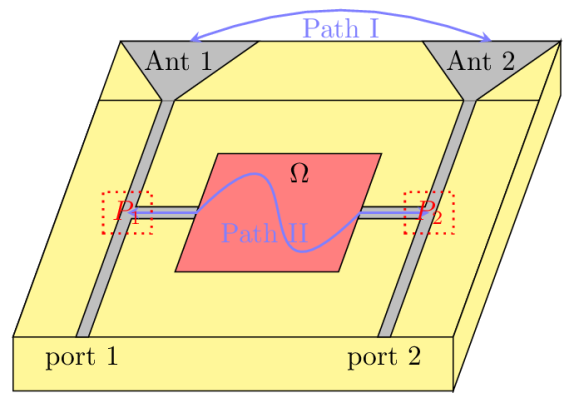
核心思路:本文的核心思路是通过拓扑优化方法,自动设计一种解耦网络,该网络能够产生与互耦信号反相的信号,从而实现对互耦的抑制。这种方法避免了传统设计方法中需要人工干预和反复调整的缺点,能够快速有效地找到最优的解耦网络结构。利用时域冲击响应代替辐射单元,提升计算效率。
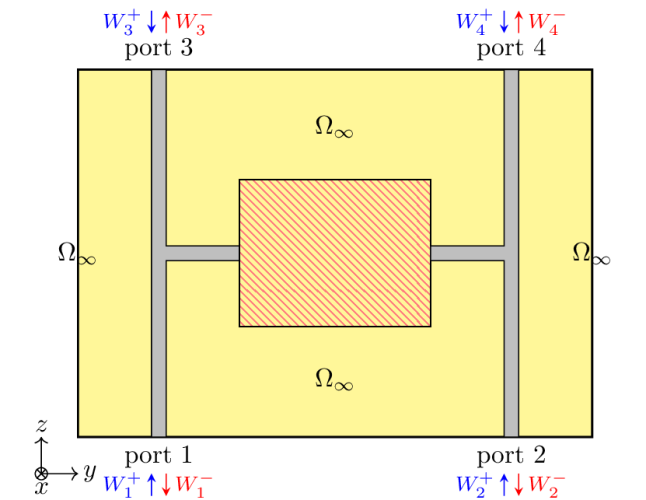
技术框架:该方法的技术框架主要包括以下几个步骤:1) 使用时域冲击响应表征辐射单元;2) 构建多目标优化问题,目标包括抑制互耦和保持端口匹配;3) 使用伴随场方法计算优化目标的梯度;4) 应用非线性滤波器控制优化设计的最小尺寸;5) 通过迭代优化,得到最终的解耦网络结构。
关键创新:该方法最重要的技术创新点在于将拓扑优化方法应用于解耦网络的设计,并采用时域冲击响应进行快速计算。与传统的解耦网络设计方法相比,该方法能够自动生成最优的解耦网络结构,无需人工干预,并且能够有效地抑制互耦效应。此外,使用伴随场方法进行梯度计算,提高了优化效率。
关键设计:在优化问题中,目标函数包括互耦抑制和端口匹配两个方面。互耦抑制通过最小化辐射单元之间的传输系数来实现,端口匹配通过最小化反射系数来实现。使用伴随场方法计算目标函数的梯度,并采用非线性滤波器对优化设计的最小尺寸进行控制,以保证设计的可行性。优化过程中,需要设置合适的迭代次数、步长和滤波器参数。
🖼️ 关键图片

📊 实验亮点
实验结果表明,该方法设计的解耦网络能够有效地抑制天线阵列中的互耦效应。对于工作在2.45 GHz附近的双元素平面天线阵列,该解耦网络能够将互耦抑制超过10 dB。实验验证了该方法的有效性和可行性,表明该方法能够为天线阵列的解耦设计提供一种新的解决方案。
🎯 应用场景
该研究成果可广泛应用于无线通信、雷达、传感器网络等领域。通过抑制天线阵列中的互耦效应,可以提高通信质量、增大通信距离、提升雷达探测精度和传感器网络的覆盖范围。此外,该方法还可以应用于其他电磁器件的设计,例如滤波器、耦合器等,具有重要的实际应用价值和广阔的应用前景。
📄 摘要(原文)
Near-field and radiation coupling between nearby radiating elements is unavoidable, and it is considered a limiting factor for applications in wireless communications and active sensing. This article proposes a density-based topology optimization approach to design decoupling networks for such systems. The decoupling networks are designed based on a multi-objective optimization problem with the radiating elements replaced by their time-domain impulse response for efficient computations and to enable the solution of the design problem using gradient-based optimization methods. We use the adjoint-field method to compute the gradients of the optimization objectives. Additionally, nonlinear filters are applied during the optimization procedure to impose minimum-size control on the optimized designs. We demonstrate the concept by designing the decoupling network for a two-element planar antenna array; the antenna is designed in a separate optimization problem. The optimized decoupling networks provide a signal path that destructively interferes with the coupling between the radiating elements while preserving their individual matching to the feeding ports. Compact decoupling networks capable of suppressing the mutual coupling by more than 10 dB between two closely separated planar antennas operating around 2.45 GHz are presented and validated experimentally.