Reducing the Communication of Distributed Model Predictive Control: Autoencoders and Formation Control
作者: Torben Schiz, Henrik Ebel
分类: eess.SY, cs.DC, cs.RO
发布日期: 2025-04-07 (更新: 2025-04-22)
备注: 24 pages, 15 figures
期刊: Control Engineering Practice, Volume 165, 106560, 2025
DOI: 10.1016/j.conengprac.2025.106560
💡 一句话要点
提出基于自编码器的分布式模型预测控制通信量缩减方法,应用于机器人编队控制。
🎯 匹配领域: 支柱一:机器人控制 (Robot Control)
关键词: 分布式模型预测控制 自编码器 通信量缩减 机器人编队控制 非完整约束
📋 核心要点
- 分布式模型预测控制(DMPC)在实际应用中受限于智能体间的大量通信需求,尤其是在需要长预测范围以保证稳定性的场景下。
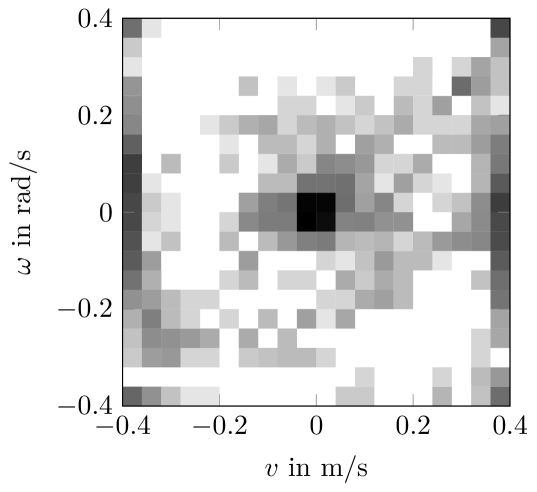
- 利用自编码器学习数据中的内在结构,在通信前压缩数据,接收后解压缩,从而减少智能体间通信的数据量。
- 在机器人编队控制仿真和实际硬件实验中验证了该方法的有效性,结果表明该方法优于直接缩短预测范围的策略。
📝 摘要(中文)
本文旨在通过减少分布式模型预测控制(DMPC)中智能体间通信的数据量,来降低其在实际应用中的通信负担。尽管无线通信技术有所进步,但通信仍然是限制DMPC应用的关键因素。DMPC方案可能需要在智能体之间交换大量信息,数据量取决于预测范围的长度,而某些应用需要较长的预测范围才能保证名义渐近稳定性。本文利用自编码器,在通信前通过编码器减少通信数据的大小,并在接收后通过解码器在分布式优化算法中重建数据。选择基于学习的缩减方法是由于数据固有的结构,这种结构源于数据与最优控制问题解的联系。该方法在差分驱动机器人编队控制的例子中进行了实现和测试,由于机器人的非完整约束,这对基于优化的控制提出了挑战,并且由于移动机器人的实际重要性而引人关注。仿真分析表明,该方法在控制性能上取得了令人满意的精度,优于通过缩短预测范围来减少通信的朴素方法。此外,在嵌入式计算硬件上进行的数值实验表明,即使在完全通信失败的实际场景中,所提出的通信缩减方法也能很好地工作。
🔬 方法详解
问题定义:论文旨在解决分布式模型预测控制(DMPC)中,由于智能体间通信量过大而导致的应用受限问题。尤其是在需要较长预测时域以保证系统稳定性的情况下,传统DMPC方法需要传输大量数据,对通信带宽提出了很高的要求。直接缩短预测时域虽然可以减少通信量,但会牺牲控制性能。
核心思路:论文的核心思路是利用自编码器学习DMPC中智能体间通信数据的内在结构,通过编码器压缩数据,减少通信量,并在接收端通过解码器重构数据。由于DMPC的数据来源于最优控制问题的解,因此具有一定的结构性,可以通过学习的方法进行有效压缩。
技术框架:整体框架如下: 1. 每个智能体运行DMPC算法,生成需要与其他智能体通信的数据。 2. 在发送数据之前,使用训练好的编码器对数据进行压缩。 3. 通过无线通信网络将压缩后的数据发送给其他智能体。 4. 接收到数据后,使用训练好的解码器对数据进行解压缩,恢复原始数据。 5. 解压缩后的数据用于DMPC算法的后续计算。
关键创新:该方法的核心创新在于将自编码器引入到DMPC的通信环节中,利用学习的方法对通信数据进行压缩,从而在不显著降低控制性能的前提下,有效减少了通信量。与直接缩短预测时域相比,该方法能够更好地保留控制性能。
关键设计: * 自编码器的网络结构:论文中未明确说明自编码器的具体网络结构,但通常可以选择卷积神经网络(CNN)或循环神经网络(RNN)等结构,具体取决于数据的特性。 * 损失函数:自编码器的损失函数通常采用均方误差(MSE),用于衡量重构数据与原始数据之间的差异。 * 训练数据:自编码器的训练数据来源于DMPC算法产生的历史数据,需要覆盖各种可能的系统状态和控制输入。
🖼️ 关键图片


📊 实验亮点
实验结果表明,所提出的基于自编码器的通信缩减方法在机器人编队控制任务中取得了良好的效果。仿真结果显示,该方法在保证控制精度的前提下,显著减少了通信量,优于直接缩短预测范围的朴素方法。在实际硬件实验中,即使在完全通信失败的情况下,该方法也能正常工作,验证了其在实际应用中的可行性和鲁棒性。
🎯 应用场景
该研究成果可应用于各种需要分布式协同控制的场景,例如多机器人协同作业、无人机集群控制、智能交通系统等。通过减少通信量,可以降低对通信带宽的要求,提高系统的可扩展性和鲁棒性,使得DMPC能够应用于资源受限的嵌入式平台和通信环境恶劣的场景。未来,该方法有望推动DMPC在实际工程中的广泛应用。
📄 摘要(原文)
Communication remains a key factor limiting the applicability of distributed model predictive control (DMPC) in realistic settings, despite advances in wireless communication. DMPC schemes can require an overwhelming amount of information exchange between agents as the amount of data depends on the length of the predication horizon, for which some applications require a significant length to formally guarantee nominal asymptotic stability. This work aims to provide an approach to reduce the communication effort of DMPC by reducing the size of the communicated data between agents. Using an autoencoder, the communicated data is reduced by the encoder part of the autoencoder prior to communication and reconstructed by the decoder part upon reception within the distributed optimization algorithm that constitutes the DMPC scheme. The choice of a learning-based reduction method is motivated by structure inherent to the data, which results from the data's connection to solutions of optimal control problems. The approach is implemented and tested at the example of formation control of differential-drive robots, which is challenging for optimization-based control due to the robots' nonholonomic constraints, and which is interesting due to the practical importance of mobile robotics. The applicability of the proposed approach is presented first in form of a simulative analysis showing that the resulting control performance yields a satisfactory accuracy. In particular, the proposed approach outperforms the canonical naive way to reduce communication by reducing the length of the prediction horizon. Moreover, it is shown that numerical experiments conducted on embedded computation hardware, with real distributed computation and wireless communication, work well with the proposed way of reducing communication even in practical scenarios in which full communication fails.