Federated Digital Twin Construction via Distributed Sensing: A Game-Theoretic Online Optimization with Overlapping Coalitions
作者: Ruoyang Chen, Changyan Yi, Fuhui Zhou, Jiawen Kang, Yuan Wu, Dusit Niyato
分类: cs.ET, cs.GT, eess.SY
发布日期: 2025-03-21
期刊: IEEE Transactions on Mobile Computing, vol. 24, no. 11, pp. 12221-12238, Nov. 2025
💡 一句话要点
提出一种基于分布式感知的联邦数字孪生构建框架,通过博弈论在线优化实现边缘-云协同。
🎯 匹配领域: 支柱二:RL算法与架构 (RL & Architecture)
关键词: 联邦学习 数字孪生 边缘计算 博弈论 在线优化 深度强化学习 资源分配
📋 核心要点
- 现有数字孪生构建方法难以应对动态演变和异构性,导致模型质量下降和资源浪费。
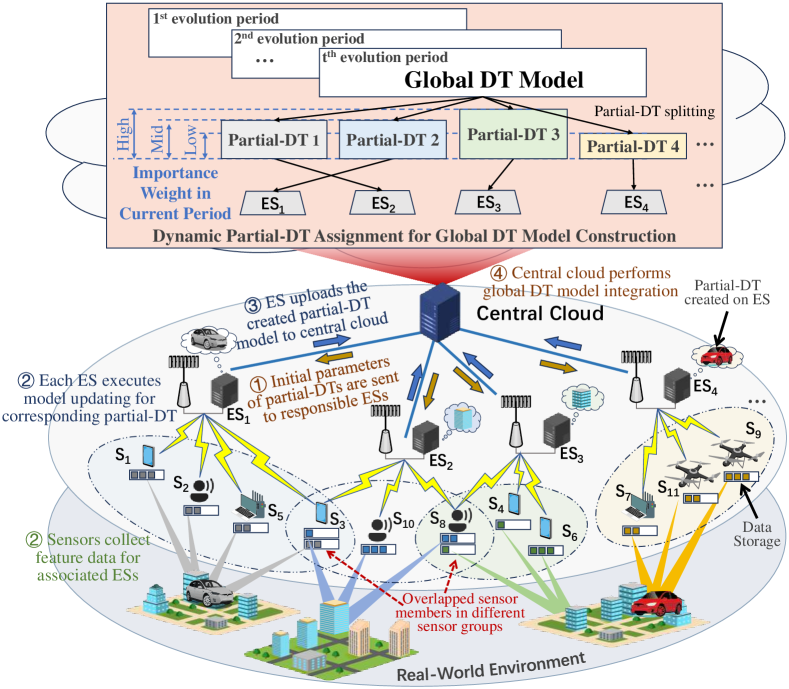
- 提出联邦学习框架,将全局DT模型分解为边缘服务器上的partial-DTs,并通过博弈论在线优化资源分配。
- 通过仿真验证,所提框架能有效构建高质量DT模型,并降低能耗和配置成本,优于对比方案。
📝 摘要(中文)
本文提出了一种新颖的联邦框架,用于构建数字孪生(DT)模型。该框架将云端构建的DT模型视为一个全局模型,它被分解为多个功能组件,即partial-DTs,这些partial-DTs由各个边缘服务器(ESs)利用相关传感器收集的特征数据创建。考虑到DT的动态演变以及partial-DTs之间的异构性,本文构建了一个在线优化问题,该问题联合且动态地优化partial-DTs从云到ESs的分配、ES-传感器的关联以创建partial-DTs,以及用于全局DT集成的计算和通信资源分配。该问题旨在最大化构建的DT模型的质量,同时最小化所有相关成本,包括能源消耗和配置成本。为此,本文首先将原始问题转化为一个等价的分层博弈,上层是一个双边匹配博弈,下层是一个重叠联盟形成博弈。在详细分析这些博弈之后,本文应用Gale-Shapley算法,并特别开发了一种基于切换规则的重叠联盟形成算法,以分别获得上下层子博弈的短期均衡。然后,本文设计了一种基于深度强化学习的解决方案,称为DMO,将结果扩展到分层博弈的长期均衡,从而产生原始问题的解决方案。仿真结果表明了所提出的框架的有效性,并证明了所提出的解决方案优于其他方案。
🔬 方法详解
问题定义:论文旨在解决在边缘-云协同环境下,如何高效构建高质量的数字孪生模型的问题。现有方法难以应对数字孪生的动态演变和partial-DTs之间的异构性,导致模型质量不高,资源利用率低,且忽略了能源消耗和配置成本。
核心思路:论文的核心思路是将全局数字孪生模型分解为多个partial-DTs,由边缘服务器利用本地传感器数据构建。通过优化partial-DTs的分配、ES-传感器的关联以及计算和通信资源分配,最大化模型质量并最小化成本。采用博弈论和深度强化学习相结合的方法,实现长期均衡。
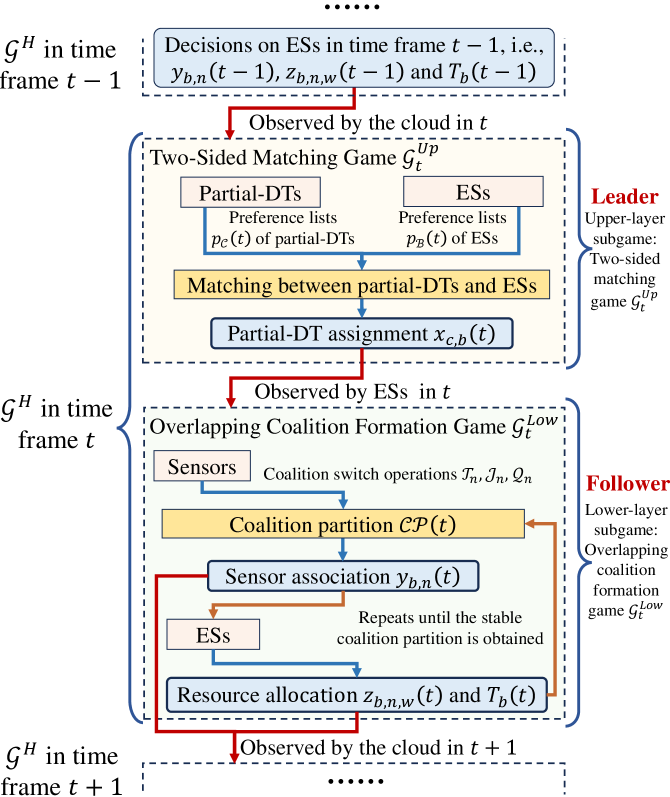
技术框架:整体框架包含三个主要部分:1) 云端将全局DT模型分解为partial-DTs;2) 边缘服务器利用传感器数据构建partial-DTs;3) 通过优化资源分配,将partial-DTs集成到云端的全局DT模型。该框架采用分层博弈结构,上层为云和边缘服务器之间的双边匹配博弈,下层为边缘服务器和传感器之间的重叠联盟形成博弈。
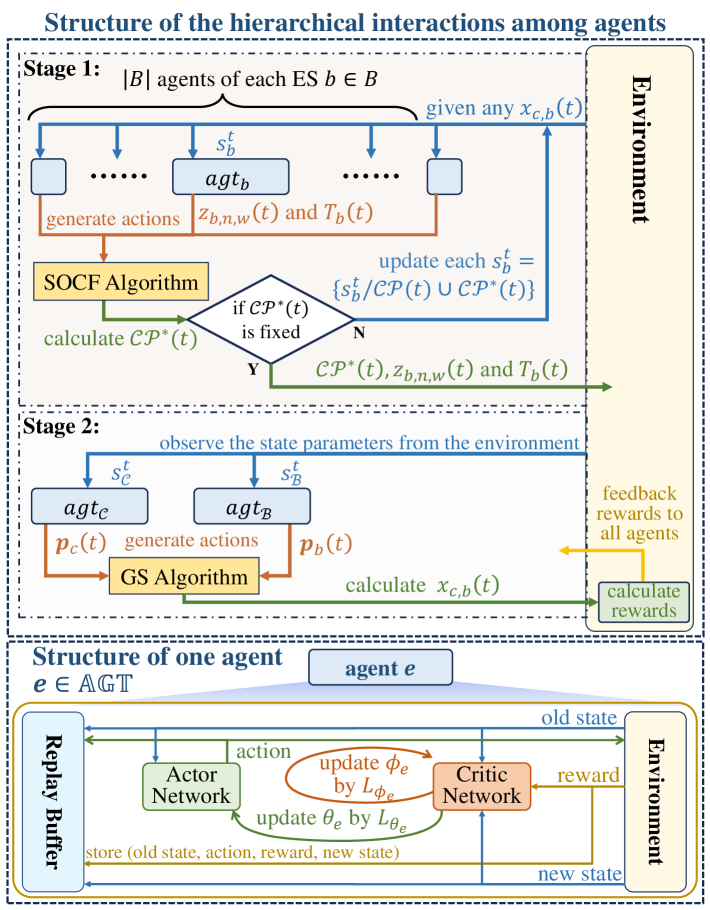
关键创新:论文的关键创新在于:1) 提出了一种基于联邦学习的数字孪生构建框架,实现了边缘-云协同;2) 将资源分配问题建模为分层博弈,并设计了相应的求解算法;3) 采用深度强化学习方法,实现了长期均衡的优化。
关键设计:在上层博弈中,采用Gale-Shapley算法进行双边匹配;在下层博弈中,开发了一种基于切换规则的重叠联盟形成算法。为了实现长期均衡,设计了一种基于深度强化学习的解决方案DMO。具体的网络结构和损失函数等细节在论文中未明确说明,属于未知信息。
🖼️ 关键图片
📊 实验亮点
仿真结果表明,所提出的联邦数字孪生构建框架能够有效提高DT模型的质量,并显著降低能源消耗和配置成本。具体性能数据和提升幅度在摘要中未明确给出,属于未知信息。但总体而言,该方法优于其他对比方案。
🎯 应用场景
该研究成果可应用于智慧城市、智能制造、智能交通等领域,通过构建高质量的数字孪生模型,实现对物理世界的实时监控、预测和优化,从而提高生产效率、降低运营成本、改善用户体验。未来可进一步探索更复杂的环境和更大规模的部署。
📄 摘要(原文)
In this paper, we propose a novel federated framework for constructing the digital twin (DT) model, referring to a living and self-evolving visualization model empowered by artificial intelligence, enabled by distributed sensing under edge-cloud collaboration. In this framework, the DT model to be built at the cloud is regarded as a global one being split into and integrating from multiple functional components, i.e., partial-DTs, created at various edge servers (ESs) using feature data collected by associated sensors. Considering time-varying DT evolutions and heterogeneities among partial-DTs, we formulate an online problem that jointly and dynamically optimizes partial-DT assignments from the cloud to ESs, ES-sensor associations for partial-DT creation, and as well as computation and communication resource allocations for global-DT integration. The problem aims to maximize the constructed DT's model quality while minimizing all induced costs, including energy consumption and configuration costs, in long runs. To this end, we first transform the original problem into an equivalent hierarchical game with an upper-layer two-sided matching game and a lower-layer overlapping coalition formation game. After analyzing these games in detail, we apply the Gale-Shapley algorithm and particularly develop a switch rules-based overlapping coalition formation algorithm to obtain short-term equilibria of upper-layer and lower-layer subgames, respectively. Then, we design a deep reinforcement learning-based solution, called DMO, to extend the result into a long-term equilibrium of the hierarchical game, thereby producing the solution to the original problem. Simulations show the effectiveness of the introduced framework, and demonstrate the superiority of the proposed solution over counterparts.