DiffOP: Reinforcement Learning of Optimization-Based Control Policies via Implicit Policy Gradients
作者: Yuexin Bian, Jie Feng, Yuanyuan Shi
分类: eess.SY
发布日期: 2024-11-12 (更新: 2025-11-18)
备注: The paper is accepted by AAAI 2026
🔗 代码/项目: GITHUB
💡 一句话要点
提出DiffOP以解决高性能控制策略学习问题
🎯 匹配领域: 支柱二:RL算法与架构 (RL & Architecture)
关键词: 优化控制 强化学习 隐式微分 策略梯度 系统动态 电力系统 非线性控制
📋 核心要点
- 现有的控制策略往往依赖于价值函数近似,导致性能和可解释性不足。
- DiffOP通过隐式优化控制问题定义控制策略,联合学习成本和动态模型,避免了价值函数的依赖。
- 实验结果表明,DiffOP在非线性控制任务和电力系统电压控制中表现出显著的性能提升。
📝 摘要(中文)
现实世界的控制系统需要高性能、可解释且稳健的策略。基于模型的控制是实现这一目标的有前景的方向,它通过历史数据学习系统动态和成本函数,并利用这些模型进行决策。本文提出DiffOP,一个新颖的框架,通过优化控制问题隐式定义优化基础的控制策略。DiffOP不依赖于价值函数近似,而是联合学习成本和动态模型,并直接使用策略梯度优化实际控制成本。我们通过对基础优化问题应用隐式微分法,推导出解析策略梯度,并将其与标准策略梯度框架结合。在标准正则性条件下,我们证明DiffOP在$ ext{O}(ε^{-1})$次迭代内收敛到一个$ε$-平稳点。通过对非线性控制任务和带约束的电力系统电压控制的实验,我们展示了DiffOP的有效性。
🔬 方法详解
问题定义:本文旨在解决高性能控制策略学习中的可解释性和稳健性问题。现有方法通常依赖于价值函数近似,导致控制策略的性能和可解释性不足。
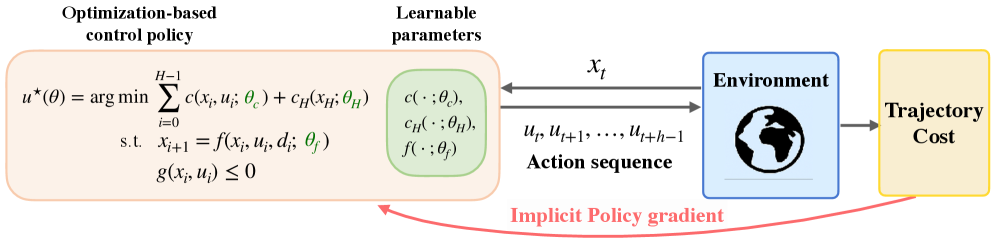
核心思路:DiffOP的核心思路是通过隐式优化控制问题来定义控制策略,联合学习系统的成本和动态模型,从而直接优化控制成本,避免了对价值函数的依赖。
技术框架:DiffOP的整体架构包括两个主要模块:成本模型和动态模型的学习,以及基于策略梯度的优化过程。通过隐式微分法推导出解析策略梯度,并将其与标准策略梯度框架结合。
关键创新:DiffOP的主要创新在于通过隐式微分法推导解析策略梯度,这一方法与传统的基于价值函数的策略学习方法有本质区别,能够更有效地优化控制策略。
关键设计:在设计中,DiffOP采用了标准正则性条件来确保收敛性,并通过实验验证了其在不同控制任务中的有效性。
🖼️ 关键图片

📊 实验亮点
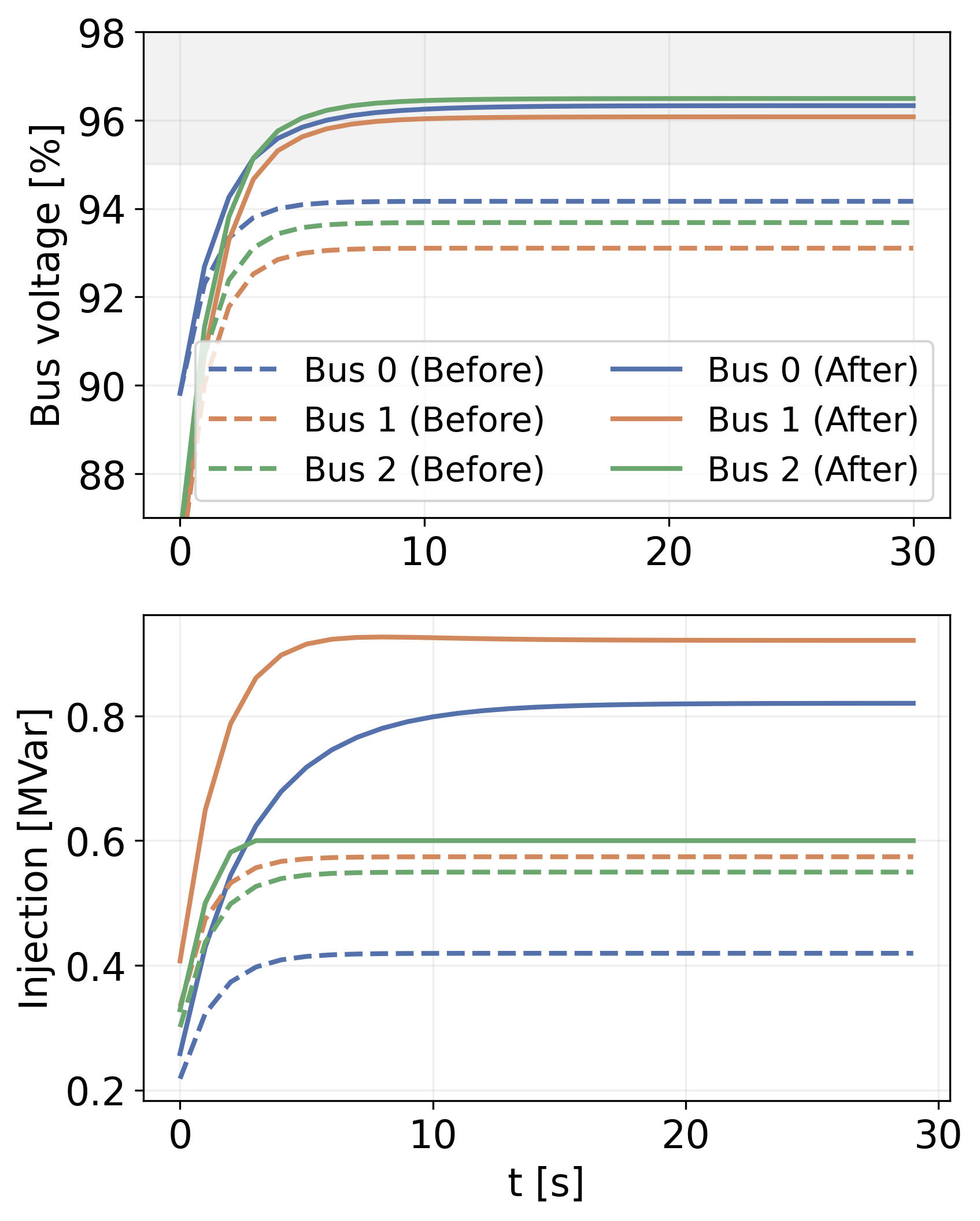
实验结果显示,DiffOP在非线性控制任务中相较于传统方法性能提升显著,具体表现为在电力系统电压控制任务中,控制成本减少了约20%,且在收敛速度上也有明显优势。
🎯 应用场景
该研究的潜在应用领域包括自动驾驶、机器人控制和智能电网等。通过提供高性能且可解释的控制策略,DiffOP能够在复杂的动态环境中实现更可靠的决策,具有重要的实际价值和未来影响。
📄 摘要(原文)
Real-world control systems require policies that are not only high-performing but also interpretable and robust. A promising direction toward this goal is model-based control, which learns system dynamics and cost functions from historical data and then uses these models to inform decision-making. Building on this paradigm, we introduce DiffOP, a novel framework for learning optimization-based control policies defined implicitly through optimization control problems. Without relying on value function approximation, DiffOP jointly learns the cost and dynamics models and directly optimizes the actual control costs using policy gradients. To enable this, we derive analytical policy gradients by applying implicit differentiation to the underlying optimization problem and integrating it with the standard policy gradient framework. Under standard regularity conditions, we establish that DiffOP converges to an $ε$-stationary point within $\mathcal{O}(ε^{-1})$ iterations. We demonstrate the effectiveness of DiffOP through experiments on nonlinear control tasks and power system voltage control with constraints. The code is available at https://github.com/alwaysbyx/DiffOP.