Protecting residential electrical panels and service through model predictive control: A field study
作者: Elias N. Pergantis, Levi D. Reyes Premer, Alex H. Lee, Priyadarshan, Haotian Liu, Eckhard A. Groll, Davide Ziviani, Kevin J. Kircher
分类: eess.SY
发布日期: 2024-09-07 (更新: 2025-02-05)
💡 一句话要点
提出基于模型预测控制的住宅电力保护系统,避免电气升级。
🎯 匹配领域: 支柱一:机器人控制 (Robot Control)
关键词: 模型预测控制 住宅电气化 电力负荷管理 智能家居 能源效率
📋 核心要点
- 住宅电气化面临老旧房屋电气基础设施不足的挑战,升级成本高昂且耗时。
- 提出一种基于模型预测控制的系统,通过智能调节设备功率,避免超出电流限制。
- 现场实验表明,该系统能在-20℃的冬季保持100A电流限制,无需升级电气面板。
📝 摘要(中文)
住宅电气化,即用电力设备替代燃油设备和车辆,可以显著减少温室气体排放和空气污染。然而,在住宅建筑中安装电器或电动汽车充电设备会急剧增加电流消耗。在老旧房屋中,高电流消耗会危及电气基础设施,如断路器面板或电力服务(将建筑物连接到配电网的电线)。升级电气基础设施可能需要很长时间和高成本,因此对电气化构成重大障碍。本文开发并现场测试了一种控制系统,通过将电气化家庭的总电流消耗保持在其面板和服务的安全限制范围内,从而避免了电气升级的需要。在所提出的控制架构中,一个高层控制器在滚动预测范围内规划设备设定点。一个低层控制器监控实时条件,并在必要时降低设备功率。该控制系统在一个有人居住的、电气化的单户住宅中进行了测试,该住宅具有符合规范的最低限度隔热、空气-空气热泵和备用电阻加热、电阻热水器以及具有I级充电的插电式混合动力电动汽车。现场测试跨越了31个冬季日,室外温度低至-20摄氏度。该控制系统通过仅调整热泵和热水器的温度设定点,将整个家庭的电流保持在额定为100安培的电气面板和服务的安全限制范围内,这是北美老旧房屋的常见额定值。仿真表明,相同的100安培限制可以容纳第二辆具有II级充电的电动汽车。所提出的控制系统可以使老旧房屋安全地电气化,而无需升级电气面板或服务,从而为普通家庭节省大约2,000美元到10,000美元。
🔬 方法详解
问题定义:老旧住宅电气化改造面临电力负荷增加,现有电力面板和线路可能无法承受的问题。直接升级电力基础设施成本高昂,且耗时较长。现有方法缺乏对家庭电力负荷的智能管理和控制,无法在不升级基础设施的前提下安全地实现电气化。
核心思路:通过模型预测控制(MPC)对家庭用电设备进行智能调度,预测未来一段时间内的电力需求,并根据电力面板和线路的容量限制,动态调整用电设备的功率,从而避免超出安全电流限制。核心在于预测未来电力需求,并优化设备运行策略。
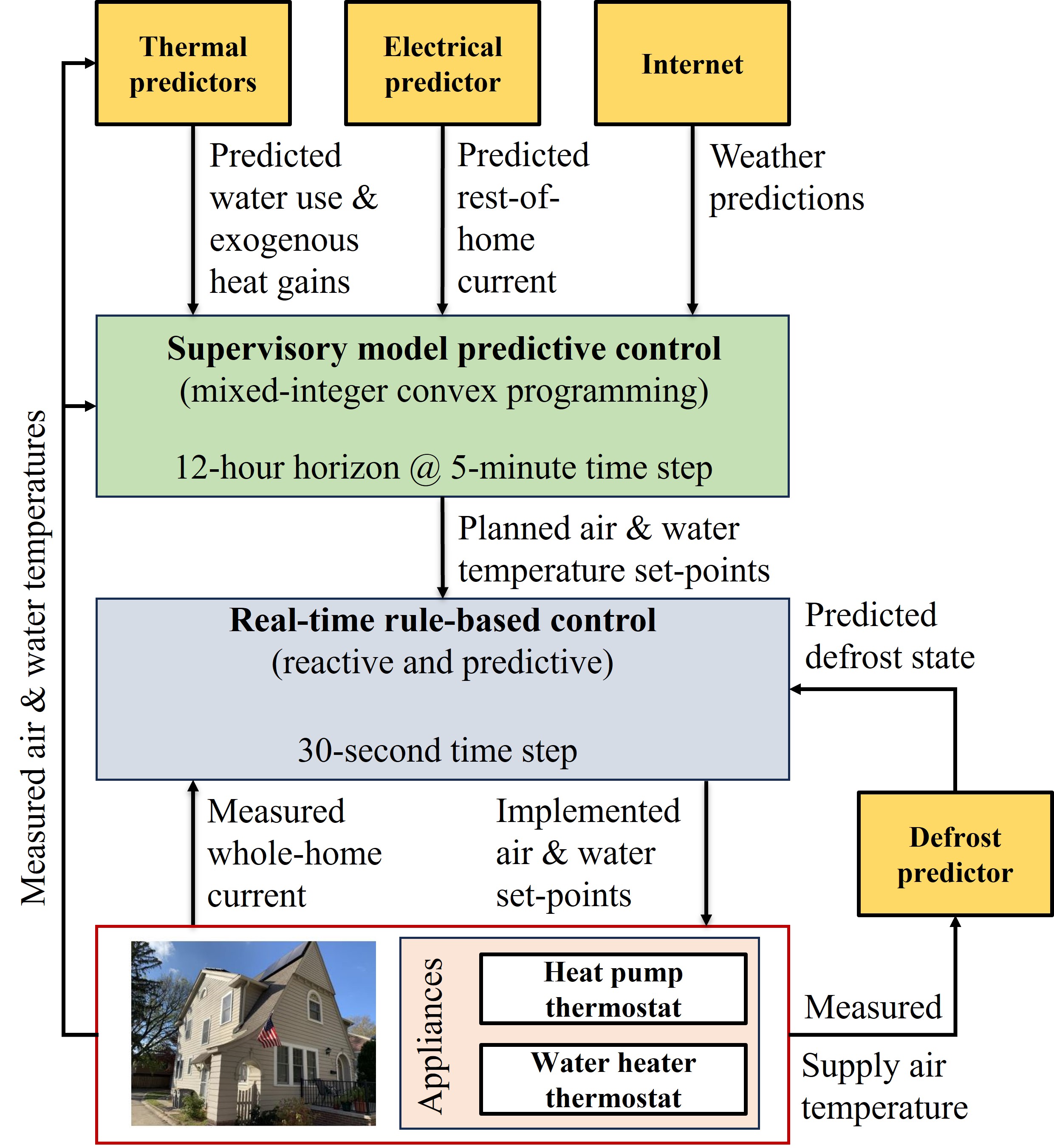
技术框架:该控制系统采用分层控制架构。高层控制器基于模型预测控制,在滚动预测时域内规划设备(如热泵和热水器)的设定点。低层控制器实时监测电流,并在必要时快速降低设备功率,以防止电流过载。整体流程包括:1. 收集家庭用电数据;2. 建立家庭用电模型;3. 使用MPC进行优化控制;4. 实时监测和调整。
关键创新:该研究的关键创新在于将模型预测控制应用于住宅电力负荷管理,实现了在不升级电气基础设施的前提下,安全地进行电气化改造。与传统的简单开关控制相比,MPC能够更精细地控制设备功率,从而更有效地利用电力资源,并避免电流过载。
关键设计:模型预测控制器的预测时域和控制时域是关键参数。选择合适的预测时域可以准确预测未来电力需求,而选择合适的控制时域可以实现快速响应。此外,热泵和热水器的温度设定点是控制器的主要控制变量。目标函数需要考虑用户舒适度和电力成本,同时满足电流限制。
🖼️ 关键图片


📊 实验亮点
在实际住宅的31天冬季现场测试中,即使室外温度低至-20℃,该控制系统也能成功将整个家庭的电流维持在100A的安全限制内,而无需升级电气面板。仿真结果表明,该系统甚至可以支持第二辆具有II级充电的电动汽车,进一步验证了其有效性和潜力。
🎯 应用场景
该研究成果可应用于老旧住宅的电气化改造,降低电气化成本,加速电气化进程。此外,该技术还可应用于智能电网、虚拟电厂等领域,实现电力负荷的灵活调度和优化,提高电力系统的稳定性和效率。未来,该技术有望推广到更多类型的建筑和电力系统。
📄 摘要(原文)
Residential electrification - replacing fossil-fueled appliances and vehicles with electric machines - can significantly reduce greenhouse gas emissions and air pollution. However, installing electric appliances or vehicle charging in a residential building can sharply increase its current draws. In older housing, high current draws can jeopardize electrical infrastructure, such as circuit breaker panels or electrical service (the wires that connect a building to the distribution grid). Upgrading electrical infrastructure can entail long delays and high costs, so poses a significant barrier to electrification. This paper develops and field-tests a control system that avoids the need for electrical upgrades by keeping an electrified home's total current draw within the safe limits of its panel and service. In the proposed control architecture, a high-level controller plans device set-points over a rolling prediction horizon. A low-level controller monitors real-time conditions and ramps down devices if necessary. The control system was tested in an occupied, electrified single-family house with code-minimum insulation, an air-to-air heat pump and backup resistance heat, a resistance water heater, and a plug-in hybrid electric vehicle with Level I charging. The field tests spanned 31 winter days with outdoor temperatures as low as -20 C. The control system maintained the whole-home current within the safe limits of electrical panels and service rated at 100 A, a common rating for older houses in North America, by adjusting only the temperature set-points of the heat pump and water heater. Simulations suggest that the same 100 A limit could accommodate a second electric vehicle with Level II charging. The proposed control system could allow older homes to safely electrify without upgrading electrical panels or service, saving a typical household on the order of $2,000 to $10,000.