RACH Traffic Prediction in Massive Machine Type Communications
作者: Hossein Mehri, Hao Chen, Hani Mehrpouyan
分类: eess.SY, cs.LG
发布日期: 2024-05-08 (更新: 2025-04-23)
期刊: H. Mehri, H. Mehrpouyan and H. Chen, "RACH Traffic Prediction in Massive Machine Type Communications," in IEEE Transactions on Machine Learning in Communications and Networking, vol. 3, pp. 315-331, 2025
DOI: 10.1109/TMLCN.2025.3542760
💡 一句话要点
提出基于LSTM和DenseNet的轻量级框架,用于大规模机器通信中RACH流量预测。
🎯 匹配领域: 支柱九:具身大模型 (Embodied Foundation Models)
关键词: 大规模机器通信 RACH流量预测 LSTM网络 DenseNet 在线学习 突发流量预测 无线资源管理
📋 核心要点
- 大规模机器通信中,事件驱动的突发流量难以准确预测,尤其是在实时网络环境中,对资源管理造成挑战。
- 提出一种基于LSTM和DenseNet的轻量级框架,通过在线学习网络数据,实现对突发流量的精确预测。
- 实验结果表明,该方法在长期预测准确率上比传统方法提高了52%,且计算复杂度较低,适合实时应用。
📝 摘要(中文)
本文提出了一种基于机器学习的框架,用于预测多信道时隙ALOHA网络中的突发流量,以解决大规模机器类型通信(mMTC)网络中事件驱动的突发流量管理问题。该框架结合了长短期记忆网络(LSTM)和带有前馈神经网络(FFNN)层的DenseNet,利用残差连接增强了机器学习网络捕获复杂模式的能力。此外,还开发了一种新的低复杂度在线预测算法,该算法利用从mMTC网络频繁收集的数据来更新LSTM网络的状态。仿真结果和复杂度分析表明,该算法在准确性和复杂度方面均优于传统方法,适用于时间敏感的实时场景。在包含单个基站和数千个具有不同流量生成特征的设备组的网络中,该方法实现了比传统方法高52%的长期预测准确率,且未增加额外的系统处理负载。
🔬 方法详解
问题定义:大规模机器类型通信(mMTC)网络中,随机事件导致的突发流量难以预测,现有方法难以在保证预测精度的同时,适应实时性要求高的场景。传统方法通常无法有效捕捉流量的复杂模式,导致预测精度较低。
核心思路:利用LSTM网络捕捉时间序列的长期依赖关系,并结合DenseNet提取流量特征,通过残差连接增强网络的训练能力。同时,设计低复杂度的在线预测算法,利用实时数据更新LSTM网络状态,以适应动态变化的网络环境。
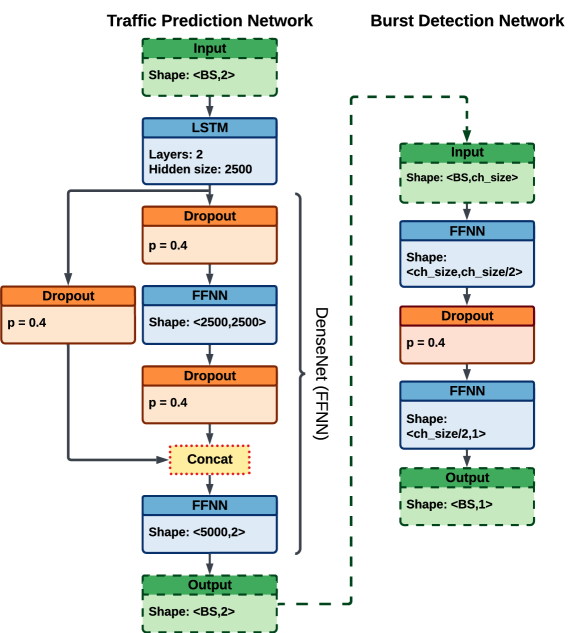
技术框架:该框架主要包含数据收集、特征提取、模型训练和在线预测四个阶段。首先,从mMTC网络中收集RACH流量数据。然后,利用LSTM和DenseNet构建的机器学习模型提取流量特征并进行训练。最后,使用在线预测算法,根据实时数据更新模型参数,进行流量预测。
关键创新:该方法结合了LSTM和DenseNet的优势,利用残差连接增强了网络的训练能力,能够更有效地捕捉流量的复杂模式。此外,提出的低复杂度在线预测算法,能够根据实时数据动态调整模型参数,提高了预测的准确性和实时性。
关键设计:LSTM网络用于捕捉时间序列的长期依赖关系,DenseNet用于提取流量特征。残差连接用于缓解梯度消失问题,提高网络训练的稳定性。在线预测算法采用低复杂度的更新策略,以保证实时性。损失函数采用均方误差(MSE),优化器采用Adam。
🖼️ 关键图片
📊 实验亮点
实验结果表明,所提出的方法在长期预测准确率上比传统方法提高了52%,且计算复杂度较低,适合实时应用。在包含单个基站和数千个设备的网络中进行了仿真,验证了该方法在实际场景中的有效性。复杂度分析表明,该算法的计算复杂度低于传统方法,更适合资源受限的mMTC设备。
🎯 应用场景
该研究成果可应用于大规模物联网(IoT)场景下的无线资源管理、网络规划和拥塞控制。通过准确预测RACH流量,可以动态调整网络资源分配,优化网络性能,提高用户体验,并降低网络运营成本。未来可扩展到其他类型的网络流量预测,例如视频流量、控制信令等。
📄 摘要(原文)
Traffic pattern prediction has emerged as a promising approach for efficiently managing and mitigating the impacts of event-driven bursty traffic in massive machine-type communication (mMTC) networks. However, achieving accurate predictions of bursty traffic remains a non-trivial task due to the inherent randomness of events, and these challenges intensify within live network environments. Consequently, there is a compelling imperative to design a lightweight and agile framework capable of assimilating continuously collected data from the network and accurately forecasting bursty traffic in mMTC networks. This paper addresses these challenges by presenting a machine learning-based framework tailored for forecasting bursty traffic in multi-channel slotted ALOHA networks. The proposed machine learning network comprises long-term short-term memory (LSTM) and a DenseNet with feed-forward neural network (FFNN) layers, where the residual connections enhance the training ability of the machine learning network in capturing complicated patterns. Furthermore, we develop a new low-complexity online prediction algorithm that updates the states of the LSTM network by leveraging frequently collected data from the mMTC network. Simulation results and complexity analysis demonstrate the superiority of our proposed algorithm in terms of both accuracy and complexity, making it well-suited for time-critical live scenarios. We evaluate the performance of the proposed framework in a network with a single base station and thousands of devices organized into groups with distinct traffic-generating characteristics. Comprehensive evaluations and simulations indicate that our proposed machine learning approach achieves a remarkable $52\%$ higher accuracy in long-term predictions compared to traditional methods, without imposing additional processing load on the system.