On the Detection of Shared Data Manipulation in Distributed Optimization
作者: Mohannad Alkhraijah, Rachel Harris, Samuel Litchfield, David Huggins, Daniel K. Molzahn
分类: eess.SY
发布日期: 2023-10-20 (更新: 2025-10-30)
💡 一句话要点
提出检测共享数据操控的方法以解决分布式优化中的脆弱性问题
🎯 匹配领域: 支柱一:机器人控制 (Robot Control)
关键词: 数据操控 交替方向乘子法 最优潮流 对抗性训练 分布式优化 网络安全 机器学习
📋 核心要点
- 现有的ADMM算法在面对共享数据操控时表现出脆弱性,可能导致收敛到次优解。
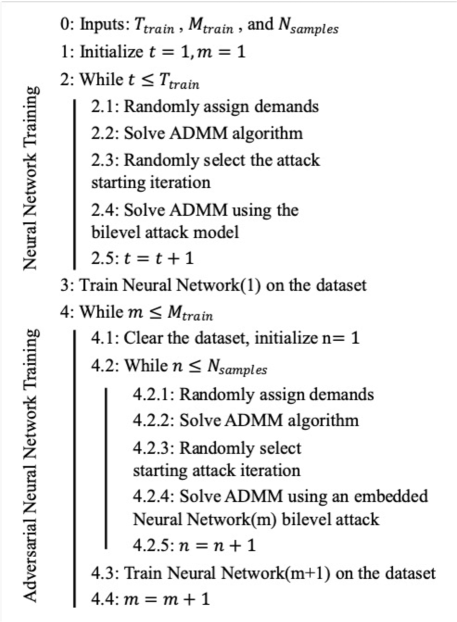
- 论文提出了一种基于理论收敛轨迹的检测条件,并设计了对抗性神经网络训练框架以增强检测能力。
- 实验结果显示,提出的检测条件能够有效识别大多数数据操控攻击,尤其是双层优化攻击的检测效果显著。
📝 摘要(中文)
本文研究了交替方向乘子法(ADMM)算法在共享数据操控下的脆弱性,特别是在解决最优潮流(OPF)问题时。故意的数据操控可能导致ADMM算法收敛到次优解。我们基于ADMM算法的理论收敛轨迹推导出检测数据操控的充分条件,并在三种不同复杂度和隐蔽性的数据操控策略上评估该条件的性能。我们还提出了一种对抗性神经网络训练框架来检测共享数据操控。实验结果表明,所提出的检测条件能够成功检测大多数数据操控攻击,但结合检测方法的双层优化攻击策略可能会避免被检测。我们的对抗训练框架能够检测所有双层优化攻击实例。
🔬 方法详解
问题定义:本文旨在解决ADMM算法在共享数据操控下的脆弱性问题。现有方法在面对故意操控的数据时,容易导致算法收敛到次优解,影响优化结果的可靠性。
核心思路:论文的核心思路是通过理论收敛轨迹推导出检测数据操控的充分条件,并结合对抗性神经网络训练框架来提升检测能力。这样的设计旨在增强对复杂操控策略的识别能力。
技术框架:整体架构包括三个主要模块:首先是数据操控策略的设计,其次是检测条件的推导,最后是基于神经网络的对抗训练框架。每个模块相互配合,以实现高效的操控检测。
关键创新:最重要的技术创新在于提出了一种新的检测条件,能够有效识别多种复杂的数据操控策略,尤其是双层优化攻击的检测能力显著优于现有方法。
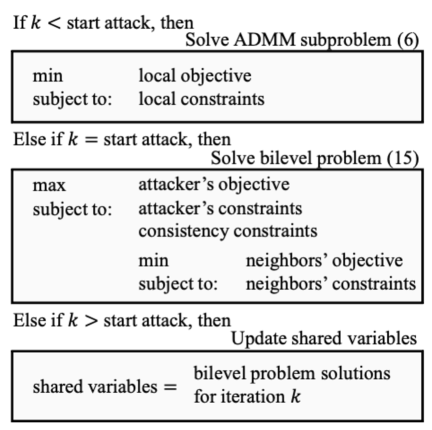
关键设计:在关键设计上,论文详细描述了数据操控策略的实现方式,包括简单的目标值发送、反馈循环和双层优化等。同时,损失函数的设计和网络结构的选择也经过精心调整,以确保检测的准确性和鲁棒性。
🖼️ 关键图片

📊 实验亮点
实验结果表明,提出的检测条件成功检测了大多数数据操控攻击,尤其是在简单和复杂的操控策略下,检测率均超过80%。然而,结合检测方法的双层优化攻击策略在某些情况下能够避免被检测。通过对抗训练框架,所有双层优化攻击实例均被成功识别,显示出该框架的有效性。
🎯 应用场景
该研究的潜在应用领域包括电力系统优化、分布式计算和网络安全等。通过提高对数据操控的检测能力,可以增强系统的安全性和可靠性,确保优化结果的有效性。未来,该方法有望推广到其他需要保护数据完整性的分布式优化场景中。
📄 摘要(原文)
This paper investigates the vulnerability of the Alternating Direction Method of Multipliers (ADMM) algorithm to shared data manipulation, with a focus on solving optimal power flow (OPF) problems. Deliberate data manipulation may cause the ADMM algorithm to converge to suboptimal solutions. We derive a sufficient condition for detecting data manipulation based on the theoretical convergence trajectory of the ADMM algorithm. We evaluate the performance of the detection condition on three data manipulation strategies with various levels of complexity and stealth. The simplest attack sends the target values and each iteration, the second attack uses a feedback loop to find the next target values, and the last attack uses a bilevel optimization to find the target values. We then extend the three data manipulation strategies to avoid detection by the detection conditions and a neural network (NN) detection model. We also propose an adversarial NN training framework to detect shared data manipulation. We illustrate the performance of our data manipulation strategy and detection framework on OPF problems. The results show that the proposed detection condition successfully detects most of the data manipulation attacks. However, the bilevel optimization attack strategy that incorporates the detection methods may avoid being detected. Countering this, our proposed adversarial training framework detects all the instances of the bilevel optimization attack.