CLExtract: Recovering Highly Corrupted DVB/GSE Satellite Stream with Contrastive Learning
作者: Minghao Lin, Minghao Cheng, Dongsheng Luo, Yueqi Chen
分类: eess.SY
发布日期: 2023-10-12
备注: SpaceSec'23, 11 pages, 14 figures
💡 一句话要点
提出CLExtract以解决高度损坏的卫星流解码问题
🎯 匹配领域: 支柱二:RL算法与架构 (RL & Architecture)
关键词: 卫星通信 对比学习 数据恢复 流解码 网络安全
📋 核心要点
- 现有的GSExtract解码器在处理高度损坏的卫星流时效果不佳,尤其在亚洲地区的解码成功率仅为2.1%。
- 本文提出了一种基于对比学习的解码方法,通过学习包头特征而非依赖损坏流中的关键信息来进行解码。
- 实验表明,本文的方法能够以数百倍的速度恢复71-99%的数据,且在流损坏加剧时效果不显著下降。
📝 摘要(中文)
随着卫星系统在现代社会中扮演越来越重要的角色,其安全性和隐私问题受到越来越多的关注。现有的GSExtract解码器在处理高度损坏的流时表现不佳,尤其是在亚洲地区的解码成功率仅为2.1%。为此,本文提出了一种基于对比学习和数据增强的解码方法,能够有效恢复高度损坏的卫星流。通过直接学习不同协议层的包头特征,本文的方法能够在流序列中识别并提取出数据负载。实验结果表明,该方法能够以比GSExtract快数百倍的速度成功恢复71-99%的被窃取数据,并且在流损坏加剧时效果依然显著。
🔬 方法详解
问题定义:本文旨在解决现有GSExtract解码器在高度损坏卫星流中的低解码成功率问题,尤其是在亚洲地区的表现极为不理想。
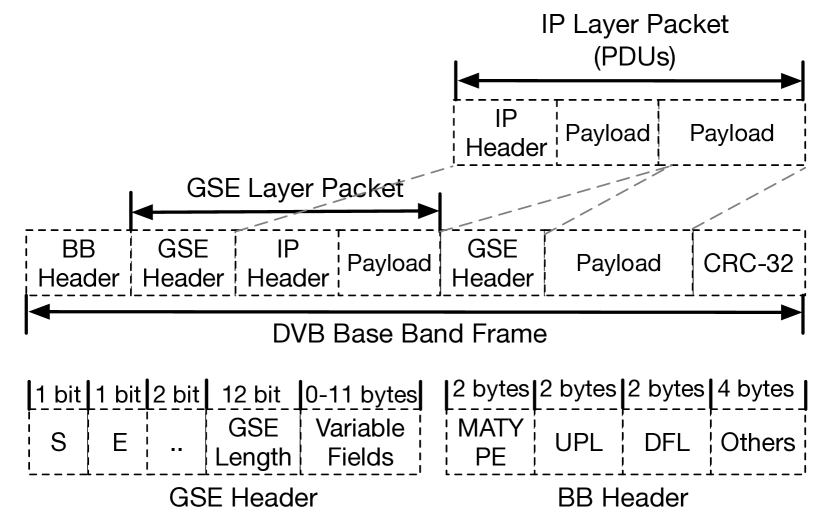
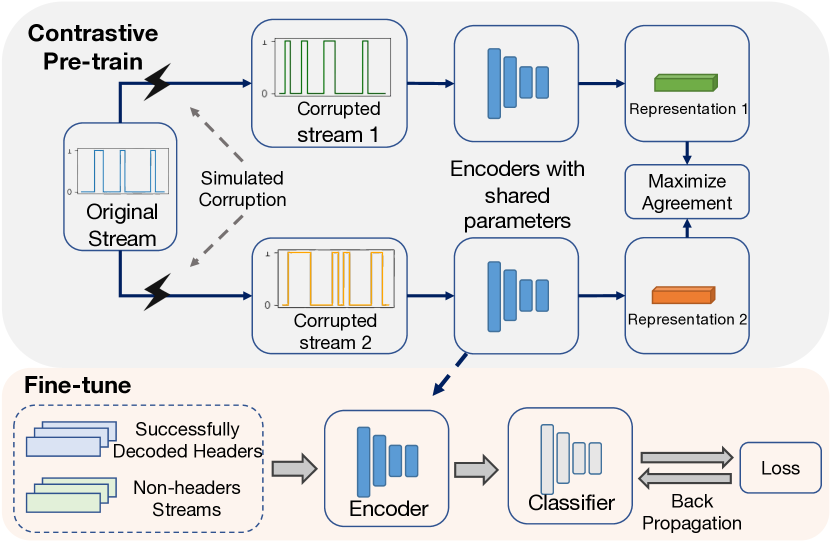
核心思路:通过引入对比学习技术,直接学习不同协议层的包头特征,从而在流序列中识别并提取数据负载,而不是依赖损坏流中的关键信息。
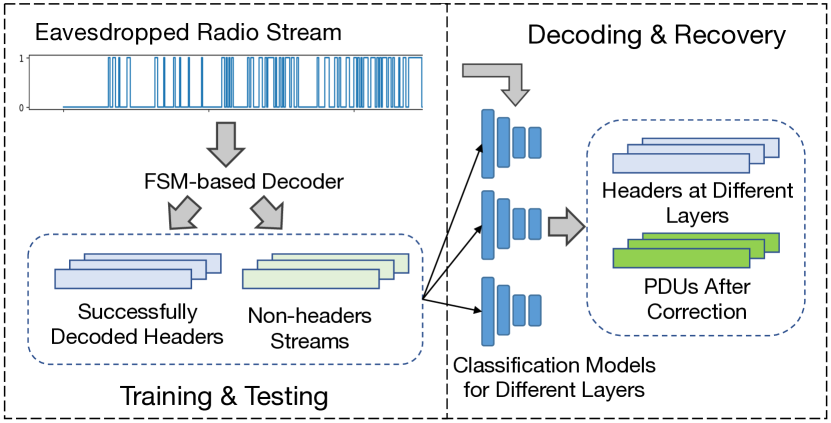
技术框架:整体架构包括数据预处理、对比学习模型训练和数据提取三个主要模块。首先对输入流进行数据增强,然后通过对比学习模型提取特征,最后从中识别并提取有效数据负载。
关键创新:本文的主要创新在于使用对比学习直接学习包头特征,这一方法与传统依赖流中关键信息的解码方式有本质区别,显著提高了解码的鲁棒性和效率。
关键设计:在模型设计上,采用了特定的损失函数以优化包头特征的学习效果,并在网络结构上进行了调整,以适应不同协议层的特征提取需求。具体参数设置和网络结构细节在实验部分进行了详细描述。
🖼️ 关键图片
📊 实验亮点
实验结果显示,CLExtract方法能够成功恢复71-99%的被窃取数据,解码速度比GSExtract快数百倍。这一显著提升表明,本文的方法在处理高度损坏的卫星流时具有优越的性能,尤其在流损坏加剧的情况下依然保持良好的效果。
🎯 应用场景
该研究的潜在应用领域包括卫星通信安全、数据恢复和网络监控等。通过提高对高度损坏卫星流的解码能力,能够有效提升卫星通信的安全性和可靠性,具有重要的实际价值和未来影响。
📄 摘要(原文)
Since satellite systems are playing an increasingly important role in our civilization, their security and privacy weaknesses are more and more concerned. For example, prior work demonstrates that the communication channel between maritime VSAT and ground segment can be eavesdropped on using consumer-grade equipment. The stream decoder GSExtract developed in this prior work performs well for most packets but shows incapacity for corrupted streams. We discovered that such stream corruption commonly exists in not only Europe and North Atlantic areas but also Asian areas. In our experiment, using GSExtract, we are only able to decode 2.1\% satellite streams we eavesdropped on in Asia. Therefore, in this work, we propose to use a contrastive learning technique with data augmentation to decode and recover such highly corrupted streams. Rather than rely on critical information in corrupted streams to search for headers and perform decoding, contrastive learning directly learns the features of packet headers at different protocol layers and identifies them in a stream sequence. By filtering them out, we can extract the innermost data payload for further analysis. Our evaluation shows that this new approach can successfully recover 71-99\% eavesdropped data hundreds of times faster speed than GSExtract. Besides, the effectiveness of our approach is not largely damaged when stream corruption becomes more severe.