Human-Inspired Neuro-Symbolic World Modeling and Logic Reasoning for Interpretable Safe UAV Landing Site Assessment
作者: Weixian Qian, Tianyi Yang, Sebastian Schroder, Yao Deng, Jiaohong Yao, Xiao Cheng, Richard Han, Xi Zheng
分类: cs.RO, cs.AI
发布日期: 2026-07-20
💡 一句话要点
提出NeuroSymLand以解决无人机安全着陆场地评估问题
🎯 匹配领域: 支柱二:RL算法与架构 (RL & Architecture) 支柱九:具身大模型 (Embodied Foundation Models)
关键词: 无人机 安全评估 神经符号 逻辑推理 可解释性 场景建模 边缘计算
📋 核心要点
- 现有的学习方法在处理协变量转移时表现不佳,缺乏透明性,导致决策难以解释和验证。
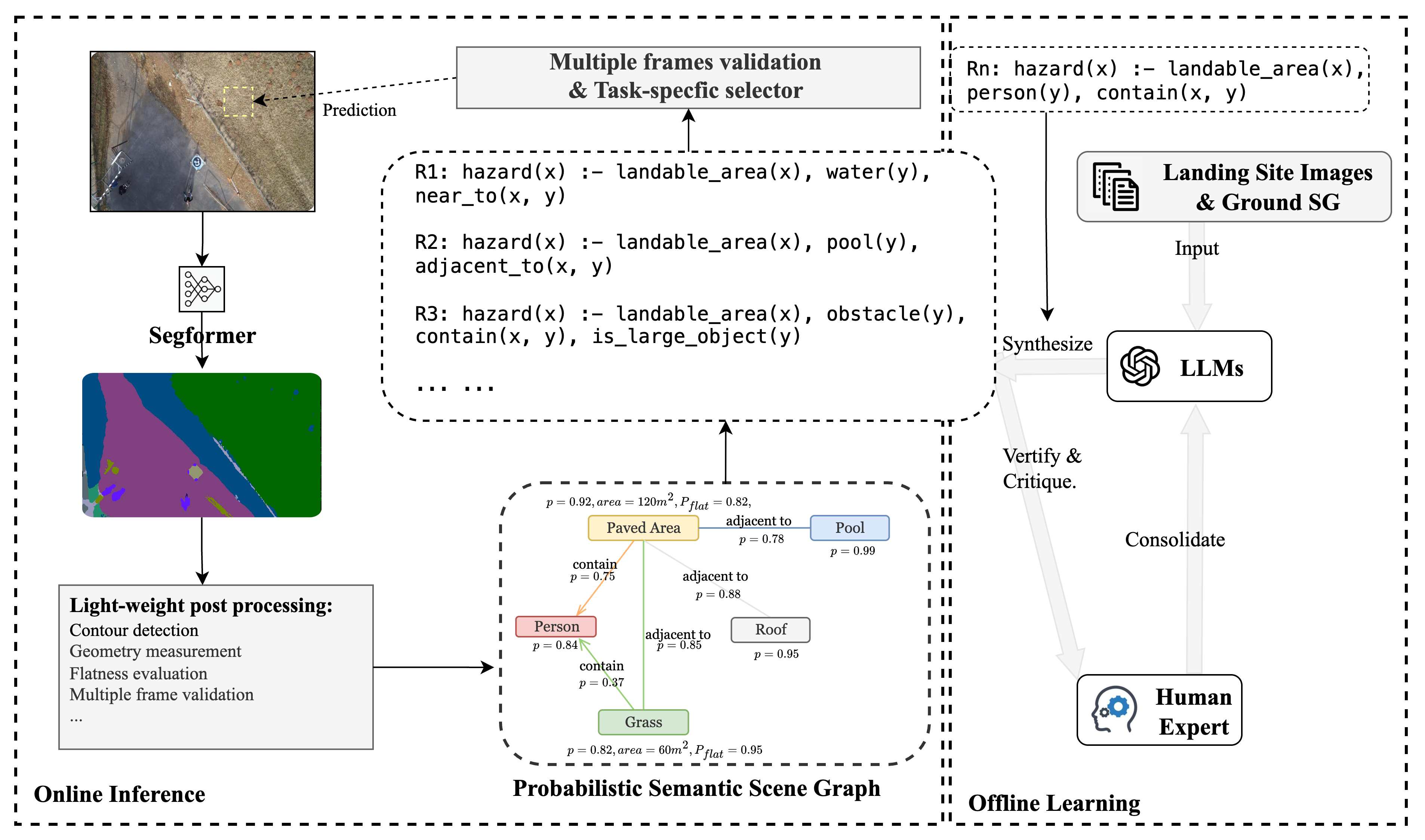
- 提出的NeuroSymLand框架通过将感知建模与逻辑推理分离,提供了一种可解释的安全评估方法。
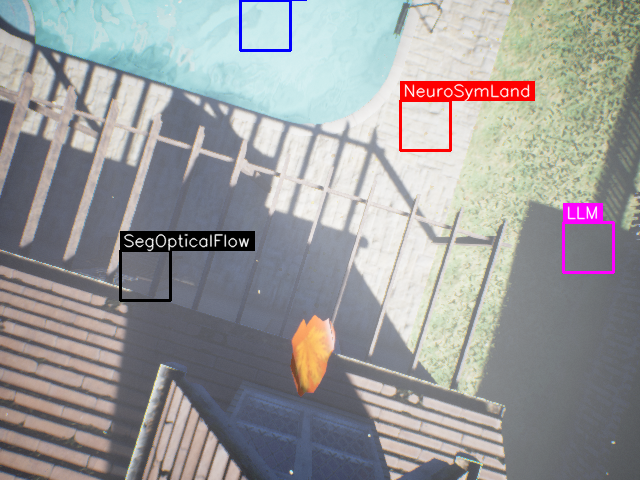
- 在72个测试场景中,NeuroSymLand实现了61次成功评估,显著优于其他基线方法,展示了其有效性。
📝 摘要(中文)
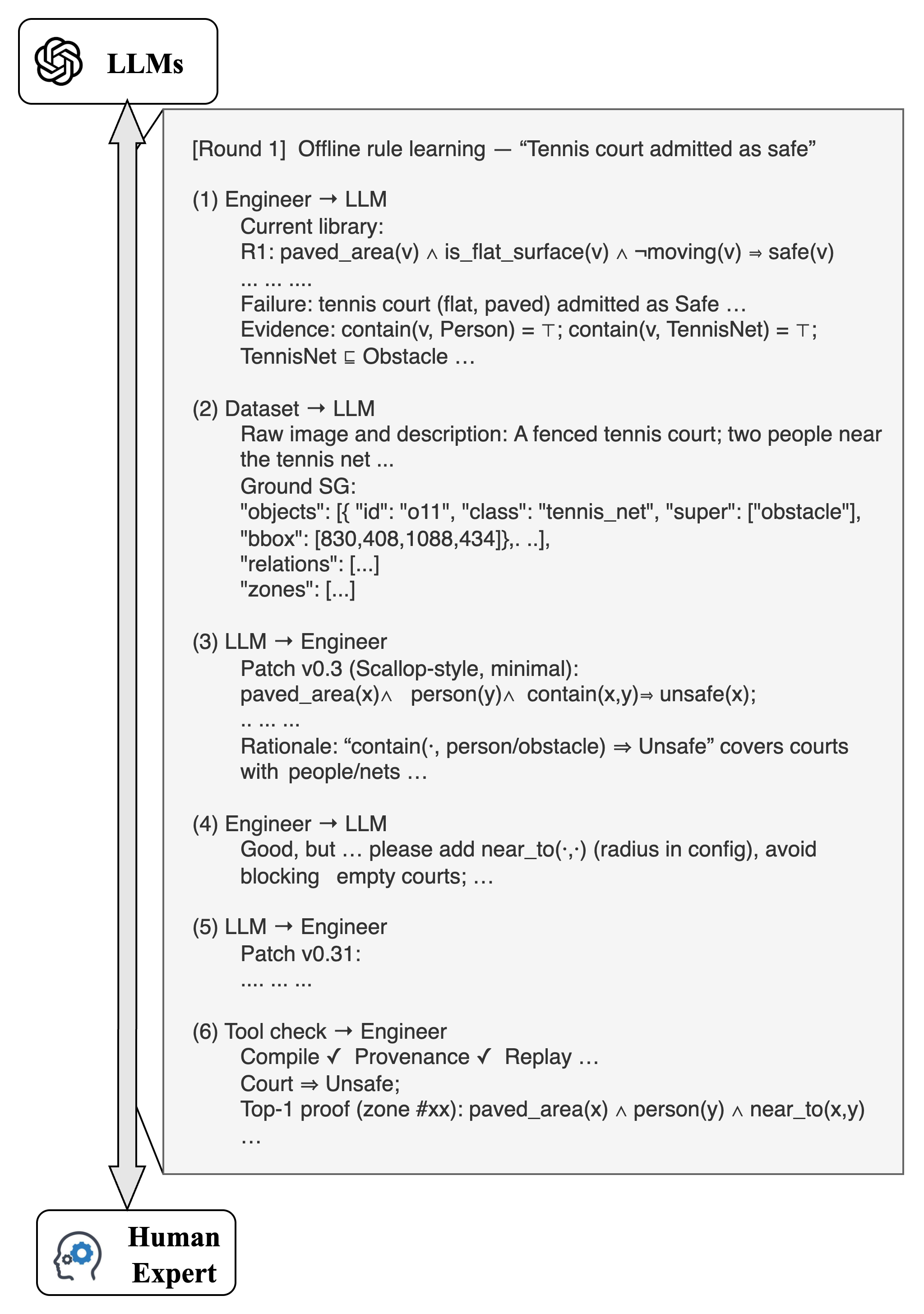
在非结构化环境中,可靠的安全着陆场地评估对无人机(UAV)在实际应用中的部署至关重要。现有基于学习的方法在协变量转移下表现不佳,且透明度有限,导致其决策难以解释和验证。本文提出了NeuroSymLand,一个神经符号框架,用于无标记的无人机着陆场地安全评估,明确将感知驱动的世界建模与基于逻辑的安全推理分离。通过轻量级分割模型逐步构建概率语义场景图,编码对象、属性和空间关系。离线合成的符号安全规则通过人机协作进行优化,并在运行时直接在该世界模型上执行,进行白盒推理,生成带有人类可读解释的排名着陆候选。实验表明,NeuroSymLand在72个模拟和硬件在环的着陆场景中实现了61次成功评估,优于四个竞争基线(成功率为37至57次)。
🔬 方法详解
问题定义:本文旨在解决无人机在非结构化环境中安全着陆场地评估的可靠性问题。现有方法在面对环境变化时表现不佳,且缺乏透明度,难以进行有效的决策验证。
核心思路:NeuroSymLand框架通过将感知驱动的世界建模与符号逻辑推理相结合,提供了一种透明且可解释的安全评估机制。这种设计使得系统能够在运行时进行实时推理,并生成可读的安全约束解释。
技术框架:该框架主要包括两个模块:轻量级分割模型用于构建概率语义场景图,编码环境中的对象及其关系;符号安全规则通过大型语言模型离线合成,并在运行时执行以进行推理。
关键创新:NeuroSymLand的核心创新在于将神经网络与符号推理相结合,形成了一种新颖的神经符号框架。这种方法与传统的纯学习方法相比,提供了更高的可解释性和透明度。
关键设计:在模型设计中,采用了轻量级的分割网络以适应资源受限的平台,并通过人机协作优化符号安全规则,确保推理过程的高效性和准确性。具体的参数设置和损失函数设计未在摘要中详细说明,需参考原文获取更多细节。
🖼️ 关键图片
📊 实验亮点
实验结果显示,NeuroSymLand在72个着陆场景中成功评估了61次,显著优于其他四个基线方法(成功率为37至57次)。该框架的可解释性和透明推理能力得到了定性分析的支持,同时在边缘计算平台上的部署开销微乎其微。
🎯 应用场景
该研究的潜在应用领域包括无人机配送、巡检和监控等实际场景。通过提供可解释的安全评估,NeuroSymLand能够增强无人机在复杂环境中的自主决策能力,提升其在实际应用中的安全性和可靠性。未来,该框架有望推广到其他移动系统的安全评估中。
📄 摘要(原文)
Reliable assessment of safe landing sites in unstructured environments is essential for deploying Unmanned Aerial Vehicles (UAVs) in real-world applications such as delivery, inspection, and surveillance. Existing learning-based approaches often degrade under covariate shift and offer limited transparency, making their decisions difficult to interpret and validate on resource-constrained platforms. We present NeuroSymLand, a neuro-symbolic framework for marker-free UAV landing site safety assessment that explicitly separates perception-driven world modeling from logic-based safety reasoning. A lightweight segmentation model incrementally constructs a probabilistic semantic scene graph encoding objects, attributes, and spatial relations. Symbolic safety rules, synthesized offline via large language models with human-in-the-loop refinement, are executed directly over this world model at runtime to perform white-box reasoning, producing ranked landing candidates with human-readable explanations of the underlying safety constraints. Across 72 simulated and hardware-in-the-loop landing scenarios, NeuroSymLand achieves 61 successful assessments, outperforming four competitive baselines, which achieve between 37 and 57 successes. Qualitative analysis highlights its superior interpretability and transparent reasoning, while deployment incurs negligible edge overhead. Our results suggest that combining explicit world modeling with symbolic reasoning can support accurate, interpretable, and edge-deployable safety assessment in mobile systems, as demonstrated through UAV landing site assessment.