Decentralized Intent-Based Multi-Robot Task Planner with LLM Oracles on Hyperledger Fabric
作者: Farhad Keramat, Salma Salimi, Tomi Westerlund
分类: cs.RO
发布日期: 2026-02-09
💡 一句话要点
提出基于LLM Oracle和Hyperledger Fabric的去中心化多机器人任务规划器
🎯 匹配领域: 支柱九:具身大模型 (Embodied Foundation Models)
关键词: 多机器人任务规划 大型语言模型 LLM Oracle Hyperledger Fabric 去中心化 人机交互 任务分解 区块链
📋 核心要点
- 现有LLM在机器人任务规划中存在中心化风险和时间顺序敏感性问题,阻碍了其在多机器人协作中的应用。
- 提出一种基于LLM Oracle的去中心化多机器人任务规划方法,利用Hyperledger Fabric实现安全的数据访问控制。
- 通过SkillChain-RTD基准测试验证了所提架构的可行性,并证明了所提出的聚合方法优于现有方法。
📝 摘要(中文)
大型语言模型(LLMs)为将自然语言用户意图转化为可执行动作开辟了新机遇。这种能力使具身AI智能体能够执行复杂任务,无需专家参与,从而使人机交互(HRI)更加便捷。然而,这些发展带来了重大的安全和隐私挑战,例如自我偏好,即单个LLM服务提供商主导市场并利用这种权力来推广自己的偏好。LLM Oracle最近被提出作为一种通过执行来自不同供应商的多个LLM并聚合其输出来获得更可靠和值得信赖的最终结果的机制,以实现LLM的去中心化。然而,这些方法的准确性高度依赖于聚合方法。目前的聚合方法主要使用各种LLM输出之间的语义相似性,不适用于机器人任务规划,其中任务的时间顺序很重要。为了填补这一空白,我们提出了一种用于机器人任务规划的具有新聚合方法的LLM Oracle。此外,我们提出了一种基于Hyperledger Fabric的去中心化多机器人基础设施,可以托管所提出的Oracle。所提出的基础设施使用户能够向系统表达他们的自然语言意图,然后可以将其分解为子任务。这些子任务需要协调来自不同供应商的不同机器人,同时对数据强制执行细粒度的访问控制管理。为了评估我们的方法,我们创建了SkillChain-RTD基准并将其公开。我们的实验结果证明了所提出的架构的可行性,并且所提出的聚合方法优于目前使用的其他聚合方法。
🔬 方法详解
问题定义:论文旨在解决多机器人任务规划中,由于依赖单一LLM服务商而导致的安全和隐私风险,以及现有LLM输出聚合方法忽略任务时间顺序的问题。现有方法无法保证任务规划的公平性和可靠性,并且难以实现细粒度的数据访问控制。
核心思路:论文的核心思路是利用LLM Oracle实现LLM的去中心化,通过执行多个LLM并聚合其输出来提高任务规划的可靠性。同时,设计一种新的聚合方法,考虑任务的时间顺序,以提高机器人任务规划的准确性。此外,使用Hyperledger Fabric构建去中心化基础设施,实现安全的数据访问控制。
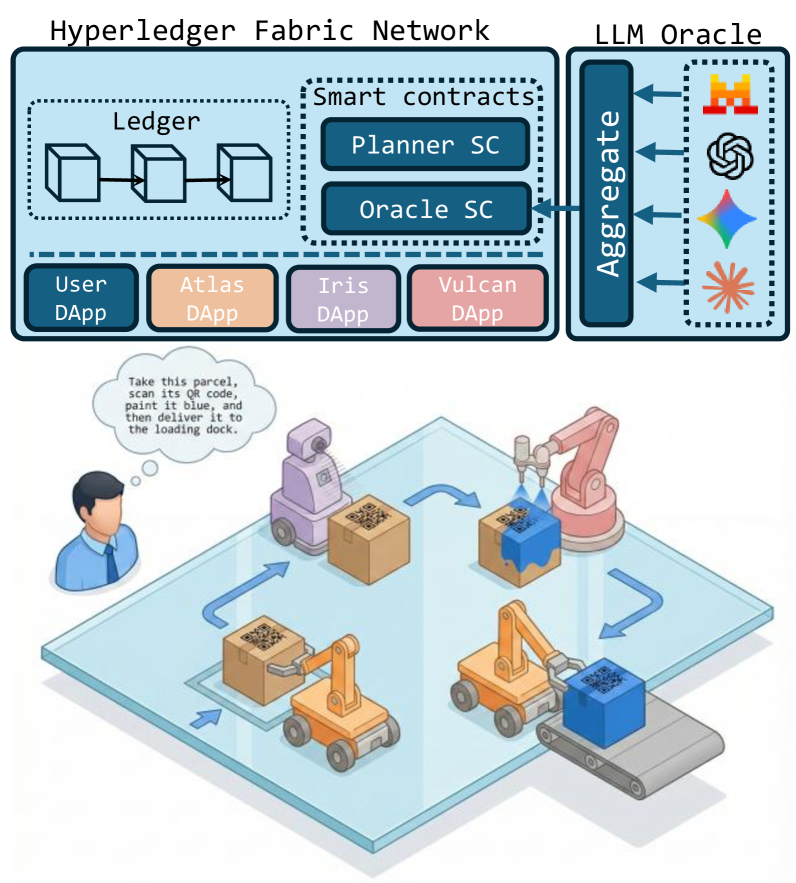
技术框架:整体架构包含以下主要模块:1) 用户通过自然语言表达任务意图;2) 系统将意图分解为子任务;3) LLM Oracle执行多个LLM,生成多个任务规划方案;4) 新的聚合方法对这些方案进行聚合,生成最终的任务规划;5) Hyperledger Fabric负责协调不同机器人的执行,并进行细粒度的数据访问控制。
关键创新:论文的关键创新点在于:1) 提出了一种新的LLM输出聚合方法,该方法考虑了任务的时间顺序,更适用于机器人任务规划;2) 构建了一个基于Hyperledger Fabric的去中心化多机器人基础设施,实现了安全的数据访问控制;3) 创建了SkillChain-RTD基准测试,用于评估多机器人任务规划算法。
关键设计:论文提出的聚合方法的具体细节未知,但强调了考虑任务时间顺序的重要性。Hyperledger Fabric的具体配置和智能合约的设计细节也未知。SkillChain-RTD基准测试的具体内容和评估指标也未知。
🖼️ 关键图片

📊 实验亮点
实验结果表明,所提出的架构是可行的,并且所提出的聚合方法优于目前使用的其他聚合方法。具体的性能数据和对比基线的详细信息未知,但论文强调了所提出的方法在机器人任务规划方面的优势。
🎯 应用场景
该研究成果可应用于智能制造、仓储物流、灾害救援等领域,实现多机器人协同完成复杂任务。通过去中心化的架构和安全的数据访问控制,可以提高任务规划的可靠性和安全性,促进人机协作的效率和智能化水平,并降低对单一服务提供商的依赖。
📄 摘要(原文)
Large language models (LLMs) have opened new opportunities for transforming natural language user intents into executable actions. This capability enables embodied AI agents to perform complex tasks, without involvement of an expert, making human-robot interaction (HRI) more convenient. However these developments raise significant security and privacy challenges such as self-preferencing, where a single LLM service provider dominates the market and uses this power to promote their own preferences. LLM oracles have been recently proposed as a mechanism to decentralize LLMs by executing multiple LLMs from different vendors and aggregating their outputs to obtain a more reliable and trustworthy final result. However, the accuracy of these approaches highly depends on the aggregation method. The current aggregation methods mostly use semantic similarity between various LLM outputs, not suitable for robotic task planning, where the temporal order of tasks is important. To fill the gap, we propose an LLM oracle with a new aggregation method for robotic task planning. In addition, we propose a decentralized multi-robot infrastructure based on Hyperledger Fabric that can host the proposed oracle. The proposed infrastructure enables users to express their natural language intent to the system, which then can be decomposed into subtasks. These subtasks require coordinating different robots from different vendors, while enforcing fine-grained access control management on the data. To evaluate our methodology, we created the SkillChain-RTD benchmark made it publicly available. Our experimental results demonstrate the feasibility of the proposed architecture, and the proposed aggregation method outperforms other aggregation methods currently in use.