A Unified Complementarity-based Approach for Rigid-Body Manipulation and Motion Prediction
作者: Bingkun Huang, Xin Ma, Nilanjan Chakraborty, Riddhiman Laha
分类: cs.RO
发布日期: 2026-02-04
备注: 18 pages, 7 figures
💡 一句话要点
提出Unicomp:一种统一的基于互补性的刚体操作与运动预测方法
🎯 匹配领域: 支柱一:机器人控制 (Robot Control) 支柱二:RL算法与架构 (RL & Architecture) 支柱七:动作重定向 (Motion Retargeting) 支柱八:物理动画 (Physics-based Animation)
关键词: 机器人操作 运动规划 摩擦接触 互补性 刚体动力学
📋 核心要点
- 现有机器人操作规划方法通常分离自由运动和接触状态,或依赖简化的接触表示,限制了接触模式转换的保真度。
- Unicomp框架将自由运动和摩擦接触统一建模为互补问题,无需固定接触假设,实现接触模式间的平滑过渡。
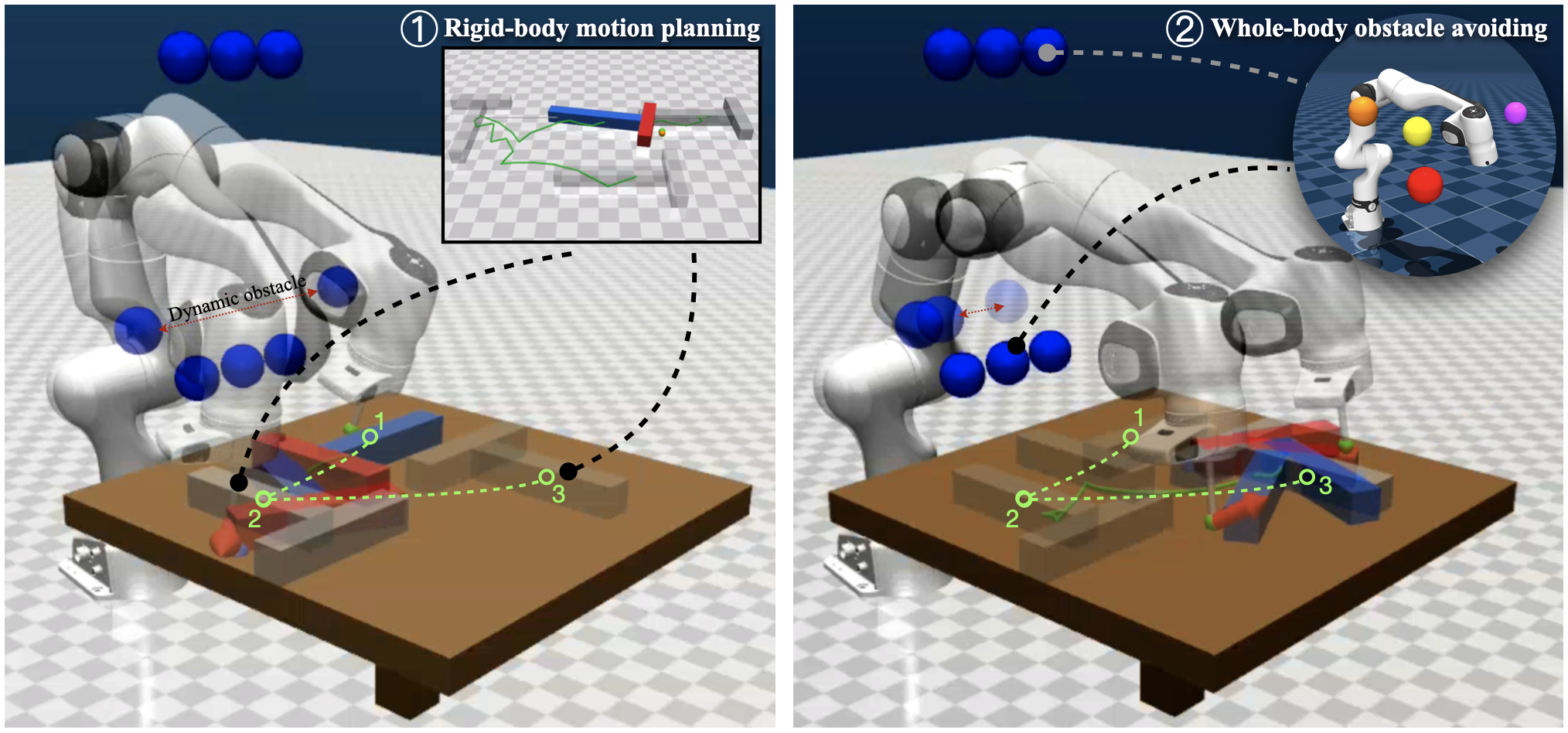
- 实验表明,该方法在平面推动和全身操作等任务中,能以交互速度实现稳定且物理一致的机器人行为。
📝 摘要(中文)
本文提出了一种统一的离散时间建模框架(Unicomp),用于机器人操作,该框架在单一数学形式中一致地捕获自由运动和摩擦接触。基于互补性的刚体动力学,我们将自由空间运动和接触交互建模为耦合的线性和非线性互补问题,从而在不强制固定接触假设的情况下,实现接触模式之间的原则性转换。对于平面块状接触,我们从最大功率耗散原理推导出摩擦接触模型,其中允许的接触扳手集由椭球极限曲面表示。这种表示捕捉了耦合的力-力矩效应,包括扭转摩擦,同时与接触块上的底层压力分布无关。由此产生的公式产生了一个离散时间预测模型,该模型通过二次约束将广义速度和接触扳手联系起来,适用于基于实时优化的规划。实验结果表明,所提出的方法能够在各种任务中以交互速度实现稳定、物理一致的行为,从平面推动到富含接触的全身动作。
🔬 方法详解
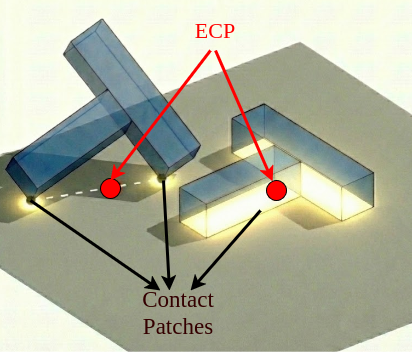
问题定义:现有机器人操作规划方法在处理非结构化环境中的操作任务时,通常需要同时考虑自由空间运动和与环境的持续摩擦接触。然而,现有的(局部)规划和仿真框架通常将这些状态分开处理,或者依赖于简化的接触表示,尤其是在建模非凸或分布式接触面时。这些近似限制了接触模式转换的保真度,并阻碍了实时执行富含接触行为的鲁棒性。
核心思路:本文的核心思路是提出一种统一的建模框架,将自由运动和摩擦接触整合到同一个数学形式中,从而避免了在不同状态之间进行切换或使用简化的接触模型。该框架基于互补性原理,将运动和接触建模为互补问题,允许在接触模式之间进行自然的转换,而无需预先假设固定的接触状态。
技术框架:Unicomp框架基于离散时间建模,其整体流程可以概括为:首先,利用互补性原理建立刚体动力学模型,将自由空间运动和接触交互表示为耦合的线性和非线性互补问题。其次,对于平面块状接触,从最大功率耗散原理推导出摩擦接触模型,使用椭球极限曲面表示允许的接触扳手集。最后,将得到的模型用于实时优化规划,通过二次约束关联广义速度和接触扳手。
关键创新:该方法最重要的创新在于其统一性。它将自由运动和摩擦接触整合到同一个互补性框架中,避免了传统方法中对不同状态的独立处理和简化假设。此外,使用椭球极限曲面表示接触扳手集,能够捕捉耦合的力-力矩效应,包括扭转摩擦,同时对接触面上的压力分布不敏感。
关键设计:在平面块状接触的摩擦模型中,关键设计在于使用椭球极限曲面来表示允许的接触扳手集。该椭球的参数可以通过实验或仿真进行标定。此外,在优化规划中,使用二次约束来关联广义速度和接触扳手,使得问题可以高效地求解。
🖼️ 关键图片
📊 实验亮点
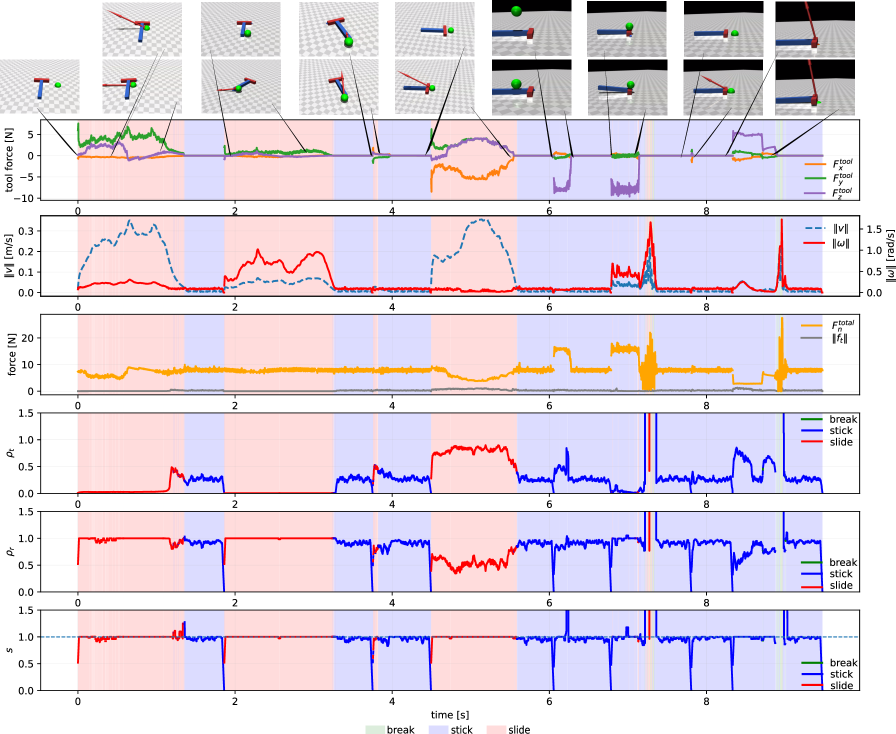
实验结果表明,Unicomp框架能够在平面推动和全身操作等任务中,以交互速度实现稳定且物理一致的机器人行为。通过对比实验,验证了该方法在处理复杂接触交互方面的优势,并展示了其在实时优化规划中的可行性。具体性能数据(如成功率、执行时间等)未在摘要中明确提及,但强调了其稳定性和物理一致性。
🎯 应用场景
该研究成果可应用于各种需要复杂接触交互的机器人操作任务,例如装配、抓取、推动和操作工具等。该方法能够提高机器人在非结构化环境中执行任务的鲁棒性和效率,并为开发更智能、更灵活的机器人系统奠定基础。未来,该方法有望应用于工业自动化、服务机器人和医疗机器人等领域。
📄 摘要(原文)
Robotic manipulation in unstructured environments requires planners to reason jointly about free-space motion and sustained, frictional contact with the environment. Existing (local) planning and simulation frameworks typically separate these regimes or rely on simplified contact representations, particularly when modeling non-convex or distributed contact patches. Such approximations limit the fidelity of contact-mode transitions and hinder the robust execution of contact-rich behaviors in real time. This paper presents a unified discrete-time modeling framework for robotic manipulation that consistently captures both free motion and frictional contact within a single mathematical formalism (Unicomp). Building on complementarity-based rigid-body dynamics, we formulate free-space motion and contact interactions as coupled linear and nonlinear complementarity problems, enabling principled transitions between contact modes without enforcing fixed-contact assumptions. For planar patch contact, we derive a frictional contact model from the maximum power dissipation principle in which the set of admissible contact wrenches is represented by an ellipsoidal limit surface. This representation captures coupled force-moment effects, including torsional friction, while remaining agnostic to the underlying pressure distribution across the contact patch. The resulting formulation yields a discrete-time predictive model that relates generalized velocities and contact wrenches through quadratic constraints and is suitable for real-time optimization-based planning. Experimental results show that the proposed approach enables stable, physically consistent behavior at interactive speeds across tasks, from planar pushing to contact-rich whole-body maneuvers.