Endowing GPT-4 with a Humanoid Body: Building the Bridge Between Off-the-Shelf VLMs and the Physical World
作者: Yingzhao Jian, Zhongan Wang, Yi Yang, Hehe Fan
分类: cs.RO, cs.AI
发布日期: 2025-10-28
💡 一句话要点
提出BiBo以解决人形代理在开放环境中交互能力不足的问题
🎯 匹配领域: 支柱一:机器人控制 (Robot Control)
关键词: 人形代理 视觉语言模型 开放世界泛化 运动执行 人机交互 智能机器人 指令编译
📋 核心要点
- 人形代理在开放环境中交互能力不足,传统方法依赖大量数据训练,成本高昂。
- 提出BiBo系统,利用现成的视觉语言模型控制人形代理,减少数据收集需求。
- 实验结果显示BiBo在开放环境中的交互成功率为90.2%,运动执行精度提高16.3%。
📝 摘要(中文)
人形代理在开放环境中处理灵活多样的交互时常面临挑战。传统方法通常依赖于收集大量数据以训练高性能模型,但成本高昂。本文提出了一种替代方案,通过赋能现成的视觉语言模型(如GPT-4)来控制人形代理,从而利用其强大的开放世界泛化能力,减少对大量数据收集的需求。我们提出的BiBo系统包括两个关键组件:一是具身指令编译器,能够将高层用户指令精确翻译为低层控制命令;二是基于扩散的运动执行器,能够生成类人运动并动态适应环境反馈。实验表明,BiBo在开放环境中的交互任务成功率达到90.2%,相比于先前方法提高了16.3%的文本引导运动执行精度。
🔬 方法详解
问题定义:本文旨在解决人形代理在开放环境中灵活交互能力不足的问题。现有方法通常依赖于大量数据训练模型,导致成本高昂且难以实现。
核心思路:论文提出通过赋能现成的视觉语言模型(VLMs)来控制人形代理,利用其开放世界的泛化能力,减少对大量数据的依赖。
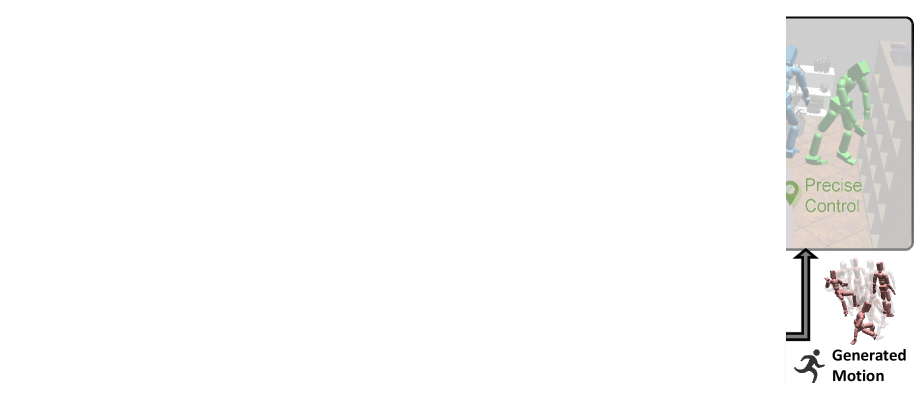
技术框架:BiBo系统由两个主要模块组成:具身指令编译器和基于扩散的运动执行器。具身指令编译器将高层用户指令转化为低层控制命令,而运动执行器则根据这些命令生成类人运动并适应环境反馈。
关键创新:最重要的创新在于将现成的VLMs与人形代理控制相结合,使得代理能够在复杂环境中执行多样化的任务,而不需要大量的训练数据。
关键设计:具身指令编译器设计了高层指令到低层命令的映射机制,运动执行器采用扩散模型生成运动轨迹,并动态调整以适应环境反馈。
🖼️ 关键图片


📊 实验亮点
实验结果显示,BiBo在开放环境中的交互任务成功率达到90.2%,相比于先前方法提高了16.3%的文本引导运动执行精度,展现出显著的性能提升。
🎯 应用场景
该研究的潜在应用领域包括人形机器人、智能家居、虚拟助手等。通过提升人形代理的交互能力,可以在服务、娱乐和教育等多个领域实现更自然的用户体验,未来可能推动人机交互的进一步发展。
📄 摘要(原文)
Humanoid agents often struggle to handle flexible and diverse interactions in open environments. A common solution is to collect massive datasets to train a highly capable model, but this approach can be prohibitively expensive. In this paper, we explore an alternative solution: empowering off-the-shelf Vision-Language Models (VLMs, such as GPT-4) to control humanoid agents, thereby leveraging their strong open-world generalization to mitigate the need for extensive data collection. To this end, we present \textbf{BiBo} (\textbf{B}uilding humano\textbf{I}d agent \textbf{B}y \textbf{O}ff-the-shelf VLMs). It consists of two key components: (1) an \textbf{embodied instruction compiler}, which enables the VLM to perceive the environment and precisely translate high-level user instructions (e.g., {\small\itshape
have a rest''}) into low-level primitive commands with control parameters (e.g., {\small\itshapesit casually, location: (1, 2), facing: 90$^\circ$''}); and (2) a diffusion-based \textbf{motion executor}, which generates human-like motions from these commands, while dynamically adapting to physical feedback from the environment. In this way, BiBo is capable of handling not only basic interactions but also diverse and complex motions. Experiments demonstrate that BiBo achieves an interaction task success rate of 90.2\% in open environments, and improves the precision of text-guided motion execution by 16.3\% over prior methods. The code will be made publicly available.