Stable Robot Motions on Manifolds: Learning Lyapunov-Constrained Neural Manifold ODEs
作者: David Boetius, Abdelrahman Abdelnaby, Ashok Kumar, Stefan Leue, Abdalla Swikir, Fares J. Abu-Dakka
分类: cs.RO, cs.LG, math.OC
发布日期: 2025-10-07
备注: 12 pages, 6 figures
💡 一句话要点
提出基于神经常微分方程的稳定机器人运动学习框架
🎯 匹配领域: 支柱一:机器人控制 (Robot Control)
关键词: 稳定性学习 神经常微分方程 黎曼流形 机器人运动 Lyapunov标准 动态系统 数据驱动控制
📋 核心要点
- 现有方法在黎曼流形上扩展稳定性保证时面临几何约束的挑战,导致动态系统的学习变得复杂。
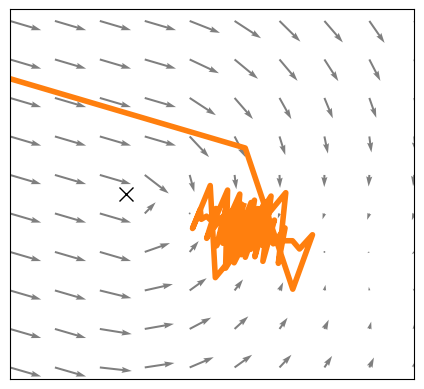
- 本文提出了一种基于神经常微分方程的框架,通过投影神经向量场来确保Lyapunov稳定性,从而实现稳定的动态系统学习。
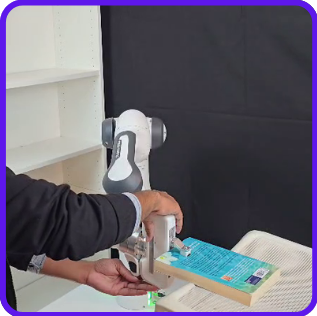
- 通过在真实世界实验中学习机器人运动,展示了该方法的性能、可扩展性和实际应用价值。
📝 摘要(中文)
从数据中学习稳定的动态系统对于安全可靠的机器人运动规划与控制至关重要。然而,将稳定性保证扩展到定义在黎曼流形上的轨迹面临显著挑战。为此,本文提出了一种通用框架,通过神经常微分方程学习黎曼流形上的稳定动态系统。该方法通过将神经向量场投影到流形上,严格满足Lyapunov稳定性标准,从而保证每个系统状态的稳定性。我们提供了一种高效的训练策略,并通过在单位四元数(S^3)和对称正定矩阵流形上的黎曼LASA数据集以及在 extbf{R}^3 imes S^3上演化的机器人运动中展示了该框架的实用性。
🔬 方法详解
问题定义:本文旨在解决在黎曼流形上学习稳定动态系统的问题。现有方法在处理流形几何约束时,难以保证系统的稳定性和有效性。
核心思路:提出通过神经常微分方程来学习动态系统,并通过投影神经向量场确保其满足Lyapunov稳定性标准,保证系统在每个状态下的稳定性。
技术框架:整体框架包括神经网络参数化的基础向量场和Lyapunov函数,通过流形上的演化直接生成复杂轨迹。训练策略高效,适用于不同流形数据集。
关键创新:最重要的创新在于将Lyapunov稳定性与神经网络学习结合,确保了在黎曼流形上学习的动态系统的稳定性,这与传统方法有本质区别。
关键设计:采用灵活的神经网络结构,设置合适的损失函数以优化Lyapunov函数,并通过有效的训练策略提升模型的学习能力和稳定性。
🖼️ 关键图片

📊 实验亮点
实验结果表明,所提出的方法在处理黎曼LASA数据集时,相较于基线方法,稳定性提升显著,能够有效学习复杂的机器人运动轨迹,展示了良好的性能和可扩展性。
🎯 应用场景
该研究的潜在应用领域包括机器人运动规划、自动驾驶、无人机飞行控制等。通过确保动态系统的稳定性,能够提升机器人在复杂环境中的安全性和可靠性,具有重要的实际价值和未来影响。
📄 摘要(原文)
Learning stable dynamical systems from data is crucial for safe and reliable robot motion planning and control. However, extending stability guarantees to trajectories defined on Riemannian manifolds poses significant challenges due to the manifold's geometric constraints. To address this, we propose a general framework for learning stable dynamical systems on Riemannian manifolds using neural ordinary differential equations. Our method guarantees stability by projecting the neural vector field evolving on the manifold so that it strictly satisfies the Lyapunov stability criterion, ensuring stability at every system state. By leveraging a flexible neural parameterisation for both the base vector field and the Lyapunov function, our framework can accurately represent complex trajectories while respecting manifold constraints by evolving solutions directly on the manifold. We provide an efficient training strategy for applying our framework and demonstrate its utility by solving Riemannian LASA datasets on the unit quaternion (S^3) and symmetric positive-definite matrix manifolds, as well as robotic motions evolving on \mathbb{R}^3 \times S^3. We demonstrate the performance, scalability, and practical applicability of our approach through extensive simulations and by learning robot motions in a real-world experiment.