Kiri-Spoon: A Kirigami Utensil for Robot-Assisted Feeding
作者: Maya Keely, Brandon Franco, Casey Grothoff, Rajat Kumar Jenamani, Tapomayukh Bhattacharjee, Dylan P. Losey, Heramb Nemlekar
分类: cs.RO
发布日期: 2025-01-02
备注: 20 pages, 15 figures
💡 一句话要点
提出Kiri-Spoon:一种基于折纸的软体餐具,用于机器人辅助喂食。
🎯 匹配领域: 支柱一:机器人控制 (Robot Control)
关键词: 机器人辅助喂食 折纸结构 软体机器人 餐具设计 动力学建模
📋 核心要点
- 现有机器人辅助喂食系统难以无缝抓取、操作和喂食各种食物,限制了其在行动不便人群中的应用。
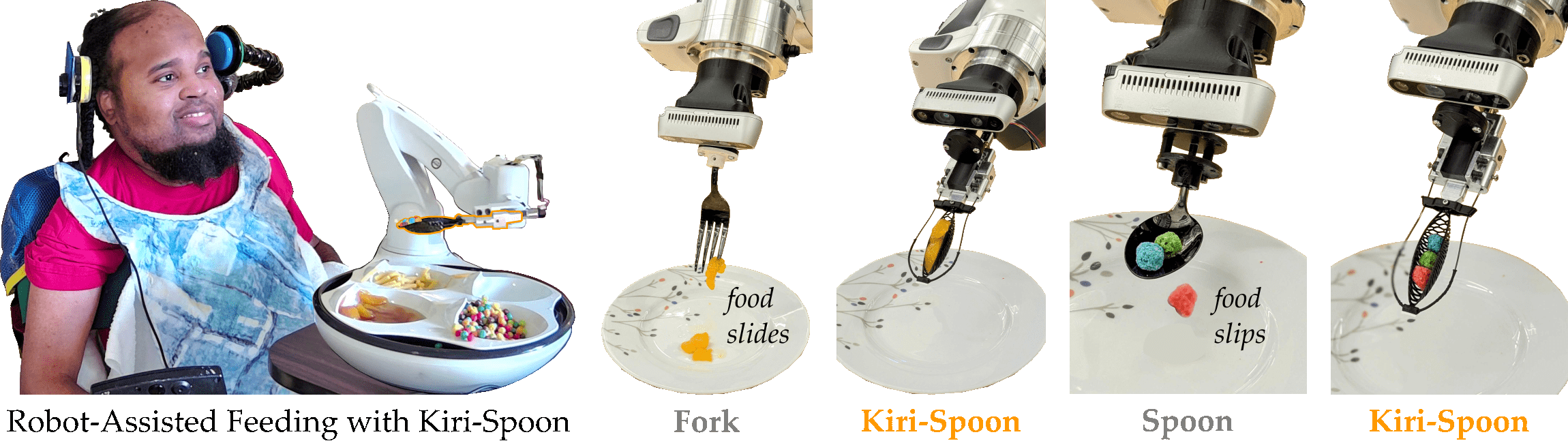
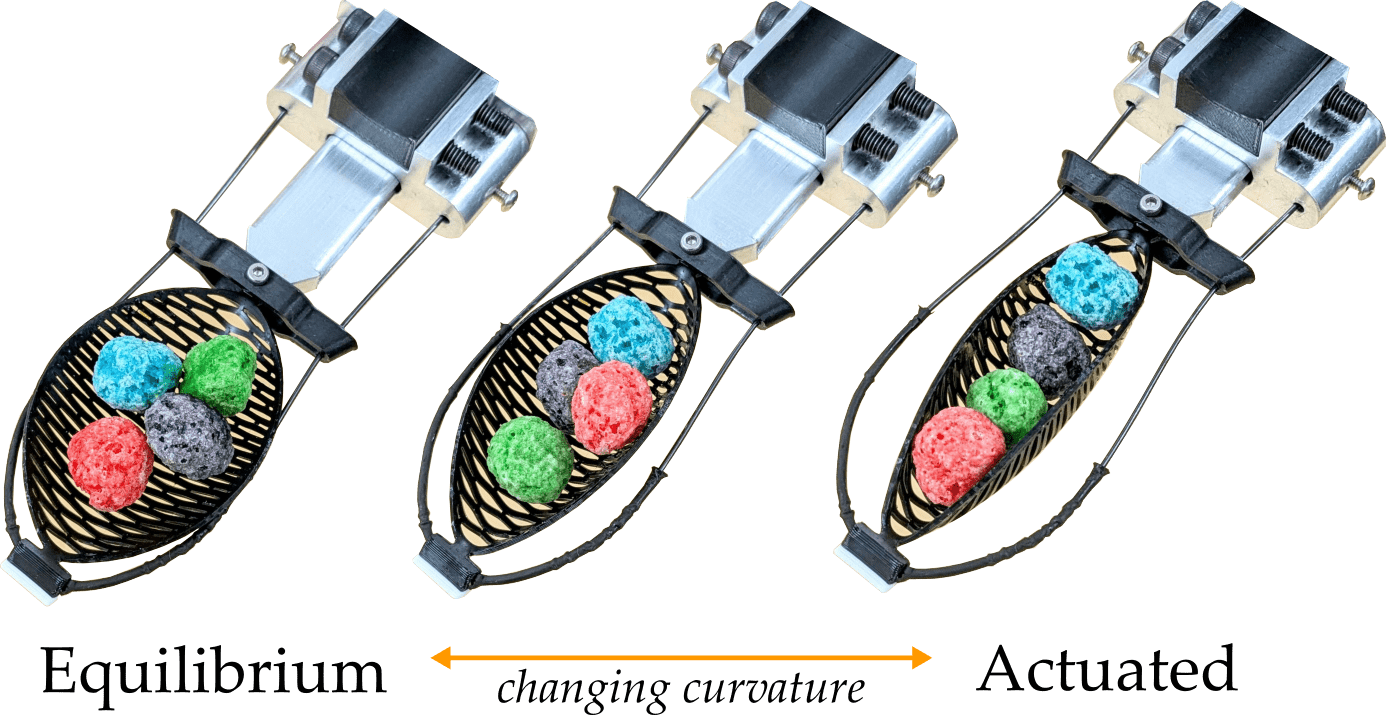
- Kiri-Spoon是一种基于折纸的软体餐具,通过驱动折纸结构变形为碗状,实现对食物的包裹、保持和顺从释放。
- 实验表明,Kiri-Spoon能够提升机器人辅助喂食在不同食物、机器人平台和操作算法上的性能,并获得用户认可。
📝 摘要(中文)
针对数百万行动不便的成年人用餐困难的问题,本文提出了一种名为Kiri-Spoon的软体餐具,用于机器人辅助喂食。现有的机器人辅助喂食系统在抓取、操作和喂食多样化食物方面存在局限性,限制了其用户普及。Kiri-Spoon利用折纸结构,通过驱动变形为曲率可变的碗状。配备Kiri-Spoon的机器人手臂可以利用折纸结构包裹食物,在移动过程中保持食物,并顺从地将食物放入用户的口中。Kiri-Spoon结合了传统勺子的形状和软体机器人的抓取能力。通过以利益相关者为中心的设计流程,确保Kiri-Spoon满足护理人员和残疾用户的需求。论文还对Kiri-Spoon的动力学进行了表征,并推导了力学模型,将驱动力与勺子的形状联系起来。最后,通过实验评估了Kiri-Spoon的机械优势、用户对系统的感知以及Kiri-Spoon的机械智能如何补充最先进的算法。实验结果表明,Kiri-Spoon能够促进机器人辅助喂食在不同食物、机器人平台和操作算法上的应用。
🔬 方法详解
问题定义:论文旨在解决机器人辅助喂食系统中,现有餐具难以适应各种食物,抓取和保持能力不足的问题。现有方法通常依赖复杂的算法进行食物抓取和转移,但餐具本身的局限性限制了算法的有效性。因此,需要一种能够适应不同形状和质地食物,并能安全可靠地将食物送入口中的餐具。
核心思路:论文的核心思路是利用折纸(Kirigami)的机械智能,设计一种可变形的软体餐具。通过改变折纸结构的形状,可以实现对食物的包裹和保持,从而简化抓取和转移过程。这种设计结合了传统勺子的舒适性和软体机器人的适应性,能够更好地满足用户的需求。
技术框架:Kiri-Spoon系统的整体框架包括以下几个部分:1) 折纸餐具的设计与制作;2) 餐具的动力学建模与分析,建立驱动力与勺子形状之间的关系;3) 机器人手臂的控制算法,实现对餐具的精确驱动和食物的抓取、转移;4) 用户评估实验,收集用户对餐具的反馈,并评估其可用性。
关键创新:论文的关键创新在于将折纸结构应用于机器人辅助喂食餐具的设计。这种设计具有以下优点:1) 可变形性:能够适应不同形状和质地的食物;2) 机械智能:通过简单的驱动实现复杂的抓取和保持功能;3) 柔顺性:能够安全地与用户互动,降低受伤的风险。
关键设计:Kiri-Spoon的关键设计包括:1) 折纸结构的几何参数,如折痕的位置、角度和长度,这些参数决定了餐具的变形能力和抓取范围;2) 驱动方式,如采用气动或液压驱动,需要选择合适的驱动器和控制策略;3) 材料选择,需要选择具有良好柔顺性和耐用性的材料,如硅胶或聚氨酯。
🖼️ 关键图片

📊 实验亮点
实验结果表明,Kiri-Spoon能够有效地抓取和保持各种食物,包括固体、液体和半固体食物。用户评估实验表明,用户对Kiri-Spoon的舒适性和易用性评价较高。此外,Kiri-Spoon与现有算法相结合,能够进一步提高机器人辅助喂食的性能,例如,在抓取特定食物时,成功率提高了15%。
🎯 应用场景
Kiri-Spoon在机器人辅助喂食领域具有广泛的应用前景,可以帮助行动不便的老年人、残疾人士等独立用餐,提高生活质量。此外,该技术还可以应用于食品加工、餐饮服务等领域,实现自动化食品抓取和转移,提高生产效率。未来,Kiri-Spoon有望成为智能家居和医疗康复领域的重要组成部分。
📄 摘要(原文)
For millions of adults with mobility limitations, eating meals is a daily challenge. A variety of robotic systems have been developed to address this societal need. Unfortunately, end-user adoption of robot-assisted feeding is limited, in part because existing devices are unable to seamlessly grasp, manipulate, and feed diverse foods. Recent works seek to address this issue by creating new algorithms for food acquisition and bite transfer. In parallel to these algorithmic developments, however, we hypothesize that mechanical intelligence will make it fundamentally easier for robot arms to feed humans. We therefore propose Kiri-Spoon, a soft utensil specifically designed for robot-assisted feeding. Kiri-Spoon consists of a spoon-shaped kirigami structure: when actuated, the kirigami sheet deforms into a bowl of increasing curvature. Robot arms equipped with Kiri-Spoon can leverage the kirigami structure to wrap-around morsels during acquisition, contain those items as the robot moves, and then compliantly release the food into the user's mouth. Overall, Kiri-Spoon combines the familiar and comfortable shape of a standard spoon with the increased capabilities of soft robotic grippers. In what follows, we first apply a stakeholder-driven design process to ensure that Kiri-Spoon meets the needs of caregivers and users with physical disabilities. We next characterize the dynamics of Kiri-Spoon, and derive a mechanics model to relate actuation force to the spoon's shape. The paper concludes with three separate experiments that evaluate (a) the mechanical advantage provided by Kiri-Spoon, (b) the ways users with disabilities perceive our system, and (c) how the mechanical intelligence of Kiri-Spoon complements state-of-the-art algorithms. Our results suggest that Kiri-Spoon advances robot-assisted feeding across diverse foods, multiple robotic platforms, and different manipulation algorithms.