An Expeditious Spatial Mean Radiant Temperature Mapping Framework using Visual SLAM and Semantic Segmentation
作者: Wei Liang, Yiting Zhang, Ji Zhang, Erica Cochran Hameen
分类: cs.RO, cs.CV
发布日期: 2024-10-12
备注: Accepted by 2024 IEEE/CVF Conference on Computer Vision and Pattern Recognition Workshop
💡 一句话要点
提出基于视觉SLAM和语义分割的空间平均辐射温度快速映射框架
🎯 匹配领域: 支柱三:空间感知与语义 (Perception & Semantics)
关键词: 平均辐射温度 视觉SLAM 语义分割 热舒适性 空间映射 Grounded SAM 室内环境
📋 核心要点
- 传统平均辐射温度(MRT)测量方法耗时且不便,难以快速评估室内热舒适性。
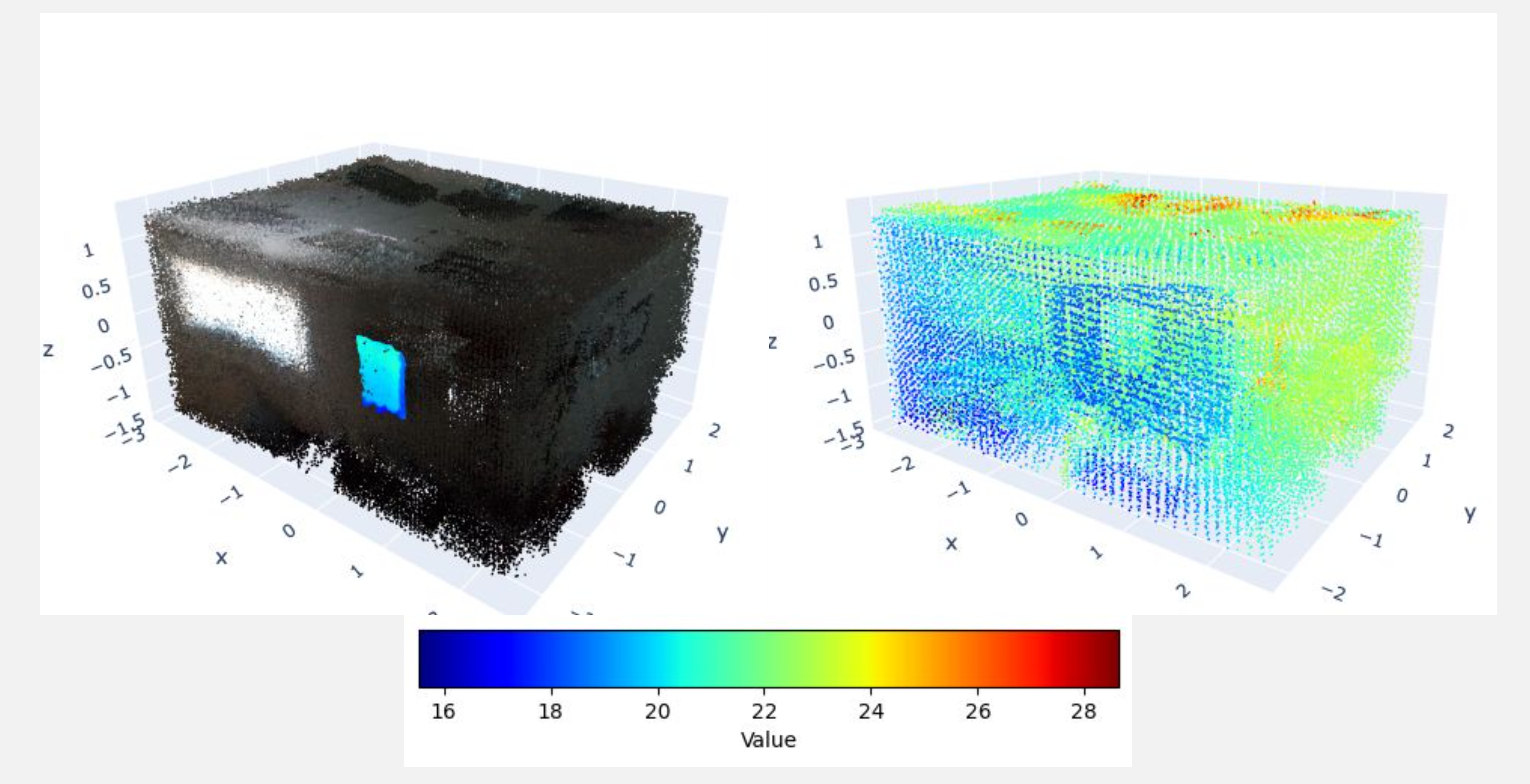
- 利用视觉SLAM构建3D热点云,结合语义分割提取不同温度特征,实现MRT的快速空间分布重建。
- 通过实验验证,该框架比传统方法更快速、高效地进行MRT测量和空间映射。
📝 摘要(中文)
为了确保建筑环境中人员的热舒适性和生产力,本文提出了一种新的平均辐射温度(MRT)测量框架,该框架利用视觉同步定位与地图构建(SLAM)和语义分割技术。该方法遵循传统MRT计算方法中表面温度和视角因子的经验法则,但采用视觉SLAM创建具有丰富表面温度信息的3D热点云。该框架还实现了Grounded SAM,一种新的对象检测和分割工具,用于提取建筑物表面上具有不同温度分布的特征。热特征的详细分割不仅减少了MRT计算中的潜在误差,而且实现了室内环境中空间MRT分布的有效重建。通过参考测量方法验证了计算结果。这种数据驱动的框架比传统方法提供更快、更有效的MRT测量和空间映射,有助于研究人员和从业人员直接参与MRT测量,并促进热舒适性和辐射冷却和加热系统的研究。
🔬 方法详解
问题定义:论文旨在解决传统平均辐射温度(MRT)测量方法耗时、不方便的问题。现有方法通常需要人工测量多个点的表面温度和视角因子,计算过程繁琐且效率低下,难以快速获取室内环境的MRT空间分布,阻碍了热舒适性研究和辐射供暖/制冷系统的优化。
核心思路:论文的核心思路是利用视觉SLAM技术快速构建室内环境的3D模型,并结合语义分割技术自动识别和提取不同表面温度的特征区域,从而实现MRT的快速、准确计算和空间分布重建。这种方法将传统的离散点测量转化为连续的空间信息获取,大大提高了测量效率。
技术框架:该框架主要包含以下几个阶段:1) 利用视觉SLAM技术(具体SLAM算法未知)构建室内环境的3D点云地图;2) 使用热像仪获取室内环境的表面温度信息,并将温度信息与3D点云进行配准,生成带有温度信息的3D热点云;3) 采用Grounded SAM进行语义分割,自动识别和分割具有不同温度特征的物体表面;4) 基于分割结果和视角因子,计算每个位置的MRT值,并构建MRT的空间分布图。
关键创新:该论文的关键创新在于将视觉SLAM和语义分割技术应用于MRT测量,实现了MRT的快速空间映射。与传统方法相比,该方法无需人工测量,能够自动获取室内环境的温度信息和几何信息,大大提高了测量效率和精度。Grounded SAM的使用也使得特征提取更加自动化和智能化。
关键设计:论文中关于视觉SLAM的具体算法、Grounded SAM的参数设置以及温度信息配准的具体方法等技术细节未知。但可以推测,温度信息配准需要考虑热像仪的标定和坐标转换,Grounded SAM的参数设置需要根据室内环境的复杂程度进行调整,以保证分割的准确性。
🖼️ 关键图片


📊 实验亮点
论文验证了该框架计算MRT的有效性,但具体性能数据、对比基线和提升幅度未知。摘要中提到该框架比传统方法提供更快、更有效的MRT测量和空间映射,但缺乏量化指标。未来的研究可以进一步提供具体的实验数据,例如测量时间、精度等,以更充分地展示该框架的优势。
🎯 应用场景
该研究成果可广泛应用于建筑环境的热舒适性评估、辐射供暖/制冷系统的设计与优化、节能建筑的改造等方面。通过快速获取室内MRT空间分布,可以帮助研究人员和工程师更好地了解室内热环境,从而设计出更舒适、更节能的建筑。
📄 摘要(原文)
Ensuring thermal comfort is essential for the well-being and productivity of individuals in built environments. Of the various thermal comfort indicators, the mean radiant temperature (MRT) is very challenging to measure. Most common measurement methodologies are time-consuming and not user-friendly. To address this issue, this paper proposes a novel MRT measurement framework that uses visual simultaneous localization and mapping (SLAM) and semantic segmentation techniques. The proposed approach follows the rule of thumb of the traditional MRT calculation method using surface temperature and view factors. However, it employs visual SLAM and creates a 3D thermal point cloud with enriched surface temperature information. The framework then implements Grounded SAM, a new object detection and segmentation tool to extract features with distinct temperature profiles on building surfaces. The detailed segmentation of thermal features not only reduces potential errors in the calculation of the MRT but also provides an efficient reconstruction of the spatial MRT distribution in the indoor environment. We also validate the calculation results with the reference measurement methodology. This data-driven framework offers faster and more efficient MRT measurements and spatial mapping than conventional methods. It can enable the direct engagement of researchers and practitioners in MRT measurements and contribute to research on thermal comfort and radiant cooling and heating systems.