Semantic Region Aware Autonomous Exploration for Multi-Type Map Construction in Unknown Indoor Environments
作者: Jianfang Mao
分类: cs.RO, eess.SY
发布日期: 2024-04-07 (更新: 2024-10-10)
💡 一句话要点
提出语义区域感知自主探索方法以解决室内环境多类型地图构建问题
🎯 匹配领域: 支柱三:空间感知与语义 (Perception & Semantics)
关键词: 自主探索 语义区域 地图构建 室内导航 机器人技术 多类型地图 优化策略
📋 核心要点
- 现有自主探索方法在复杂环境中存在重复探索同一区域的问题,导致效率低下。
- 本文提出的语义区域感知自主探索方法,通过充分利用语义区域信息来优化导航策略。
- 实验结果显示,该方法在探索时间和轨迹长度上分别减少了50.7%和48.1%,探索率超过98%。
📝 摘要(中文)
主流的自主探索方法通常在相同区域进行过度重复探索,导致在复杂场景中探索时间和轨迹过长。为了解决这一问题,本文提出了一种新颖的语义区域感知自主探索方法,其核心思想是利用语义区域的信息来优化自主导航策略。该方法使移动机器人在移动到下一个区域之前充分探索当前语义区域,从而避免过度重复探索并加快探索速度。此外,与现有通常构建单一类型地图的自主探索方法相比,我们的方法能够构建包括点云地图、占据网格地图、拓扑地图和语义地图在内的四种类型的地图。实验结果表明,与基于RRT(快速探索随机树)的经典自主探索方法相比,我们的方法实现了最高50.7%的探索时间缩短和48.1%的探索轨迹长度缩短,同时保持了超过98%的探索率。
🔬 方法详解
问题定义:本文旨在解决现有自主探索方法在复杂室内环境中存在的重复探索问题,导致探索时间和轨迹过长。
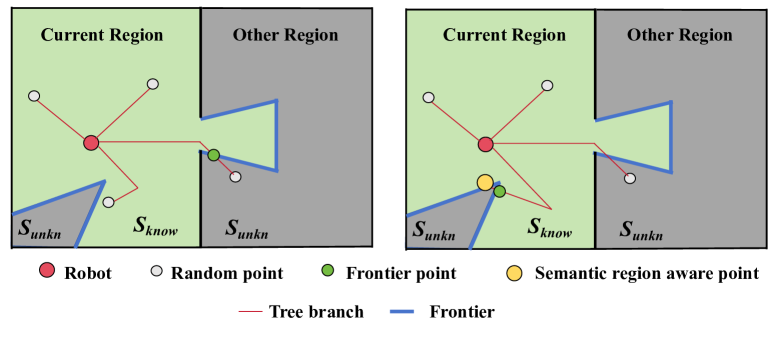
核心思路:提出的语义区域感知自主探索方法通过充分探索当前语义区域,优化移动机器人的导航策略,从而避免不必要的重复探索。
技术框架:该方法的整体架构包括语义区域识别、导航策略优化和多类型地图构建三个主要模块,确保机器人在探索过程中高效利用环境信息。
关键创新:最重要的创新点在于引入语义区域的概念,使得机器人能够在不同类型的地图构建中灵活切换,显著提升探索效率。
关键设计:在技术细节上,方法中采用了特定的参数设置和损失函数,以确保语义信息的有效利用,同时设计了适应不同地图类型的网络结构。
🖼️ 关键图片


📊 实验亮点
实验结果显示,提出的方法在探索时间上减少了50.7%,探索轨迹长度减少了48.1%,同时保持了超过98%的探索率,显著优于传统的RRT基线方法,展示了其在复杂环境中的有效性。
🎯 应用场景
该研究的潜在应用领域包括室内导航、智能家居、无人仓库等场景,能够显著提升机器人在未知环境中的探索效率和地图构建能力,具有重要的实际价值和未来影响。
📄 摘要(原文)
Mainstream autonomous exploration methods usually perform excessively-repeated explorations for the same region, leading to long exploration time and exploration trajectory in complex scenes. To handle this issue, we propose a novel semantic region aware autonomous exploration method, the core idea of which is considering the information of semantic regions to optimize the autonomous navigation strategy. Our method enables the mobile robot to fully explore the current semantic region before moving to the next region, contributing to avoid excessively-repeated explorations and accelerate the exploration speed. In addition, compared with existing au?tonomous exploration methods that usually construct the single-type map, our method allows to construct four types of maps including point cloud map, occupancy grid map, topological map, and semantic map. The experiment results demonstrate that our method achieves the highest 50.7% exploration time reduction and 48.1% exploration trajectory length reduction while maintaining >98% exploration rate when comparing with the classical RRT (Rapid-exploration Random Tree) based autonomous exploration method.