Combining Shape Completion and Grasp Prediction for Fast and Versatile Grasping with a Multi-Fingered Hand
作者: Matthias Humt, Dominik Winkelbauer, Ulrich Hillenbrand, Berthold Bäuml
分类: cs.RO, cs.AI, cs.CV, cs.LG
发布日期: 2023-10-31 (更新: 2026-01-19)
备注: 8 pages, 10 figures, 3 tables, 1 algorithm. Published in Humanoids 2023. Project page: https://aidx-lab.org/grasping/humanoids23
期刊: 2023 IEEE-RAS 22nd International Conference on Humanoid Robots (Humanoids), pp. 1-8, 2023
DOI: 10.1109/HUMANOIDS57100.2023.10375210
💡 一句话要点
提出结合形状补全与抓取预测的方法以解决多指机器人抓取问题
🎯 匹配领域: 支柱三:空间感知与语义 (Perception & Semantics)
关键词: 形状补全 抓取预测 多指机器人 深度学习 助理机器人 物体识别 机器人抓取
📋 核心要点
- 现有方法在抓取对象时面临部分可观测性和多指手灵活抓取的挑战,尤其是在缺乏先验知识的情况下。
- 论文提出了一种快速且高保真的深度学习管道,结合形状补全和抓取预测,能够在单幅深度图像基础上进行有效抓取。
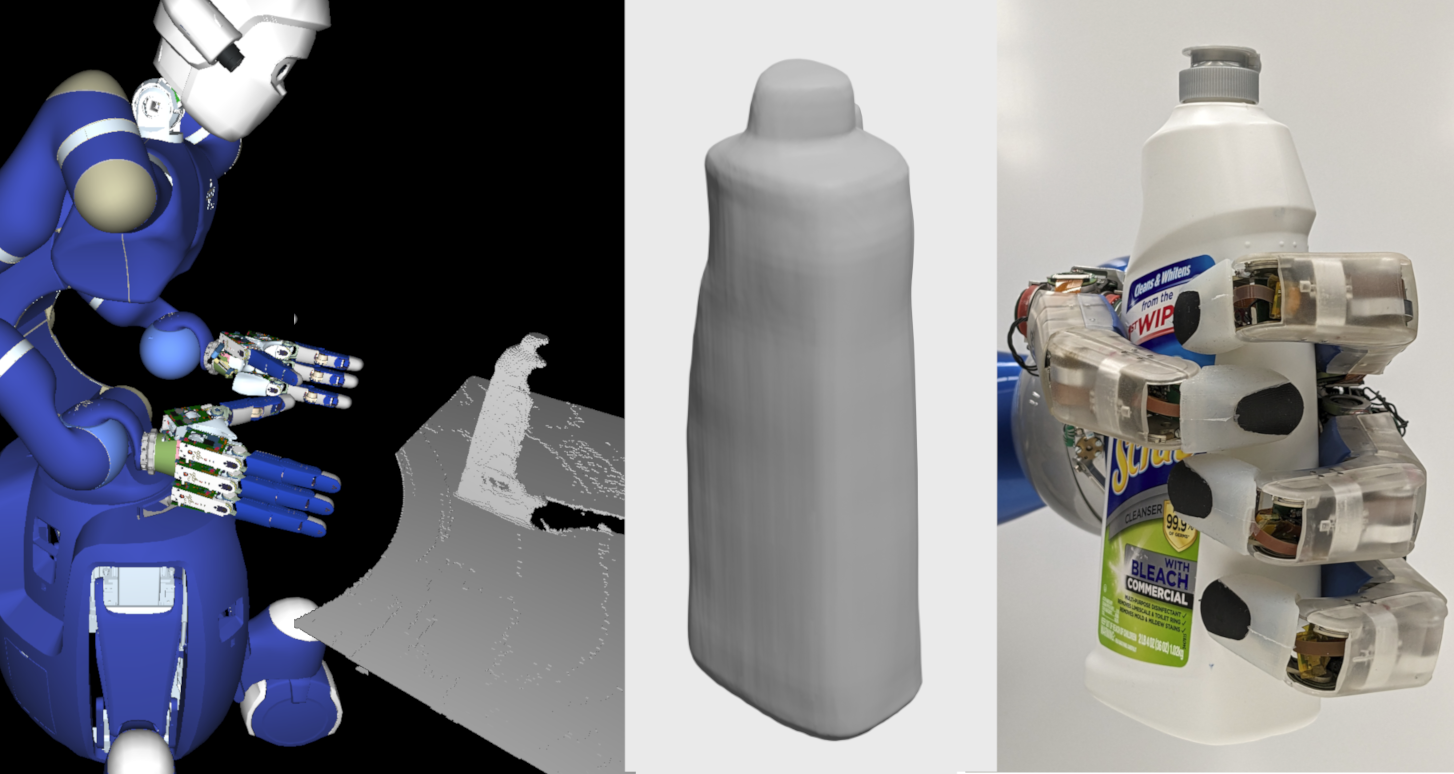
- 实验结果显示,该方法在物理机器人平台上成功抓取多种家庭物品,整个处理时间约为1秒,具有较高的实用性。
📝 摘要(中文)
在助理机器人领域,抓取对象的能力尤其重要,尤其是在缺乏先验知识的情况下。本文提出了一种新颖的深度学习管道,结合了基于单幅深度图像的形状补全模块和基于预测物体形状的抓取预测模块。形状补全网络基于VQDIF,能够在任意查询点预测空间占用值。抓取预测采用两阶段架构,首先生成手部姿态,然后回归每个姿态的手指关节配置。实验表明,该方法能够成功抓取多种家庭物品,整个管道速度快,形状补全和抓取生成仅需约1秒。
🔬 方法详解
问题定义:本文旨在解决在缺乏先验知识的情况下,如何有效抓取部分可观测物体的问题。现有方法在处理多指手抓取时存在灵活性不足和效率低下的痛点。
核心思路:论文提出的解决方案是结合形状补全与抓取预测,通过深度学习模型快速生成物体形状和抓取策略,以提高抓取的成功率和效率。
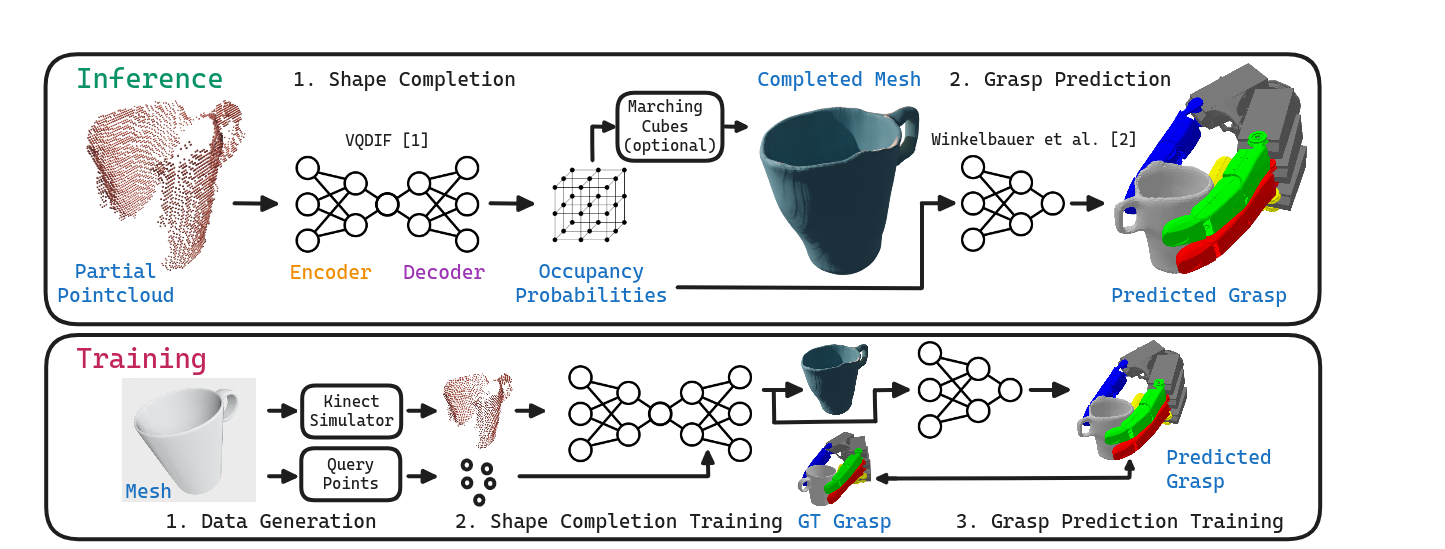
技术框架:整体架构包括两个主要模块:首先是形状补全模块,基于单幅深度图像预测物体的空间占用;其次是抓取预测模块,基于预测的物体形状生成抓取策略。
关键创新:最重要的创新在于将形状补全与抓取预测有效结合,形成一个快速响应的深度学习管道,显著提升了多指手的抓取能力。与现有方法相比,该方法在处理复杂抓取场景时表现出更高的灵活性和准确性。
关键设计:在网络设计上,形状补全网络采用VQDIF架构,能够在任意查询点进行空间占用预测;抓取预测则使用两阶段架构,首先生成手部姿态,再回归手指关节配置。训练过程中注重数据的真实感和增强,特别关注困难案例的处理。
🖼️ 关键图片
📊 实验亮点
实验结果表明,该方法在物理机器人平台上成功抓取多种家庭物品,整个处理时间仅为1秒,其中形状补全耗时0.7秒,抓取生成耗时0.3秒,显示出显著的效率提升。
🎯 应用场景
该研究具有广泛的应用潜力,尤其在助理机器人、智能家居和自动化仓储等领域。通过提高机器人对物体的抓取能力,可以显著提升其在实际环境中的工作效率和灵活性,推动智能机器人技术的进一步发展。
📄 摘要(原文)
Grasping objects with limited or no prior knowledge about them is a highly relevant skill in assistive robotics. Still, in this general setting, it has remained an open problem, especially when it comes to only partial observability and versatile grasping with multi-fingered hands. We present a novel, fast, and high fidelity deep learning pipeline consisting of a shape completion module that is based on a single depth image, and followed by a grasp predictor that is based on the predicted object shape. The shape completion network is based on VQDIF and predicts spatial occupancy values at arbitrary query points. As grasp predictor, we use our two-stage architecture that first generates hand poses using an autoregressive model and then regresses finger joint configurations per pose. Critical factors turn out to be sufficient data realism and augmentation, as well as special attention to difficult cases during training. Experiments on a physical robot platform demonstrate successful grasping of a wide range of household objects based on a depth image from a single viewpoint. The whole pipeline is fast, taking only about 1 s for completing the object's shape (0.7 s) and generating 1000 grasps (0.3 s).