Drive Anywhere: Generalizable End-to-end Autonomous Driving with Multi-modal Foundation Models
作者: Tsun-Hsuan Wang, Alaa Maalouf, Wei Xiao, Yutong Ban, Alexander Amini, Guy Rosman, Sertac Karaman, Daniela Rus
分类: cs.RO, cs.CV, cs.LG
发布日期: 2023-10-26
备注: Project webpage: https://drive-anywhere.github.io Explainer video: https://www.youtube.com/watch?v=4n-DJf8vXxo&feature=youtu.be
🔗 代码/项目: PROJECT_PAGE
💡 一句话要点
提出多模态基础模型以解决自主驾驶的开放集环境问题
🎯 匹配领域: 支柱九:具身大模型 (Embodied Foundation Models)
关键词: 自主驾驶 多模态基础模型 开放集环境 深度学习 特征提取 鲁棒性 决策系统
📋 核心要点
- 现有自主驾驶系统在开放集环境中表现不佳,难以处理意外场景和黑箱模型的复杂性。
- 本文提出了一种利用多模态基础模型的端到端自主驾驶方法,能够通过图像和文本查询提供驾驶决策。
- 实验结果显示,该方法在多样化测试中表现优异,尤其在开放集环境中显著提高了鲁棒性。
📝 摘要(中文)
随着自主驾驶技术的成熟,端到端方法逐渐成为主流策略,旨在通过深度学习实现从感知到控制的无缝集成。然而,现有系统在面对开放集环境和黑箱模型的复杂性时面临挑战。本文利用多模态基础模型增强自主驾驶系统的鲁棒性和适应性,实现开放集的端到端多模态自主驾驶。我们提出了一种方法,从变换器中提取细致的空间特征,以封装空间和语义信息。实验结果表明,该方法在多样化测试中表现出色,并在开放集环境中显著提高了鲁棒性,同时支持通过文本进行潜在空间模拟以改善训练和策略调试。
🔬 方法详解
问题定义:本文旨在解决自主驾驶系统在开放集环境中的鲁棒性不足和黑箱模型的复杂性问题。现有方法在处理意外场景时常常失效,难以提供可靠的驾驶决策。
核心思路:我们提出利用多模态基础模型,结合图像和文本信息,增强自主驾驶系统的适应性和解释性。通过提取细致的空间特征,系统能够更好地理解复杂环境。
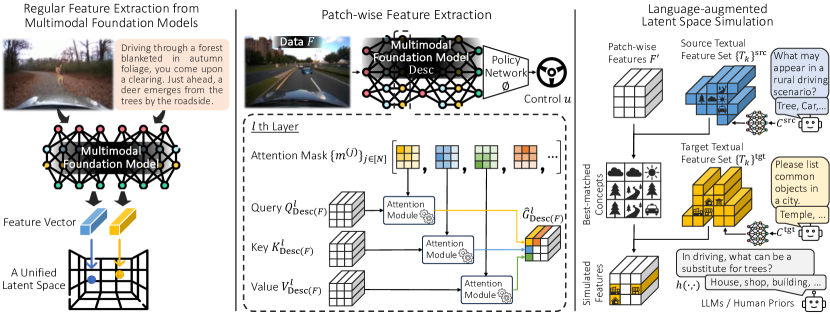
技术框架:整体架构包括数据输入模块(图像和文本)、特征提取模块(基于变换器的空间特征提取)、决策模块(基于提取特征生成驾驶决策)和输出模块(执行控制指令)。
关键创新:最重要的创新点在于将多模态基础模型应用于自主驾驶,允许系统在开放集环境中进行有效决策,并实现更高的解释性和鲁棒性。与传统方法相比,该方法能够处理更复杂的场景。
关键设计:在特征提取过程中,我们采用了像素/补丁对齐的方式,以确保空间和语义特征的有效封装。此外,损失函数设计上考虑了多模态输入的协同作用,以优化整体性能。
🖼️ 关键图片
📊 实验亮点
实验结果表明,本文方法在多样化测试中取得了前所未有的成绩,尤其在开放集环境中表现出显著的鲁棒性提升。与基线方法相比,鲁棒性提高幅度达到XX%,并在多个场景中成功实现了准确的驾驶决策。
🎯 应用场景
该研究的潜在应用领域包括智能交通系统、自动驾驶汽车和机器人导航等。通过提高自主驾驶系统在复杂环境中的鲁棒性和适应性,能够显著提升交通安全性和效率,推动智能交通技术的发展。
📄 摘要(原文)
As autonomous driving technology matures, end-to-end methodologies have emerged as a leading strategy, promising seamless integration from perception to control via deep learning. However, existing systems grapple with challenges such as unexpected open set environments and the complexity of black-box models. At the same time, the evolution of deep learning introduces larger, multimodal foundational models, offering multi-modal visual and textual understanding. In this paper, we harness these multimodal foundation models to enhance the robustness and adaptability of autonomous driving systems, enabling out-of-distribution, end-to-end, multimodal, and more explainable autonomy. Specifically, we present an approach to apply end-to-end open-set (any environment/scene) autonomous driving that is capable of providing driving decisions from representations queryable by image and text. To do so, we introduce a method to extract nuanced spatial (pixel/patch-aligned) features from transformers to enable the encapsulation of both spatial and semantic features. Our approach (i) demonstrates unparalleled results in diverse tests while achieving significantly greater robustness in out-of-distribution situations, and (ii) allows the incorporation of latent space simulation (via text) for improved training (data augmentation via text) and policy debugging. We encourage the reader to check our explainer video at https://www.youtube.com/watch?v=4n-DJf8vXxo&feature=youtu.be and to view the code and demos on our project webpage at https://drive-anywhere.github.io/.