Model-Based Runtime Monitoring with Interactive Imitation Learning
作者: Huihan Liu, Shivin Dass, Roberto Martín-Martín, Yuke Zhu
分类: cs.RO, cs.AI, cs.LG
发布日期: 2023-10-26
🔗 代码/项目: PROJECT_PAGE
💡 一句话要点
提出基于模型的运行时监控以解决机器人学习中的错误检测问题
🎯 匹配领域: 支柱二:RL算法与架构 (RL & Architecture)
关键词: 机器人学习 运行时监控 模仿学习 故障检测 动态模型 人机团队 高风险任务
📋 核心要点
- 现有的交互式模仿学习方法通常需要持续的人类监督和反馈,限制了其在实际领域的应用。
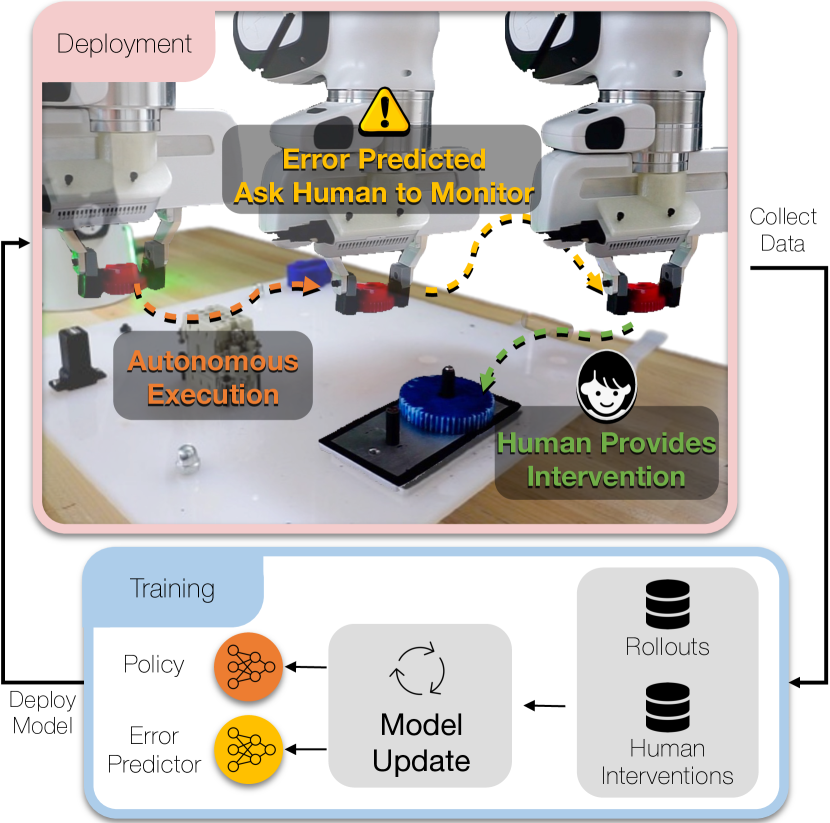
- 本文提出了一种基于模型的运行时监控算法,能够实时监测任务执行中的错误并预测潜在故障。
- 实验结果表明,该方法在仿真和物理硬件上分别提高了23%和40%的成功率,优于基线方法。
📝 摘要(中文)
机器人学习方法近年来取得了显著进展,但普遍存在的泛化和鲁棒性挑战仍然阻碍其广泛应用。未能及时检测和处理潜在故障使得最先进的学习系统无法在高风险任务中发挥作用。本文提出了一种基于模型的运行时监控算法,能够从部署数据中学习,检测系统异常并预测故障。与以往方法不同,本方法通过学习潜在空间动态模型和故障分类器,能够预先模拟未来的动作结果,及时发现分布外和高风险状态。该方法在交互式模仿学习框架内训练,能够随着人机团队的经验不断更新模型,从而减少人类的工作负担,确保任务执行的可靠性。
🔬 方法详解
问题定义:本文旨在解决机器人在任务执行过程中未能及时检测和处理潜在故障的问题。现有方法通常依赖于历史故障经验进行训练,无法有效预测未来的故障。
核心思路:本研究提出了一种基于模型的运行时监控算法,通过学习潜在空间的动态模型和故障分类器,能够在任务执行过程中实时监测并预测故障,从而提高机器人系统的安全性和可靠性。
技术框架:整体架构包括数据收集、模型训练和实时监控三个主要模块。首先,系统从人机团队的实际部署中收集数据;然后,利用这些数据训练动态模型和故障分类器;最后,在任务执行过程中实时监控并检测异常状态。
关键创新:本研究的关键创新在于能够在没有历史故障经验的情况下,通过潜在空间动态模型的学习,预先模拟未来的动作结果,从而实现对高风险状态的及时检测。这与传统方法的本质区别在于不再依赖于过去的故障数据。
关键设计:在模型训练过程中,采用了特定的损失函数以平衡动态模型和故障分类器的学习。同时,网络结构设计上考虑了潜在空间的有效表示,以提高模型的泛化能力和鲁棒性。具体参数设置和网络架构细节在实验部分进行了详细说明。
🖼️ 关键图片


📊 实验亮点
实验结果显示,所提出的方法在系统级和单元测试指标上均优于基线方法。在仿真环境中成功率提高了23%,而在物理硬件上成功率提高了40%,显示出该方法在实际应用中的有效性和优势。
🎯 应用场景
该研究的潜在应用领域包括工业机器人、服务机器人和自主移动系统等高风险任务场景。通过提高机器人在复杂环境中的错误检测能力,能够显著提升其安全性和可靠性,进而推动机器人技术在实际应用中的广泛部署。
📄 摘要(原文)
Robot learning methods have recently made great strides, but generalization and robustness challenges still hinder their widespread deployment. Failing to detect and address potential failures renders state-of-the-art learning systems not combat-ready for high-stakes tasks. Recent advances in interactive imitation learning have presented a promising framework for human-robot teaming, enabling the robots to operate safely and continually improve their performances over long-term deployments. Nonetheless, existing methods typically require constant human supervision and preemptive feedback, limiting their practicality in realistic domains. This work aims to endow a robot with the ability to monitor and detect errors during task execution. We introduce a model-based runtime monitoring algorithm that learns from deployment data to detect system anomalies and anticipate failures. Unlike prior work that cannot foresee future failures or requires failure experiences for training, our method learns a latent-space dynamics model and a failure classifier, enabling our method to simulate future action outcomes and detect out-of-distribution and high-risk states preemptively. We train our method within an interactive imitation learning framework, where it continually updates the model from the experiences of the human-robot team collected using trustworthy deployments. Consequently, our method reduces the human workload needed over time while ensuring reliable task execution. Our method outperforms the baselines across system-level and unit-test metrics, with 23% and 40% higher success rates in simulation and on physical hardware, respectively. More information at https://ut-austin-rpl.github.io/sirius-runtime-monitor/