Language Models as Zero-Shot Trajectory Generators
作者: Teyun Kwon, Norman Di Palo, Edward Johns
分类: cs.RO, cs.AI, cs.CL, cs.HC, cs.LG
发布日期: 2023-10-17 (更新: 2024-06-17)
备注: Published in IEEE Robotics and Automation Letters (Volume: 9, Issue: 7, July 2024, Pages: 6728-6735); 10 pages, 12 figures
期刊: IEEE Robotics and Automation Letters (Volume: 9, Issue: 7, July 2024, Pages: 6728-6735)
💡 一句话要点
提出LLM作为零-shot轨迹生成器以解决机器人控制问题
🎯 匹配领域: 支柱一:机器人控制 (Robot Control) 支柱九:具身大模型 (Embodied Foundation Models)
关键词: 大型语言模型 机器人控制 轨迹生成 低层控制 任务提示 失败检测 重规划
📋 核心要点
- 现有方法通常假设大型语言模型在低层轨迹生成方面的能力有限,限制了其在机器人控制中的应用。
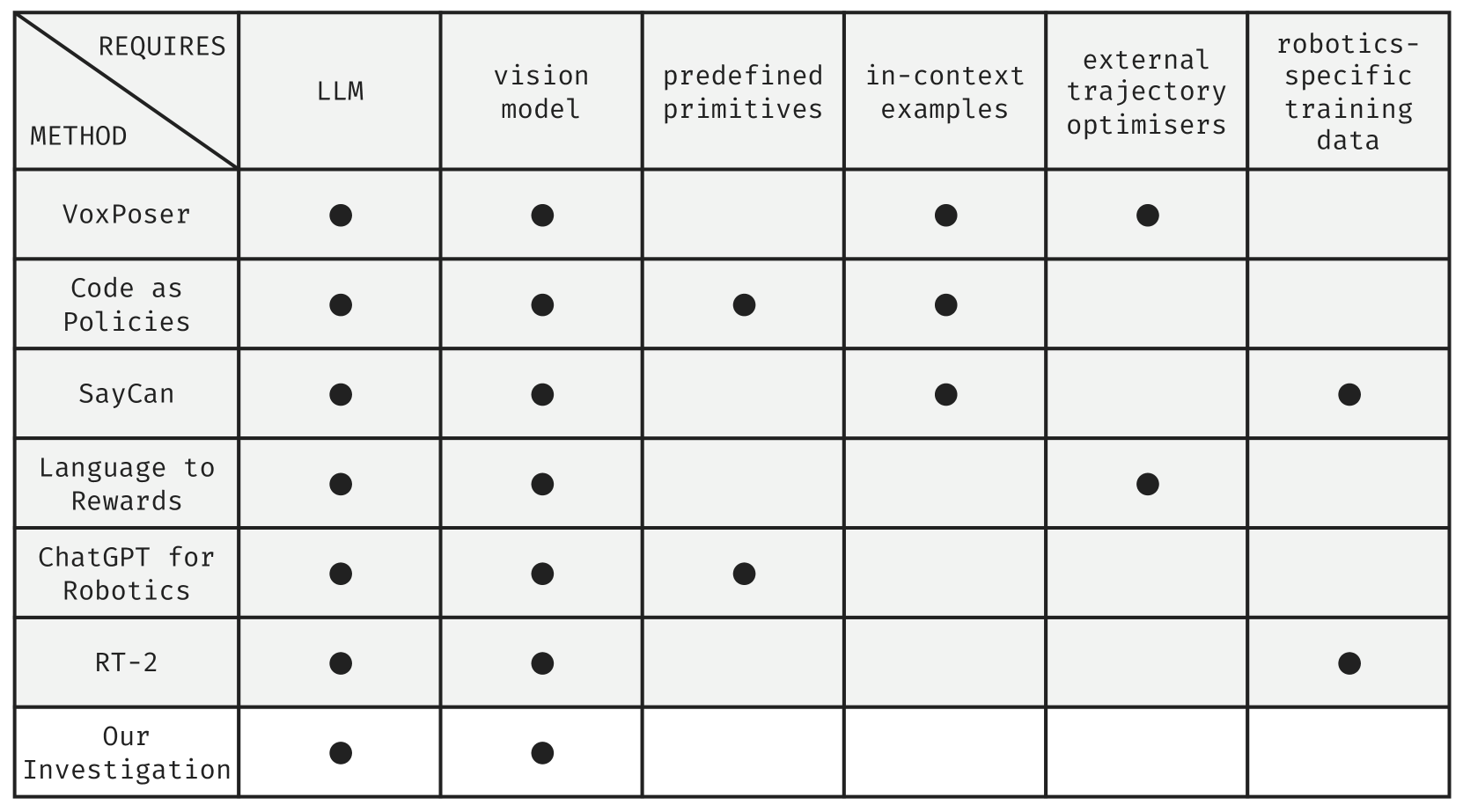
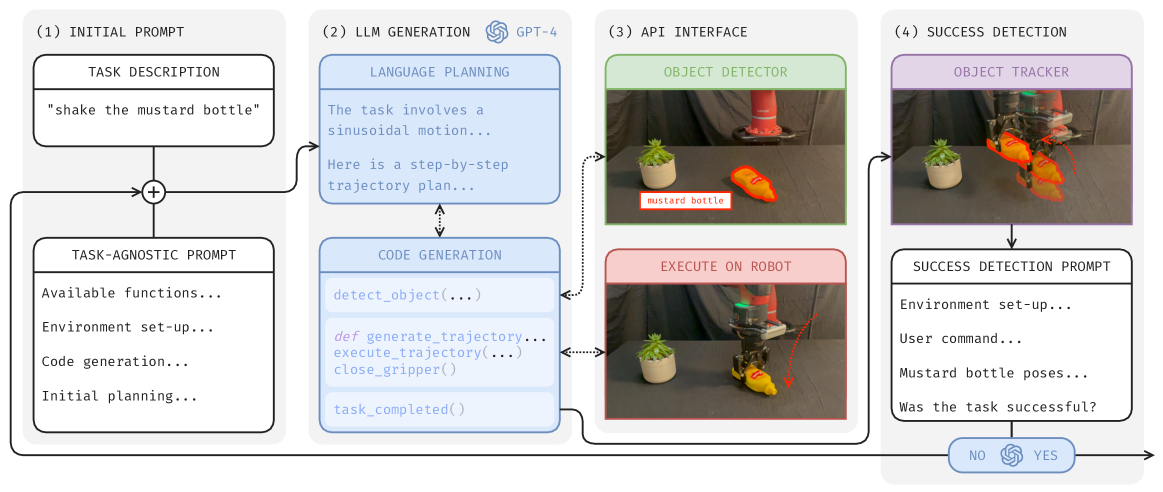
- 本研究提出了一种新方法,利用GPT-4直接生成操作任务的末端执行器姿态序列,而无需示例或外部优化器。
- 实验结果表明,GPT-4在30个真实任务中表现出色,能够有效处理低层控制并进行失败检测与轨迹重规划。
📝 摘要(中文)
大型语言模型(LLMs)最近在机器人高层规划中展现出潜力,但通常认为其对低层轨迹的理解不足。本研究深入探讨了GPT-4能否在仅依赖物体检测和分割模型的情况下,直接预测操作任务的末端执行器姿态序列。我们设计了一个无上下文示例的通用提示,并在30个基于语言的实际任务中进行了评估。结果显示,LLMs具备足够的低层机器人控制理解能力,能够检测失败并重新规划轨迹。这一发现挑战了对LLMs在机器人领域能力的传统认知。
🔬 方法详解
问题定义:本研究旨在解决大型语言模型在低层轨迹生成中的应用限制,现有方法往往依赖于复杂的示例或外部优化器,导致灵活性不足。
核心思路:论文提出通过设计一个通用的任务提示,直接利用GPT-4生成末端执行器的姿态序列,从而简化机器人控制过程。此设计旨在验证LLMs在低层控制任务中的潜力。
技术框架:整体架构包括输入的任务描述,经过GPT-4处理后生成的姿态序列,最终通过物体检测和分割模型进行验证。主要模块包括任务提示生成、姿态预测和结果验证。
关键创新:最重要的创新在于首次展示LLMs能够在没有上下文示例的情况下,直接生成有效的低层控制轨迹,这与传统方法依赖示例和优化器的方式有本质区别。
关键设计:关键设计包括无上下文的通用提示,确保模型能够在多种任务中适应,并通过简单的输入实现复杂的输出。
🖼️ 关键图片

📊 实验亮点
实验结果显示,GPT-4在30个真实世界的语言任务中表现优异,成功生成有效的末端执行器姿态序列,且能够在检测到操作失败时进行轨迹重规划。这一能力的展示显著提升了LLMs在机器人控制中的应用潜力。
🎯 应用场景
该研究的潜在应用领域包括服务机器人、工业自动化和家庭助理等。通过提升LLMs在低层控制任务中的能力,机器人能够更灵活地应对多样化的操作需求,提升工作效率和用户体验。未来,这一技术可能会推动更智能的机器人系统的发展。
📄 摘要(原文)
Large Language Models (LLMs) have recently shown promise as high-level planners for robots when given access to a selection of low-level skills. However, it is often assumed that LLMs do not possess sufficient knowledge to be used for the low-level trajectories themselves. In this work, we address this assumption thoroughly, and investigate if an LLM (GPT-4) can directly predict a dense sequence of end-effector poses for manipulation tasks, when given access to only object detection and segmentation vision models. We designed a single, task-agnostic prompt, without any in-context examples, motion primitives, or external trajectory optimisers. Then we studied how well it can perform across 30 real-world language-based tasks, such as "open the bottle cap" and "wipe the plate with the sponge", and we investigated which design choices in this prompt are the most important. Our conclusions raise the assumed limit of LLMs for robotics, and we reveal for the first time that LLMs do indeed possess an understanding of low-level robot control sufficient for a range of common tasks, and that they can additionally detect failures and then re-plan trajectories accordingly. Videos, prompts, and code are available at: https://www.robot-learning.uk/language-models-trajectory-generators.