Zero-Shot Robotic Manipulation with Pretrained Image-Editing Diffusion Models
作者: Kevin Black, Mitsuhiko Nakamoto, Pranav Atreya, Homer Walke, Chelsea Finn, Aviral Kumar, Sergey Levine
分类: cs.RO
发布日期: 2023-10-16
备注: 22 pages, 8 figures
🔗 代码/项目: PROJECT_PAGE
💡 一句话要点
提出SuSIE以解决零样本机器人操作问题
🎯 匹配领域: 支柱一:机器人控制 (Robot Control) 支柱二:RL算法与架构 (RL & Architecture) 支柱九:具身大模型 (Embodied Foundation Models)
关键词: 零样本学习 机器人操作 图像编辑 扩散模型 目标条件策略 高层规划 低层控制
📋 核心要点
- 现有的机器人操作方法在处理未见物体和场景时表现不佳,限制了其在复杂环境中的应用。
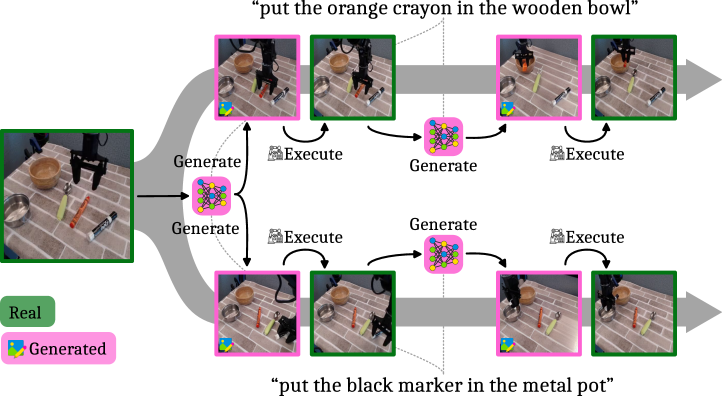
- SuSIE方法通过图像编辑扩散模型生成中间子目标,结合语言命令和当前观察,提升了机器人操作的灵活性。
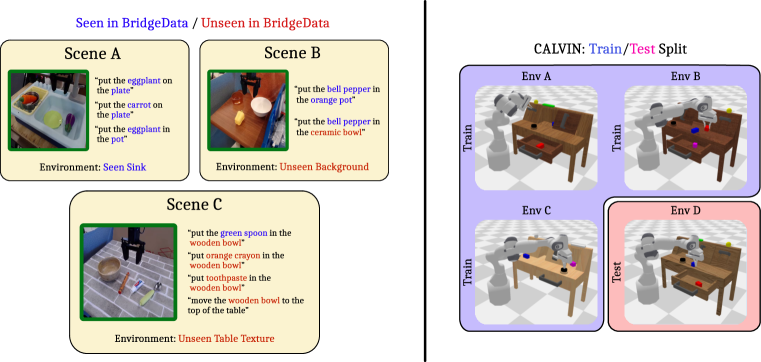
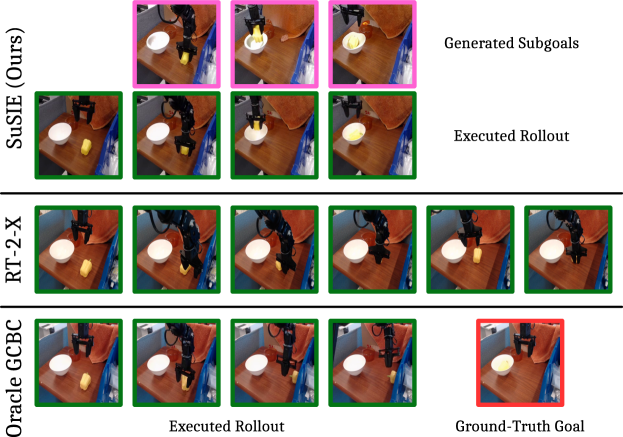
- 实验结果显示,SuSIE在CALVIN基准测试中表现优异,且在真实操作任务中泛化能力强,超越了多个基线模型。
📝 摘要(中文)
为了使通用机器人能够在真正的非结构化环境中操作,它们需要识别和推理新颖的物体和场景。这些物体和场景可能不在机器人的训练数据中。我们提出了SuSIE方法,利用图像编辑扩散模型作为高层规划器,提出低层控制器可以完成的中间子目标。具体来说,我们对InstructPix2Pix进行了微调,使其能够根据机器人的当前观察和语言命令输出假设的未来“子目标”观察。同时,我们使用机器人数据训练了一个低层目标条件策略,作为上述低层控制器。实验结果表明,高层子目标预测能够利用互联网规模的预训练和视觉理解来指导低层目标条件策略,显著优于传统的语言条件策略。我们在CALVIN基准测试中取得了最先进的结果,并在真实世界的操作任务中展示了强大的泛化能力,超越了强基线。
🔬 方法详解
问题定义:本论文旨在解决通用机器人在未见物体和场景中的操作能力不足的问题。现有方法通常依赖于大量的训练数据和特定场景,难以适应复杂的现实环境。
核心思路:论文提出的SuSIE方法利用图像编辑扩散模型生成中间子目标,从而为低层控制器提供明确的操作指引。这种设计使得机器人能够在没有直接训练数据的情况下,推理出新的操作步骤。
技术框架:SuSIE的整体架构包括两个主要模块:高层规划器和低层控制器。高层规划器通过微调的InstructPix2Pix模型生成子目标,而低层控制器则是一个目标条件策略,负责执行这些子目标。
关键创新:SuSIE的核心创新在于将图像编辑扩散模型应用于机器人操作规划中,利用其强大的视觉理解能力来生成操作指引。这一方法与传统的语言条件策略相比,显著提升了机器人在未见场景中的操作能力。
关键设计:在技术细节上,SuSIE对InstructPix2Pix进行了针对视频数据的微调,使用了人类视频和机器人回放数据。同时,低层控制器的训练采用了目标条件策略,确保其能够有效执行高层规划器生成的子目标。
🖼️ 关键图片
📊 实验亮点
在实验中,SuSIE在CALVIN基准测试中取得了最先进的结果,且在真实操作任务中表现出强大的泛化能力,超越了多个强基线模型,显示出显著的性能提升。
🎯 应用场景
该研究的潜在应用领域包括服务机器人、工业自动化和家庭助理等。通过提升机器人对新环境的适应能力,SuSIE可以在多种复杂场景中实现更高效的操作,具有重要的实际价值和广泛的未来影响。
📄 摘要(原文)
If generalist robots are to operate in truly unstructured environments, they need to be able to recognize and reason about novel objects and scenarios. Such objects and scenarios might not be present in the robot's own training data. We propose SuSIE, a method that leverages an image-editing diffusion model to act as a high-level planner by proposing intermediate subgoals that a low-level controller can accomplish. Specifically, we finetune InstructPix2Pix on video data, consisting of both human videos and robot rollouts, such that it outputs hypothetical future "subgoal" observations given the robot's current observation and a language command. We also use the robot data to train a low-level goal-conditioned policy to act as the aforementioned low-level controller. We find that the high-level subgoal predictions can utilize Internet-scale pretraining and visual understanding to guide the low-level goal-conditioned policy, achieving significantly better generalization and precision than conventional language-conditioned policies. We achieve state-of-the-art results on the CALVIN benchmark, and also demonstrate robust generalization on real-world manipulation tasks, beating strong baselines that have access to privileged information or that utilize orders of magnitude more compute and training data. The project website can be found at http://rail-berkeley.github.io/susie .