AMSwarmX: Safe Swarm Coordination in CompleX Environments via Implicit Non-Convex Decomposition of the Obstacle-Free Space
作者: Vivek K. Adajania, Siqi Zhou, Arun Kumar Singh, Angela P. Schoellig
分类: cs.RO
发布日期: 2023-10-13
备注: Submitted to ICRA 2024
💡 一句话要点
提出AMSwarX以解决复杂环境中的四旋翼群体协调问题
🎯 匹配领域: 支柱一:机器人控制 (Robot Control)
关键词: 四旋翼 群体协调 运动规划 碰撞避免 复杂环境 非凸分解 Octomap 交替最小化
📋 核心要点
- 现有的安全飞行走廊方法在处理四旋翼群体时过于保守,限制了自由空间的利用。
- 本文提出了一种交替最小化的方法,统一处理静态和动态碰撞约束,避免了保守的自由空间近似。
- 实验表明,该方法在成功率、任务完成时间和计算效率上均显著优于传统SFC方法。
📝 摘要(中文)
在复杂环境中,四旋翼的运动规划利用安全飞行走廊(SFC)来避免静态障碍物。然而,针对四旋翼群体,传统的SFC方法过于保守,限制了可用的自由空间。本文提出了一种基于交替最小化的方法,无需构建保守的自由空间近似,统一处理静态和动态碰撞约束。通过与Octomap的距离查询结合,提供了隐式非凸自由空间分解。实验结果显示,与基于SFC的方法相比,成功率提高了60%,任务完成时间平均减少了1.8倍,每个代理的计算时间平均减少了23倍。
🔬 方法详解
问题定义:本文旨在解决四旋翼群体在复杂环境中运动规划时的碰撞避免问题。现有的安全飞行走廊方法由于过于保守,导致可用自由空间不足,影响了群体协调能力。
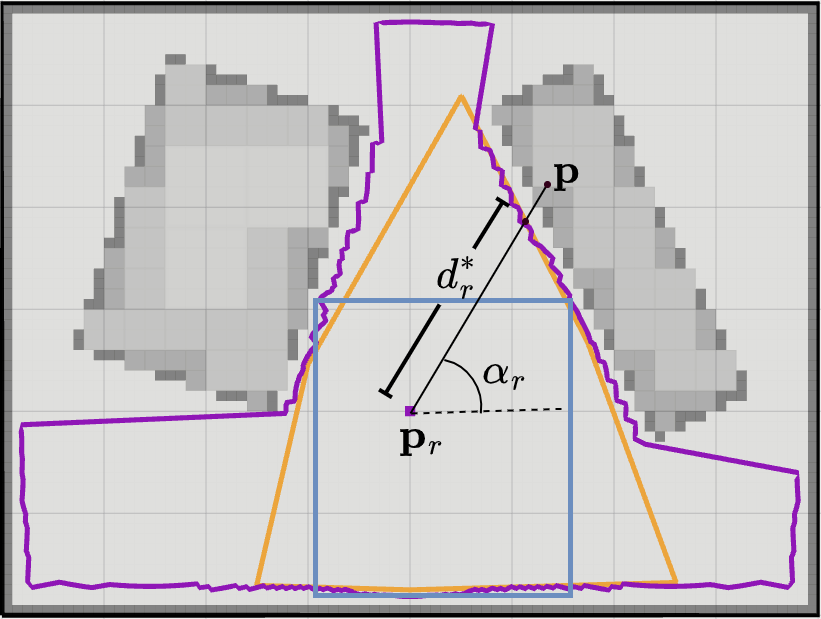
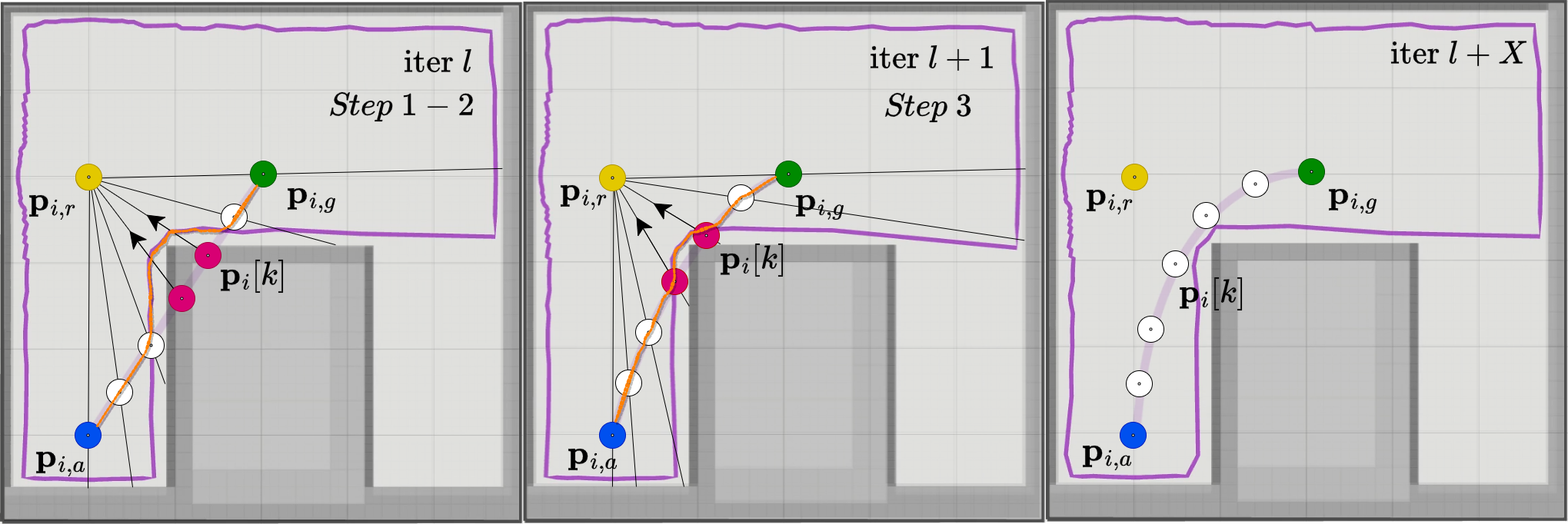
核心思路:提出的交替最小化方法通过统一处理静态和动态碰撞约束,避免了构建保守自由空间的需要。动态碰撞通过共享位置轨迹处理,静态障碍物避免则结合Octomap进行距离查询。
技术框架:整体方法包括两个主要模块:首先,利用Octomap进行环境建模并提取障碍物信息;其次,通过交替最小化算法优化四旋翼的运动轨迹,确保在动态环境中安全飞行。
关键创新:本研究的创新点在于引入隐式非凸自由空间分解,显著提高了四旋翼群体在复杂环境中的协调能力,与传统的SFC方法相比,提供了更灵活的碰撞避免策略。
关键设计:在算法设计中,采用了基于共享轨迹的动态碰撞处理机制,并通过Octomap进行障碍物距离查询,确保了算法的实时性和有效性。
🖼️ 关键图片
📊 实验亮点
实验结果显示,提出的方法在成功率上提高了60%,任务完成时间平均减少了1.8倍,每个代理的计算时间平均减少了23倍,验证了其在复杂环境中的有效性和优越性。
🎯 应用场景
该研究的潜在应用领域包括无人机编队、搜索与救援、环境监测等场景,能够在复杂和动态的环境中实现高效的四旋翼群体协调。未来,该方法可扩展至其他类型的多机器人系统,提升其在复杂环境中的自主导航能力。
📄 摘要(原文)
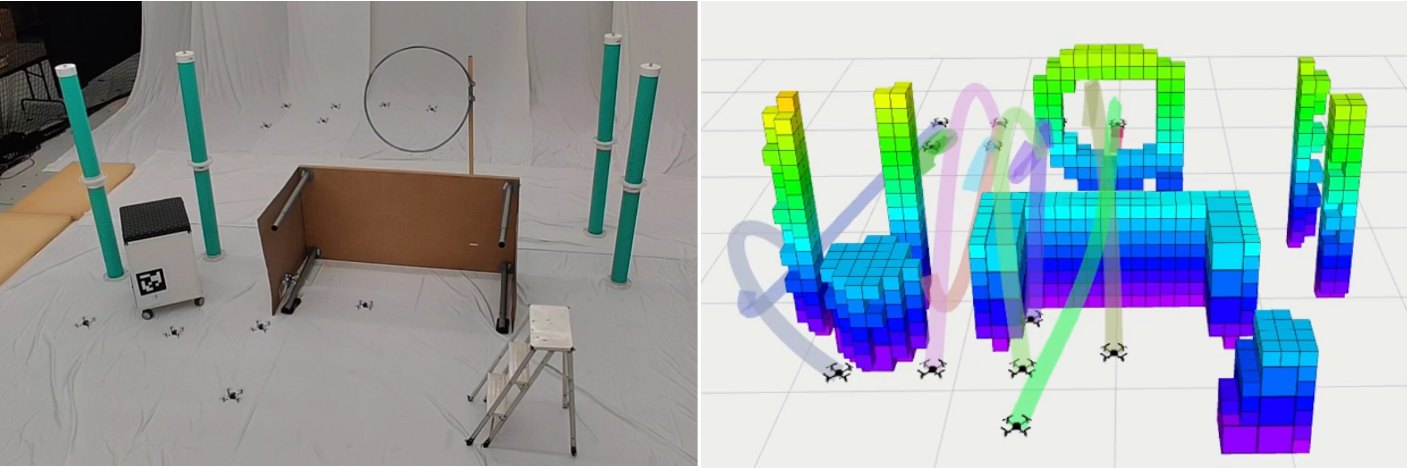
Quadrotor motion planning in complex environments leverage the concept of safe flight corridor (SFC) to facilitate static obstacle avoidance. Typically, SFCs are constructed through convex decomposition of the environment's free space into cuboids, convex polyhedra, or spheres. However, when dealing with a quadrotor swarm, such SFCs can be overly conservative, substantially limiting the available free space for quadrotors to coordinate. This paper presents an Alternating Minimization-based approach that does not require building a conservative free-space approximation. Instead, both static and dynamic collision constraints are treated in a unified manner. Dynamic collisions are handled based on shared position trajectories of the quadrotors. Static obstacle avoidance is coupled with distance queries from the Octomap, providing an implicit non-convex decomposition of free space. As a result, our approach is scalable to arbitrary complex environments. Through extensive comparisons in simulation, we demonstrate a $60\%$ improvement in success rate, an average $1.8\times$ reduction in mission completion time, and an average $23\times$ reduction in per-agent computation time compared to SFC-based approaches. We also experimentally validated our approach using a Crazyflie quadrotor swarm of up to 12 quadrotors in obstacle-rich environments. The code, supplementary materials, and videos are released for reference.