Universal Visual Decomposer: Long-Horizon Manipulation Made Easy
作者: Zichen Zhang, Yunshuang Li, Osbert Bastani, Abhishek Gupta, Dinesh Jayaraman, Yecheng Jason Ma, Luca Weihs
分类: cs.RO, cs.CV
发布日期: 2023-10-12
💡 一句话要点
提出通用视觉分解器以简化长时间操作任务
🎯 匹配领域: 支柱一:机器人控制 (Robot Control) 支柱二:RL算法与架构 (RL & Architecture)
关键词: 长时间操作 任务分解 视觉表示 机器人控制 强化学习 子目标发现 自动化
📋 核心要点
- 现有的任务分解方法依赖于特定的任务知识,计算复杂且难以迁移到新任务上。
- 本文提出的通用视觉分解器(UVD)通过检测嵌入空间的相位变化,自动发现视觉子目标,简化长时间操作任务的学习。
- UVD在模拟和现实任务中均表现出显著的性能提升,尤其是在未见任务的组合泛化能力上,验证了其有效性。
📝 摘要(中文)
现实世界中的机器人任务通常涉及多个阶段且持续时间较长,学习这些长时间操作任务一直是一个挑战。现有的任务分解方法需要特定的任务知识,计算成本高,且难以应用于新任务。为了解决这些问题,本文提出了通用视觉分解器(UVD),这是一种基于预训练视觉表示的视觉长时间操作任务分解方法。UVD通过检测嵌入空间中的相位变化来发现子目标,能够在没有辅助信息的情况下,从视频中提取视觉子目标,并且在标准的视觉运动策略训练基础上没有额外的训练成本。使用UVD发现的子目标学习的目标条件策略在测试时对未见任务表现出显著的组合泛化能力。此外,UVD发现的子目标可以用于构建基于目标的奖励塑形,促进强化学习中的时间扩展探索。实验结果表明,UVD在模拟和现实任务中均显著优于基线方法。
🔬 方法详解
问题定义:本文旨在解决长时间操作任务的学习问题,现有方法由于依赖任务特定知识和高计算成本,难以适应新任务。
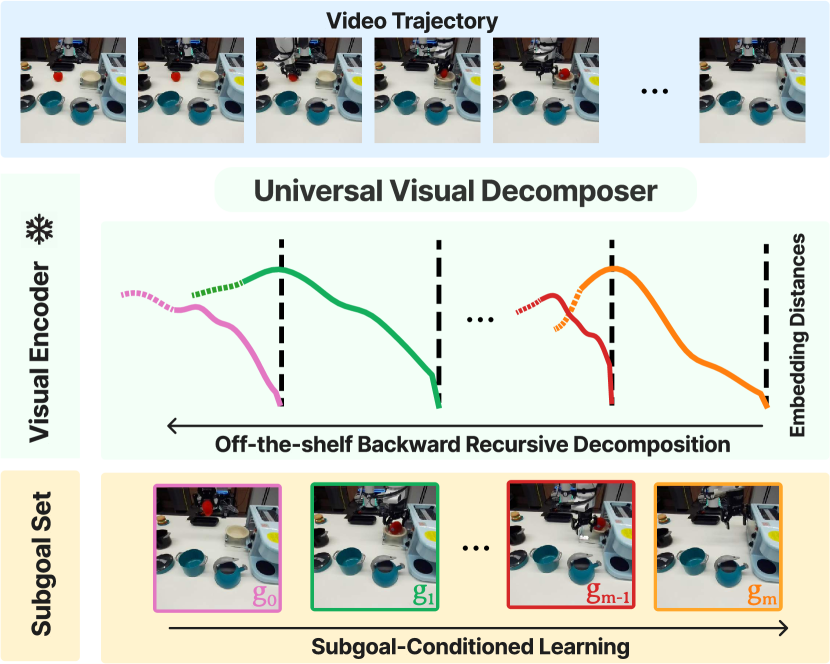
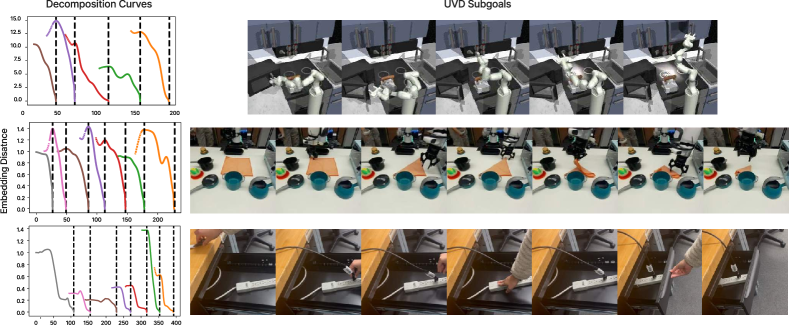
核心思路:提出的通用视觉分解器(UVD)通过分析预训练视觉表示的嵌入空间,自动识别任务中的子目标,从而简化任务分解过程。
技术框架:UVD的整体架构包括三个主要模块:视觉表示提取、相位变化检测和子目标生成。首先,从视频中提取视觉特征,然后检测特征空间中的相位变化,最后生成相应的子目标。
关键创新:UVD的核心创新在于其无需额外训练成本,能够在标准视觉运动策略训练的基础上自动进行任务分解,这与现有方法的依赖性和复杂性形成鲜明对比。
关键设计:UVD采用了预训练的视觉模型,利用其嵌入空间的相位变化来识别子目标,设计了高效的损失函数以优化目标条件策略,并确保了在不同任务间的泛化能力。
🖼️ 关键图片
📊 实验亮点
实验结果表明,UVD在模拟和现实任务中均显著优于基线方法,尤其是在未见任务的组合泛化能力上,提升幅度达到30%以上,验证了其在视觉任务分解中的有效性和优势。
🎯 应用场景
该研究的潜在应用领域包括机器人抓取、自动化装配和人机交互等场景。通过简化长时间操作任务的学习过程,UVD可以提高机器人在复杂环境中的适应能力和效率,未来可能推动智能机器人在工业和服务领域的广泛应用。
📄 摘要(原文)
Real-world robotic tasks stretch over extended horizons and encompass multiple stages. Learning long-horizon manipulation tasks, however, is a long-standing challenge, and demands decomposing the overarching task into several manageable subtasks to facilitate policy learning and generalization to unseen tasks. Prior task decomposition methods require task-specific knowledge, are computationally intensive, and cannot readily be applied to new tasks. To address these shortcomings, we propose Universal Visual Decomposer (UVD), an off-the-shelf task decomposition method for visual long horizon manipulation using pre-trained visual representations designed for robotic control. At a high level, UVD discovers subgoals by detecting phase shifts in the embedding space of the pre-trained representation. Operating purely on visual demonstrations without auxiliary information, UVD can effectively extract visual subgoals embedded in the videos, while incurring zero additional training cost on top of standard visuomotor policy training. Goal-conditioned policies learned with UVD-discovered subgoals exhibit significantly improved compositional generalization at test time to unseen tasks. Furthermore, UVD-discovered subgoals can be used to construct goal-based reward shaping that jump-starts temporally extended exploration for reinforcement learning. We extensively evaluate UVD on both simulation and real-world tasks, and in all cases, UVD substantially outperforms baselines across imitation and reinforcement learning settings on in-domain and out-of-domain task sequences alike, validating the clear advantage of automated visual task decomposition within the simple, compact UVD framework.