Model Predictive Inferential Control of Neural State-Space Models for Autonomous Vehicle Motion Planning
作者: Iman Askari, Ali Vaziri, Xuemin Tu, Shen Zeng, Huazhen Fang
分类: cs.RO, eess.SY
发布日期: 2023-10-12 (更新: 2025-11-17)
💡 一句话要点
提出模型预测推断控制以解决自主车辆运动规划问题
🎯 匹配领域: 支柱一:机器人控制 (Robot Control)
关键词: 模型预测控制 神经状态空间 自主驾驶 贝叶斯估计 粒子滤波 运动规划 计算效率
📋 核心要点
- 现有的基于梯度的MPC方法在处理复杂的神经状态空间模型时,面临计算负担重和优化困难的问题。
- 本文提出的MPIC方法通过将MPC问题转化为贝叶斯状态估计问题,旨在高效推断最佳控制决策。
- 仿真结果显示,MPIC方法在计算效率上显著优于传统的基于梯度的MPC方法,能够有效应对大规模问题。
📝 摘要(中文)
模型预测控制(MPC)在自主车辆的安全和最优运动规划中具有重要作用。本文研究了如何在神经状态空间模型下实现基于MPC的运动规划。由于神经状态空间模型导致高度复杂的非线性和非凸优化问题,传统的基于梯度的MPC方法在计算负载上面临挑战。为此,本文提出了模型预测推断控制(MPIC)的方法,旨在从控制目标和约束中推断最佳控制决策。我们将运动规划的MPC问题转化为贝叶斯状态估计问题,并开发了一种新的隐式粒子滤波/平滑方法来执行估计。通过仿真研究,我们评估了MPIC方法在不同场景下的表现,并与基于梯度的MPC进行了全面比较,结果表明MPIC在复杂神经网络架构下具有显著的计算效率,能够解决大规模的MPC问题。
🔬 方法详解
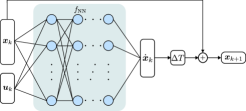
问题定义:本文旨在解决在神经状态空间模型下进行自主车辆运动规划时,传统基于梯度的MPC方法在计算效率和优化能力上的不足。
核心思路:提出模型预测推断控制(MPIC),通过将MPC问题转化为贝叶斯状态估计问题,从而推断最佳控制决策,减少计算负担。
技术框架:MPIC方法包括两个主要模块:首先是将运动规划问题转化为状态估计问题,其次是利用隐式粒子滤波/平滑方法进行状态估计,具体实现为无迹卡尔曼滤波器/平滑器的银行。
关键创新:MPIC的核心创新在于将复杂的MPC问题简化为贝叶斯估计问题,显著提高了计算效率和估计精度,与传统方法相比具有本质区别。
关键设计:在设计中,采用了无迹卡尔曼滤波器的结构,优化了采样效率和计算速度,确保在复杂神经网络架构下仍能保持高效的估计准确性。
🖼️ 关键图片
📊 实验亮点
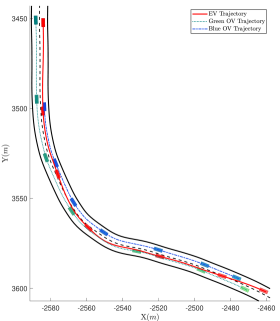
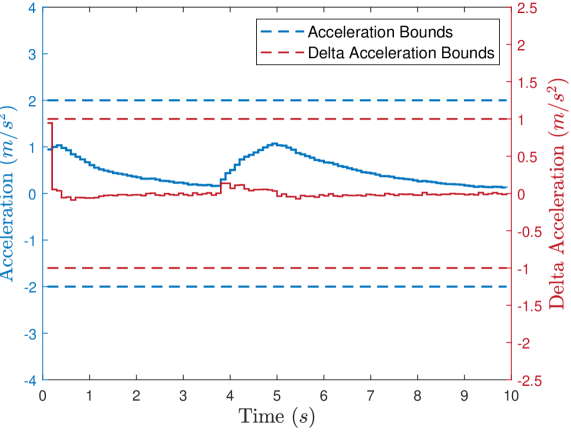
实验结果表明,MPIC方法在复杂神经网络架构下的计算效率显著提升,相较于传统基于梯度的MPC方法,能够有效解决大规模MPC问题,展示了在不同场景下的优越性能。
🎯 应用场景
该研究的潜在应用领域包括自主驾驶、智能交通系统和机器人导航等。通过提高运动规划的效率和准确性,MPIC方法能够在复杂环境中实现更安全和更高效的自主车辆操作,具有重要的实际价值和未来影响。
📄 摘要(原文)
Model predictive control (MPC) has proven useful in enabling safe and optimal motion planning for autonomous vehicles. In this paper, we investigate how to achieve MPC-based motion planning when a neural state-space model represents the vehicle dynamics. As the neural state-space model will lead to highly complex, nonlinear and nonconvex optimization landscapes, mainstream gradient-based MPC methods will struggle to provide viable solutions due to heavy computational load. In a departure, we propose the idea of model predictive inferential control (MPIC), which seeks to infer the best control decisions from the control objectives and constraints. Following this idea, we convert the MPC problem for motion planning into a Bayesian state estimation problem. Then, we develop a new implicit particle filtering/smoothing approach to perform the estimation. This approach is implemented as banks of unscented Kalman filters/smoothers and offers high sampling efficiency, fast computation, and estimation accuracy. We evaluate the MPIC approach through a simulation study of autonomous driving in different scenarios, along with an exhaustive comparison with gradient-based MPC. The simulation results show that the MPIC approach has considerable computational efficiency despite complex neural network architectures and the capability to solve large-scale MPC problems for neural state-space models.