${\tt MORALS}$: Analysis of High-Dimensional Robot Controllers via Topological Tools in a Latent Space
作者: Ewerton R. Vieira, Aravind Sivaramakrishnan, Sumanth Tangirala, Edgar Granados, Konstantin Mischaikow, Kostas E. Bekris
分类: cs.RO
发布日期: 2023-10-05 (更新: 2024-03-16)
备注: The first two authors contributed equally to this paper
期刊: 2024 IEEE International Conference on Robotics and Automation (ICRA), Yokohama, Japan, 2024, pp. 27-33
DOI: 10.1109/ICRA57147.2024.10610383
💡 一句话要点
提出MORALS以解决高维机器人控制器的吸引域估计问题
🎯 匹配领域: 支柱一:机器人控制 (Robot Control)
关键词: 高维控制 机器人控制 吸引域估计 自编码神经网络 Morse图 数据驱动控制 动态系统分析
📋 核心要点
- 现有方法在高维系统中面临挑战,通常需要封闭形式的表达,限制了数据驱动控制器的应用。
- 本文提出MORALS,通过将自编码神经网络与Morse图结合,实现对高维系统吸引域的高效估计。
- 在高维机器人数据集上的评估表明,MORALS在RoA估计上表现出数据效率,显著提升了预测能力。
📝 摘要(中文)
估计机器人控制器的吸引域(RoA)对于安全应用和控制器组合至关重要。现有方法通常需要封闭形式的表达,限制了数据驱动控制器的适用性。仅依赖轨迹展开的方法往往数据需求量大。本文提出MORALS,通过结合自编码神经网络与Morse图,提供了一种高效的RoA估计方法,特别适用于高维系统。MORALS在67维的人形机器人和96维的三指机械手上展示了良好的预测能力,能够有效地估计吸引子及其RoA。
🔬 方法详解
问题定义:本文旨在解决高维机器人控制器的吸引域(RoA)估计问题。现有方法通常依赖于封闭形式的表达,限制了其在数据驱动控制器中的应用,且基于轨迹展开的方法往往需要大量数据。
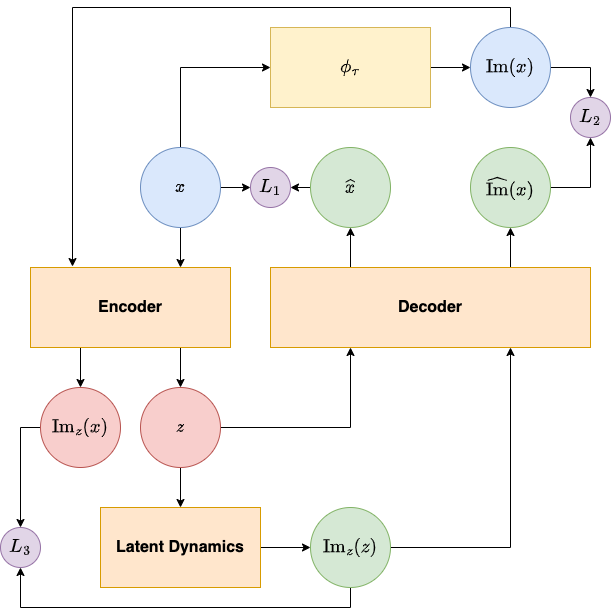
核心思路:MORALS的核心思路是将自编码神经网络与Morse图结合,首先将控制系统的动态投影到学习的潜在空间中,然后构建表示基础动态双稳态性的Morse图的简化形式。这样设计的目的是为了在不需要分析模型的情况下,实现高效的RoA估计。
技术框架:MORALS的整体架构包括两个主要模块:首先是自编码神经网络,用于学习潜在空间中的动态表示;其次是Morse图构建模块,负责生成和分析潜在空间中的动态特性。
关键创新:MORALS的主要创新在于结合了自编码网络和Morse图,克服了传统方法在高维系统中面临的挑战,实现了数据驱动控制器的RoA估计。与现有方法相比,MORALS在数据效率和预测能力上具有显著优势。
关键设计:在网络结构上,MORALS采用了深度自编码器来提取高维数据的潜在特征,损失函数设计为重构损失与Morse图的结构损失的结合,以确保学习到的潜在空间能够有效表示动态特性。
🖼️ 关键图片


📊 实验亮点
在67维人形机器人和96维三指机械手的实验中,MORALS展示了优越的RoA估计能力,显著提高了数据效率。与传统方法相比,MORALS在高维系统中的预测能力得到了有效提升,验证了其在复杂动态环境中的应用潜力。
🎯 应用场景
该研究的潜在应用领域包括机器人控制、自动驾驶、智能制造等高维动态系统的安全性分析与控制策略设计。通过提供高效的RoA估计,MORALS能够帮助工程师在设计控制器时更好地理解系统的动态特性,从而提高系统的安全性和可靠性。
📄 摘要(原文)
Estimating the region of attraction (${\tt RoA}$) for a robot controller is essential for safe application and controller composition. Many existing methods require a closed-form expression that limit applicability to data-driven controllers. Methods that operate only over trajectory rollouts tend to be data-hungry. In prior work, we have demonstrated that topological tools based on ${\it Morse Graphs}$ (directed acyclic graphs that combinatorially represent the underlying nonlinear dynamics) offer data-efficient ${\tt RoA}$ estimation without needing an analytical model. They struggle, however, with high-dimensional systems as they operate over a state-space discretization. This paper presents ${\it Mo}$rse Graph-aided discovery of ${\it R}$egions of ${\it A}$ttraction in a learned ${\it L}$atent ${\it S}$pace (${\tt MORALS}$). The approach combines auto-encoding neural networks with Morse Graphs. ${\tt MORALS}$ shows promising predictive capabilities in estimating attractors and their ${\tt RoA}$s for data-driven controllers operating over high-dimensional systems, including a 67-dim humanoid robot and a 96-dim 3-fingered manipulator. It first projects the dynamics of the controlled system into a learned latent space. Then, it constructs a reduced form of Morse Graphs representing the bistability of the underlying dynamics, i.e., detecting when the controller results in a desired versus an undesired behavior. The evaluation on high-dimensional robotic datasets indicates data efficiency in ${\tt RoA}$ estimation.