Graph-Theoretic Bézier Curve Optimization over Safe Corridors for Safe and Smooth Motion Planning
作者: Soufyan Zayou, Ömür Arslan
分类: cs.RO, cs.CG, eess.SY
发布日期: 2023-10-02
备注: 12 pages, 6 figures, 3 tables, extended version of a paper submitted for publication
💡 一句话要点
提出图论视角的贝塞尔曲线优化以实现安全平滑运动规划
🎯 匹配领域: 支柱一:机器人控制 (Robot Control) 支柱七:动作重定向 (Motion Retargeting) 支柱八:物理动画 (Physics-based Animation)
关键词: 贝塞尔曲线 运动规划 图论 优化目标 机器人系统 安全走廊 参数化表示
📋 核心要点
- 现有的贝塞尔曲线优化方法在定义优化目标时存在局限,难以全面考虑机器人运动的多样性和复杂性。
- 本文提出了一种基于图论的贝塞尔曲线优化方法,通过引入共识距离来统一不同的优化目标,增强了优化的灵活性。
- 实验结果表明,使用有限差分的范数和方差作为优化目标,相较于传统方法,能够实现更简单直观的交互图和优化效果。
📝 摘要(中文)
贝塞尔曲线作为一种参数化运动表示,在多种机器人系统的安全和平滑运动规划中具有重要应用。本文提出了一种统一的图论视角来定义和理解贝塞尔曲线优化目标,基于控制点的交互图拉普拉斯算子推导出共识距离。我们展示了标准物理优化目标如何定义贝塞尔控制点之间的共识距离,并引入几何和统计优化目标作为替代共识距离。通过在自动构建的安全走廊上进行贝塞尔曲线优化,我们提供了显式的二次优化公式,并得出有限差分的范数和方差在简化交互图和优化目标方面的优势。
🔬 方法详解
问题定义:本文旨在解决贝塞尔曲线优化中优化目标定义的不足,现有方法往往无法全面考虑机器人运动的复杂性和多样性。
核心思路:通过引入图论视角,利用控制点的交互图拉普拉斯算子推导共识距离,统一不同的优化目标,提升优化灵活性和效果。
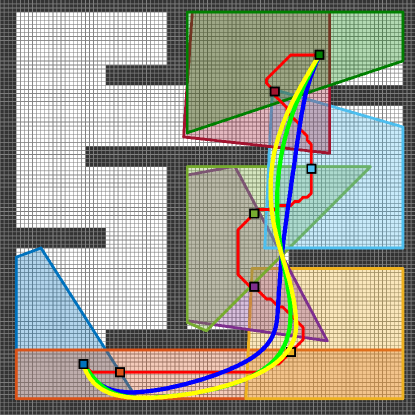
技术框架:整体框架包括:1) 自动构建安全走廊;2) 定义贝塞尔曲线的优化目标;3) 进行二次优化并分析结果。主要模块涵盖了几何和统计优化目标的构建。
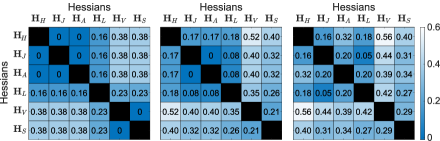
关键创新:最重要的创新在于引入了基于有限差分和方差的共识距离,简化了优化过程,且与传统的贝塞尔导数范数方法相比,提供了更直观的优化目标。
关键设计:在参数设置上,采用了基于交互图的拉普拉斯算子,损失函数设计为优化共识距离,网络结构则围绕贝塞尔矩阵操作展开,确保了优化过程的高效性与准确性。
🖼️ 关键图片
📊 实验亮点
实验结果显示,使用有限差分的范数和方差作为优化目标,相较于传统方法,能够实现更简单的交互图和优化目标,且在运动轨迹的平滑性和安全性上有显著提升,具体性能数据未提供。
🎯 应用场景
该研究的潜在应用领域包括无人机飞行、自动驾驶汽车以及机器人手臂的运动规划。通过优化贝塞尔曲线,可以在复杂环境中实现更安全、更平滑的运动路径,具有重要的实际价值和广泛的应用前景。
📄 摘要(原文)
As a parametric motion representation, Bézier curves have significant applications in polynomial trajectory optimization for safe and smooth motion planning of various robotic systems, including flying drones, autonomous vehicles, and robotic manipulators. An essential component of Bézier curve optimization is the optimization objective, as it significantly influences the resulting robot motion. Standard physical optimization objectives, such as minimizing total velocity, acceleration, jerk, and snap, are known to yield quadratic optimization of Bézier curve control points. In this paper, we present a unifying graph-theoretic perspective for defining and understanding Bézier curve optimization objectives using a consensus distance of Bézier control points derived based on their interaction graph Laplacian. In addition to demonstrating how standard physical optimization objectives define a consensus distance between Bézier control points, we also introduce geometric and statistical optimization objectives as alternative consensus distances, constructed using finite differencing and differential variance. To compare these optimization objectives, we apply Bézier curve optimization over convex polygonal safe corridors that are automatically constructed around a maximal-clearance minimal-length reference path. We provide an explicit analytical formulation for quadratic optimization of Bézier curves using Bézier matrix operations. We conclude that the norm and variance of the finite differences of Bézier control points lead to simpler and more intuitive interaction graphs and optimization objectives compared to Bézier derivative norms, despite having similar robot motion profiles.