Three-dimensional inversion of gravity data using implicit neural representations and scientific machine learning
作者: Pankaj K Mishra, Sanni Laaksonen, Jochen Kamm, Anand Singh
分类: cs.LG
发布日期: 2026-04-07
💡 一句话要点
提出隐式神经表示以解决三维重力数据反演问题
🎯 匹配领域: 支柱三:空间感知与语义 (Perception & Semantics)
关键词: 重力数据反演 隐式神经表示 科学机器学习 地质结构重建 多物理场反演
📋 核心要点
- 现有的重力数据反演方法往往依赖于预定义网格,难以处理复杂的地质结构,且容易出现过平滑现象。
- 本文提出了一种基于隐式神经表示的三维重力反演方法,通过物理驱动的损失函数直接训练网络,避免了传统方法的局限。
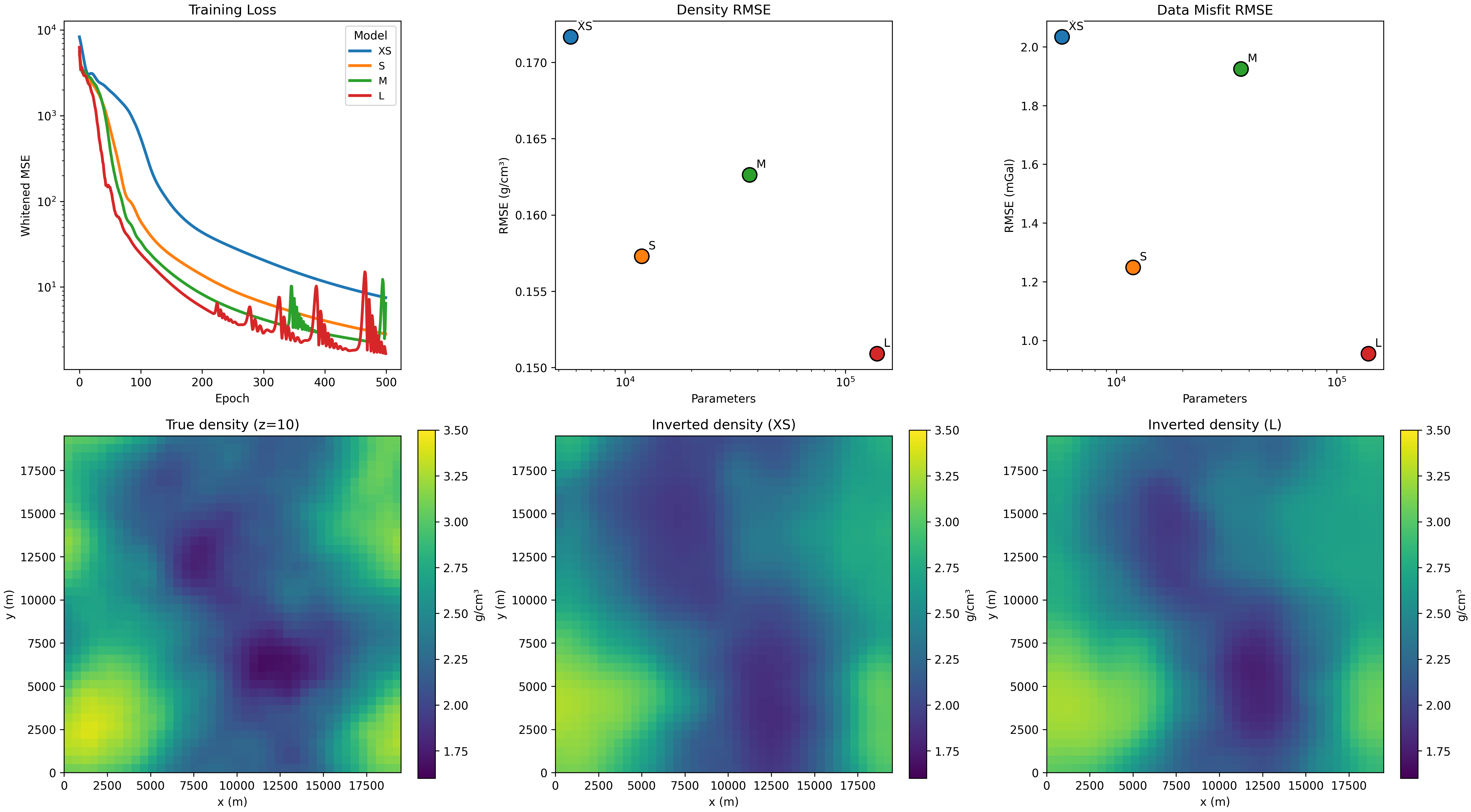
- 实验结果显示,该方法在不同深度的模型中成功重建了复杂结构,且在参数数量上具有更好的可扩展性。
📝 摘要(中文)
重力数据反演是研究地下密度变化的重要方法,涉及矿产勘探、地热评估、碳储存等领域。本文提出了一种科学机器学习方法,通过隐式神经表示(INR)将地下密度表示为连续场,直接通过基于物理的前向模型损失训练深度神经网络。该方法无需预定义网格或离散化,能够有效捕捉传统坐标网络难以处理的锐利对比和短波特征。实验结果表明,该框架在合成模型中重建了详细的地质结构和边界,展示了隐式表示在大规模地球物理反演中的潜力。
🔬 方法详解
问题定义:本文旨在解决传统重力数据反演方法在处理复杂地质结构时的不足,特别是预定义网格导致的过平滑现象。
核心思路:通过隐式神经表示(INR)将地下密度表示为连续场,利用物理驱动的损失函数直接训练深度神经网络,从而实现更高效的反演。
技术框架:整体架构包括数据输入、隐式神经网络、物理损失计算和反演输出四个主要模块。网络通过空间编码增强对短波特征的捕捉能力。
关键创新:该方法的核心创新在于使用隐式神经表示来表示密度场,避免了传统方法的网格依赖性,且无需显式正则化或深度加权。
关键设计:损失函数设计为基于物理的前向模型损失,网络结构采用深度神经网络,空间编码技术用于提高对地质结构的恢复能力。实验中,参数数量随着问题规模的增大而减少。
🖼️ 关键图片


📊 实验亮点
实验结果表明,隐式神经表示框架在合成模型中成功重建了复杂的地质结构,且在不同深度的模型中表现出优越的恢复能力。与传统方法相比,该方法在参数数量上显著减少,提升了反演效率。
🎯 应用场景
该研究具有广泛的应用潜力,尤其在矿产勘探、地热能评估、碳捕集与存储等领域。隐式神经表示的灵活性和可扩展性使其能够适应多种地球物理方法,未来可能推动多物理场联合反演的研究进展。
📄 摘要(原文)
Inversion of gravity data is an important method for investigating subsurface density variations relevant to mineral exploration, geothermal assessment, carbon storage, natural hydrogen, groundwater resources, and tectonic evolution. Here we present a scientific machine-learning approach for three-dimensional gravity inversion that represents subsurface density as a continuous field using an implicit neural representation (INR). The method trains a deep neural network directly through a physics-based forward-model loss, mapping spatial coordinates to a continuous density field without predefined meshes or discretisation. Spatial encoding enhances the network's capacity to capture sharp contrasts and short-wavelength features that conventional coordinate-based networks tend to oversmooth due to spectral bias. We demonstrate the approach on synthetic examples including smooth models, representing realistic geological complexity, and a dipping block model to assess recovery of structures at different depths. The INR framework reconstructs detailed structure and geologically plausible boundaries without explicit regularisation or depth weighting, while reducing the number of inversion parameters as the problem size grows bigger. These results highlight the potential of implicit representations to enable scalable, flexible, and interpretable large-scale geophysical inversion. This framework could generalise to other geophysical methods and for joint/multiphysics inversion.