Fully Convolutional Spatiotemporal Learning for Microstructure Evolution Prediction
作者: Michael Trimboli, Mohammed Alsubaie, Sirani M. Perera, Ke-Gang Wang, Xianqi Li
分类: cs.LG
发布日期: 2026-02-23
备注: 24 pages, 11 figures
💡 一句话要点
提出全卷积时空学习模型,加速材料微观结构演化预测。
🎯 匹配领域: 支柱八:物理动画 (Physics-based Animation)
关键词: 微观结构演化 全卷积网络 时空学习 深度学习 材料科学
📋 核心要点
- 传统相场模型模拟微观结构演化计算量大,限制了其应用。
- 提出全卷积时空模型,通过自监督学习模拟数据,高效预测微观结构演化。
- 实验表明,该模型在预测精度和计算效率上均优于循环神经网络,并具有良好的泛化能力。
📝 摘要(中文)
理解和预测微观结构演化是材料科学的基础,因为它决定了材料的最终性能。传统的模拟方法,如相场模型,虽然能提供高精度的结果,但由于需要在精细的时空分辨率下求解复杂的偏微分方程,因此计算成本很高。为了解决这个问题,我们提出了一种基于深度学习的框架,该框架可以在保持高精度的同时加速微观结构演化的预测。我们的方法利用全卷积时空模型,以自监督的方式,使用从微观结构过程(包括晶粒生长和旋节分解)模拟生成的连续图像进行训练。训练后的神经网络有效地学习了潜在的物理动力学,并能准确地捕捉演化微观结构的短期局部行为和长期统计特性,同时还能推广到未知的时空域以及配置和材料参数的变化。与循环神经网络架构相比,我们的模型在训练和推理中都以显著降低的计算成本实现了最先进的预测性能。这项工作为材料科学中的时空学习建立了一个强大的基线,并为快速可靠的微观结构模拟提供了一种可扩展的、数据驱动的替代方案。
🔬 方法详解
问题定义:论文旨在解决材料科学中微观结构演化预测的计算成本问题。传统的相场模型虽然精度高,但需要求解复杂的偏微分方程,计算量巨大,难以应用于大规模或长时间的模拟。
核心思路:论文的核心思路是利用深度学习,特别是全卷积神经网络,直接从模拟数据中学习微观结构演化的时空动态。通过训练神经网络来近似求解偏微分方程,从而避免了耗时的数值计算。
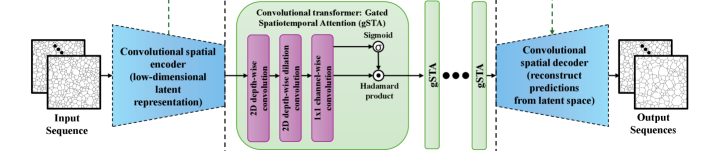
技术框架:整体框架是端到端的全卷积时空模型。输入是微观结构演化的连续图像序列,输出是预测的未来微观结构状态。模型主要包含卷积层、池化层和反卷积层,用于提取时空特征并进行预测。训练过程采用自监督学习,即利用模拟数据本身作为标签。
关键创新:最重要的创新点是使用全卷积网络进行时空学习,这与传统的循环神经网络方法不同。全卷积网络可以并行处理整个图像,避免了循环神经网络的序列依赖性,从而显著提高了计算效率。此外,自监督学习策略避免了对大量标注数据的需求。
关键设计:论文采用了一种多尺度卷积结构,以捕捉不同尺度的微观结构特征。损失函数包括均方误差和结构相似性指数(SSIM),以保证预测结果的精度和视觉质量。网络参数通过Adam优化器进行训练。
🖼️ 关键图片
📊 实验亮点

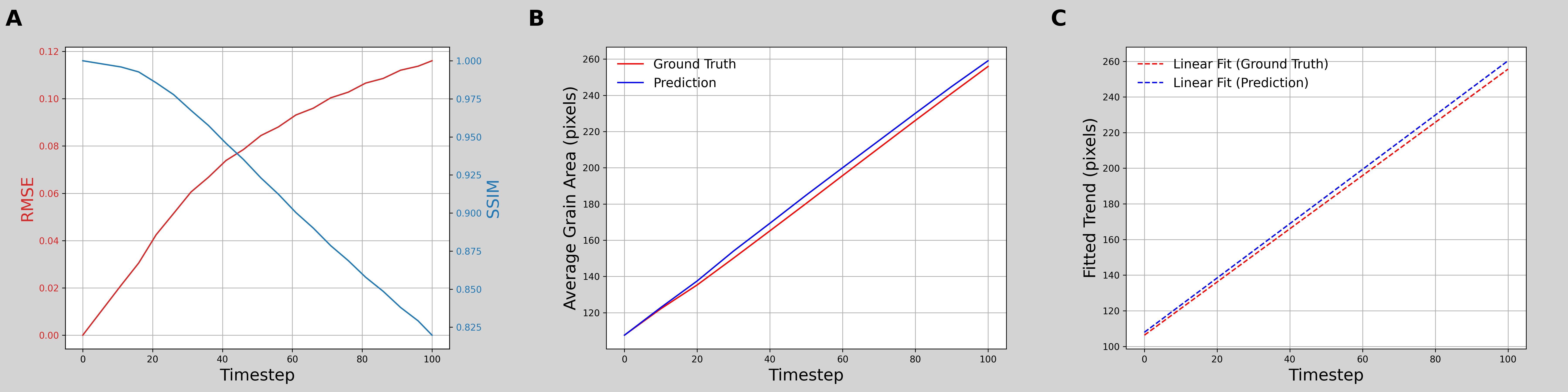
实验结果表明,该全卷积时空模型在微观结构演化预测任务中取得了state-of-the-art的性能,并且计算效率显著优于循环神经网络。具体而言,该模型在预测精度上与相场模型相当,但计算速度提升了几个数量级。此外,该模型还展现了良好的泛化能力,可以应用于不同的材料参数和配置。
🎯 应用场景
该研究成果可应用于材料设计、工艺优化和性能预测等领域。通过快速准确地预测微观结构演化,可以加速新材料的研发过程,优化现有材料的制备工艺,并预测材料在不同工况下的性能表现。该方法还可扩展到其他涉及时空演化的物理过程模拟。
📄 摘要(原文)
Understanding and predicting microstructure evolution is fundamental to materials science, as it governs the resulting properties and performance of materials. Traditional simulation methods, such as phase-field models, offer high-fidelity results but are computationally expensive due to the need to solve complex partial differential equations at fine spatiotemporal resolutions. To address this challenge, we propose a deep learning-based framework that accelerates microstructure evolution predictions while maintaining high accuracy. Our approach utilizes a fully convolutional spatiotemporal model trained in a self-supervised manner using sequential images generated from simulations of microstructural processes, including grain growth and spinodal decomposition. The trained neural network effectively learns the underlying physical dynamics and can accurately capture both short-term local behaviors and long-term statistical properties of evolving microstructures, while also demonstrating generalization to unseen spatiotemporal domains and variations in configuration and material parameters. Compared to recurrent neural architectures, our model achieves state-of-the-art predictive performance with significantly reduced computational cost in both training and inference. This work establishes a robust baseline for spatiotemporal learning in materials science and offers a scalable, data-driven alternative for fast and reliable microstructure simulations.