LightGTS-Cov: Covariate-Enhanced Time Series Forecasting
作者: Yong Shang, Zhipeng Yao, Ning Jin, Xiangfei Qiu, Hui Zhang, Bin Yang
分类: cs.LG
发布日期: 2026-02-11
💡 一句话要点
提出LightGTS-Cov以解决时间序列预测中的协变量问题
🎯 匹配领域: 支柱九:具身大模型 (Embodied Foundation Models)
关键词: 时间序列预测 协变量整合 电价预测 可再生能源 深度学习模型
📋 核心要点
- 现有时间序列模型在处理外生协变量时存在不足,通常忽略或简单拼接,导致预测效果不佳。
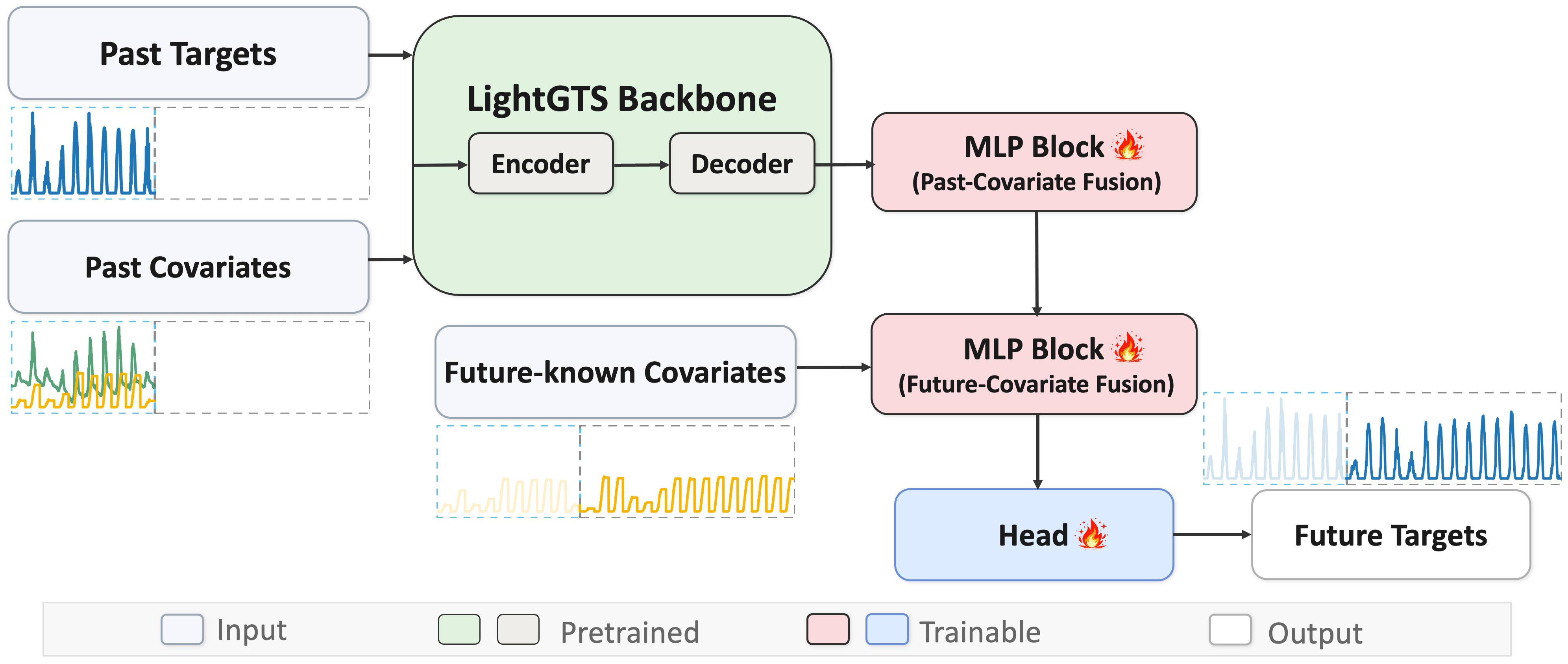
- LightGTS-Cov通过在LightGTS基础上增加一个小型多层感知器,显式整合时间对齐的协变量,提升预测性能。
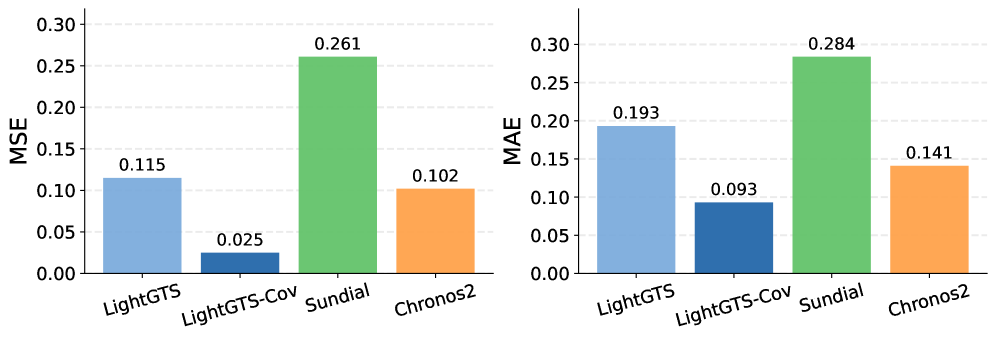
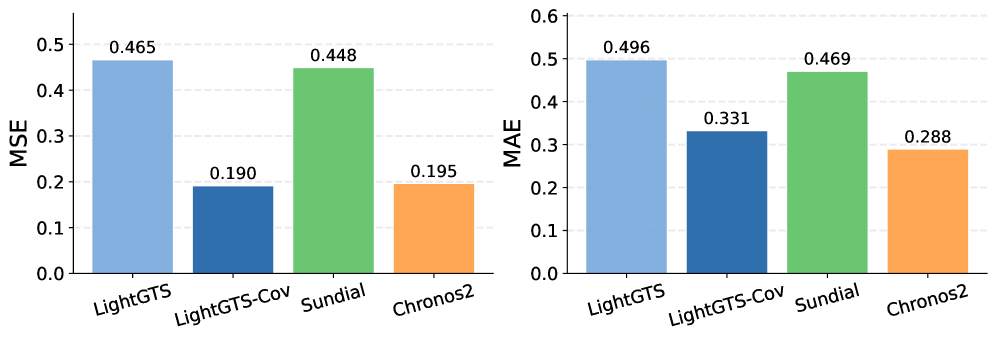
- 在电价和能源生成数据集上,LightGTS-Cov在协变量感知基准测试中表现优异,验证了其在实际应用中的有效性。
📝 摘要(中文)
时间序列基础模型通常在大型多源数据集上进行预训练,但往往忽视外生协变量或仅通过简单拼接目标序列来整合,这限制了其在电价预测和可再生能源预测等协变量丰富应用中的有效性。本文提出LightGTS-Cov,这是LightGTS的协变量增强扩展,保留了其轻量级、周期感知的骨干结构,同时显式地结合了已知的过去和未来协变量。LightGTS-Cov在电价和能源生成数据集的协变量感知基准测试中,始终优于LightGTS,并在提供未来已知协变量的情况下超越其他基线。我们还展示了其在两个实际能源案例中的应用价值,验证了其在工业环境中的有效性。
🔬 方法详解
问题定义:本文旨在解决现有时间序列预测模型在处理外生协变量时的不足,尤其是在电价和可再生能源预测中,现有方法往往忽视或简单拼接协变量,导致预测效果受限。
核心思路:LightGTS-Cov的核心思路是通过在LightGTS的基础上增加一个小型多层感知器(MLP),以残差方式整合时间对齐的协变量,从而提升预测的准确性和鲁棒性。
技术框架:LightGTS-Cov的整体架构包括一个轻量级的LightGTS骨干网络和一个用于协变量整合的MLP模块。该框架能够处理过去和未来已知的协变量,并在解码过程中对输出进行细化。
关键创新:LightGTS-Cov的主要创新在于其轻量级设计和对协变量的显式整合,区别于传统方法的简单拼接方式,使得模型在协变量丰富的场景下表现更佳。
关键设计:模型参数设置约为100万,MLP插件参数约为10万,采用残差连接来整合协变量,确保模型在保持轻量级的同时,能够有效提升预测性能。
🖼️ 关键图片
📊 实验亮点
在电价和能源生成数据集的实验中,LightGTS-Cov consistently outperform LightGTS,且在提供未来已知协变量的情况下,相较于其他基线模型表现出更优的预测性能,验证了其在实际工业环境中的有效性和稳定性。
🎯 应用场景
LightGTS-Cov在电力行业的应用潜力巨大,特别是在长期光伏发电预测和日内电价预测中,通过结合未来天气预报和调度计划等协变量,能够显著提高预测准确性,帮助决策者优化资源配置和管理。
📄 摘要(原文)
Time series foundation models are typically pre-trained on large, multi-source datasets; however, they often ignore exogenous covariates or incorporate them via simple concatenation with the target series, which limits their effectiveness in covariate-rich applications such as electricity price forecasting and renewable energy forecasting. We introduce LightGTS-Cov, a covariate-enhanced extension of LightGTS that preserves its lightweight, period-aware backbone while explicitly incorporating both past and future-known covariates. Built on a $\sim$1M-parameter LightGTS backbone, LightGTS-Cov adds only a $\sim$0.1M-parameter MLP plug-in that integrates time-aligned covariates into the target forecasts by residually refining the outputs of the decoding process. Across covariate-aware benchmarks on electricity price and energy generation datasets, LightGTS-Cov consistently outperforms LightGTS and achieves superior performance over other covariate-aware baselines under both settings, regardless of whether future-known covariates are provided. We further demonstrate its practical value in two real-world energy case applications: long-term photovoltaic power forecasting with future weather forecasts and day-ahead electricity price forecasting with weather and dispatch-plan covariates. Across both applications, LightGTS-Cov achieves strong forecasting accuracy and stable operational performance after deployment, validating its effectiveness in real-world industrial settings.