Securing Time in Energy IoT: A Clock-Dynamics-Aware Spatio-Temporal Graph Attention Network for Clock Drift Attacks and Y2K38 Failures
作者: Saeid Jamshidi, Omar Abdul Wahab, Rolando Herrero, Foutse Khomh
分类: cs.LG, cs.AI
发布日期: 2026-01-30
💡 一句话要点
提出STGAT时空图注意力网络,解决能源物联网中的时钟漂移攻击和Y2K38问题。
🎯 匹配领域: 支柱一:机器人控制 (Robot Control) 支柱九:具身大模型 (Embodied Foundation Models)
关键词: 时空图注意力网络 能源物联网 时钟漂移攻击 Y2K38问题 异常检测
📋 核心要点
- 现有异常检测模型假设时间戳可靠,无法捕捉能源物联网中时钟漂移、同步篡改等时间不一致性问题。
- STGAT通过漂移感知的时序嵌入和图注意力机制,同时建模设备内的时间扭曲和设备间的空间一致性。
- 实验表明,STGAT在能源物联网遥测数据上实现了95.7%的准确率,显著优于现有方法,并将检测延迟降低了26%。
📝 摘要(中文)
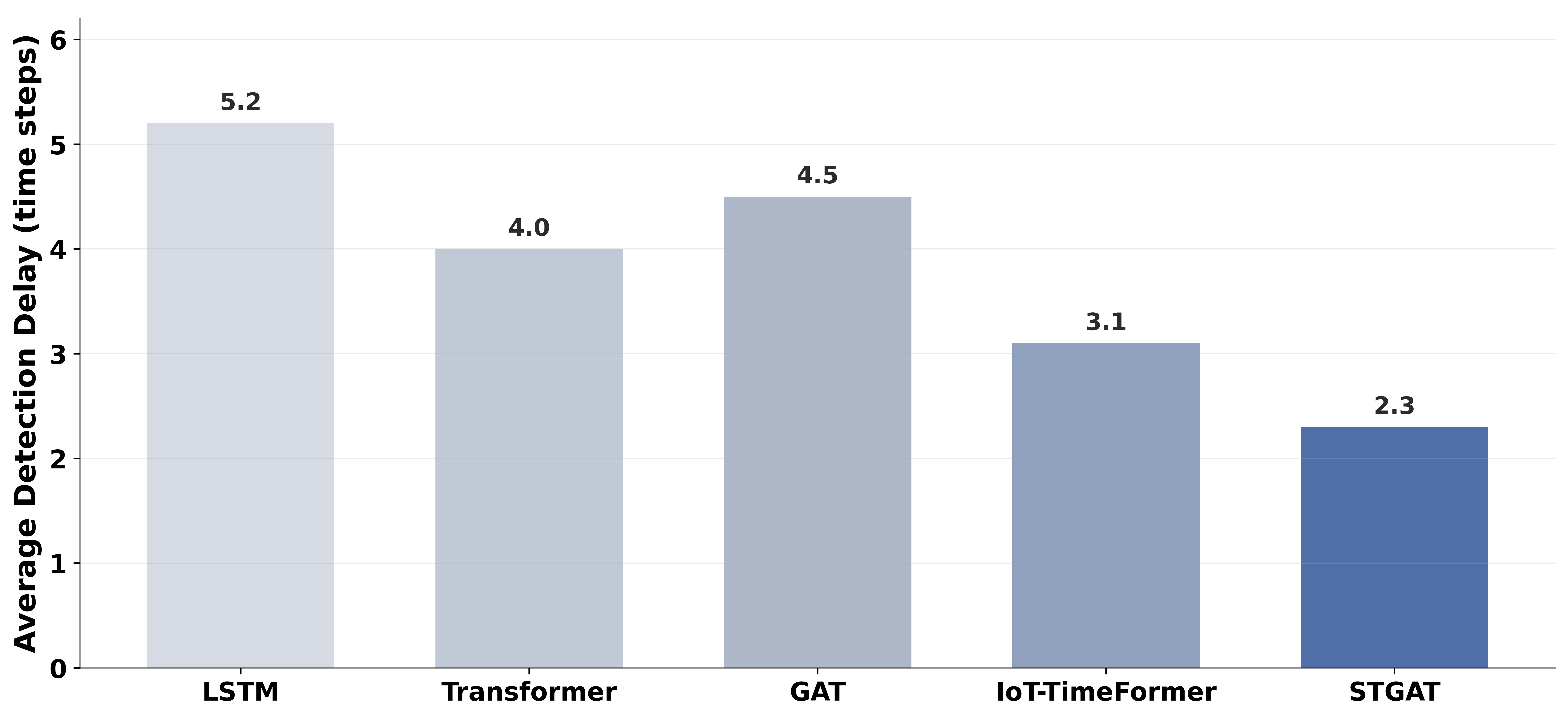
本文提出了一种名为STGAT(时空图注意力网络)的框架,用于解决能源物联网系统中时间完整性问题。该框架旨在应对时钟漂移、时间同步篡改以及时间戳不连续性(如Y2K38 Unix溢出)等问题,这些问题会扰乱时间顺序。STGAT结合了漂移感知的时序嵌入和时序自注意力,以捕获单个设备上被破坏的时间演变,并使用图注意力来建模时间错误的 spatial 传播。曲率正则化的潜在表示在几何上将正常的时钟演变与由漂移、同步偏移和溢出事件引起的异常区分开来。在受控时间扰动的能源物联网遥测数据上的实验结果表明,STGAT实现了95.7%的准确率,优于循环神经网络、Transformer和基于图的基线模型(d > 1.8, p < 0.001)。此外,STGAT将检测延迟降低了26%,实现了2.3个时间步的延迟,同时在溢出、漂移和物理不一致的情况下保持了稳定的性能。
🔬 方法详解
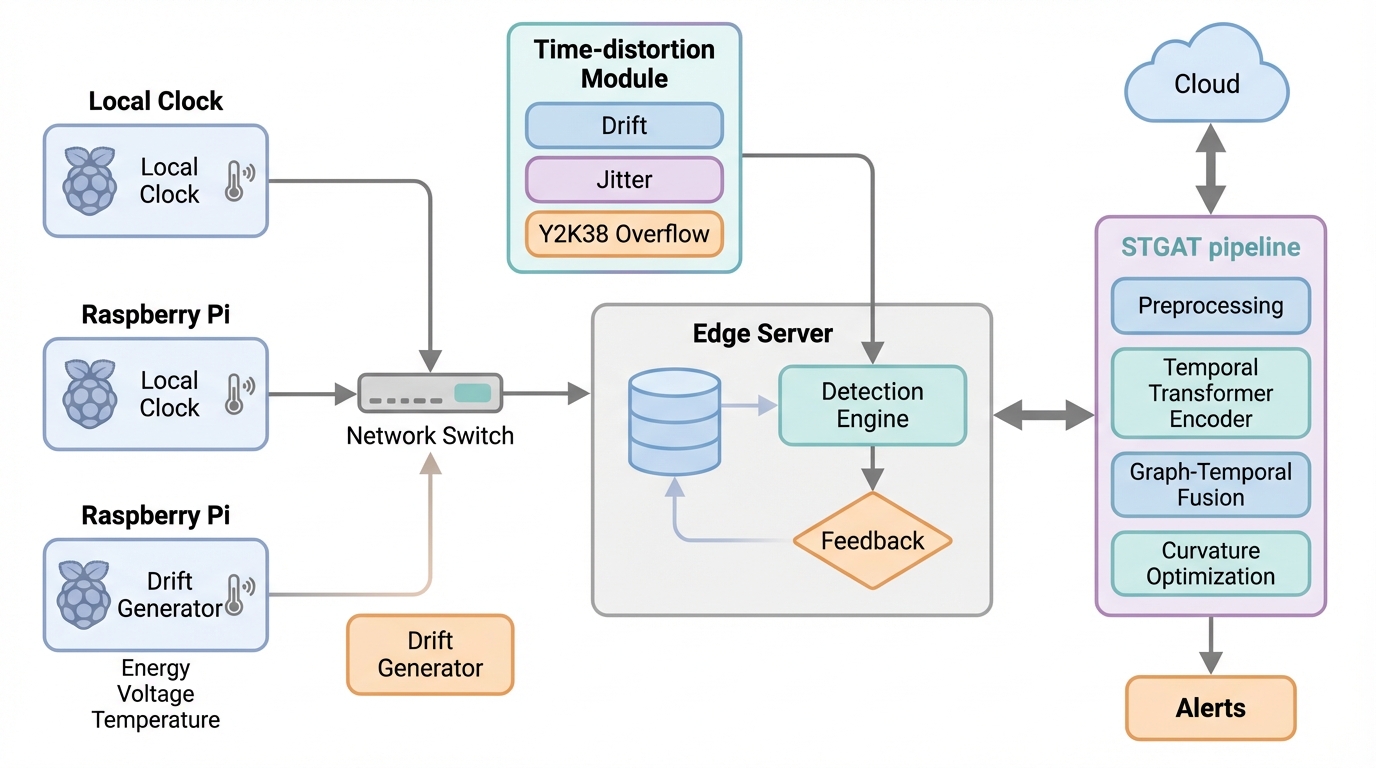
问题定义:论文旨在解决能源物联网(Energy IoT)中由于时钟漂移、时间同步攻击以及Y2K38溢出等问题导致的时间完整性受损问题。现有异常检测方法通常假设时间戳是可靠的,因此无法有效地检测和定位这些时间相关的异常。
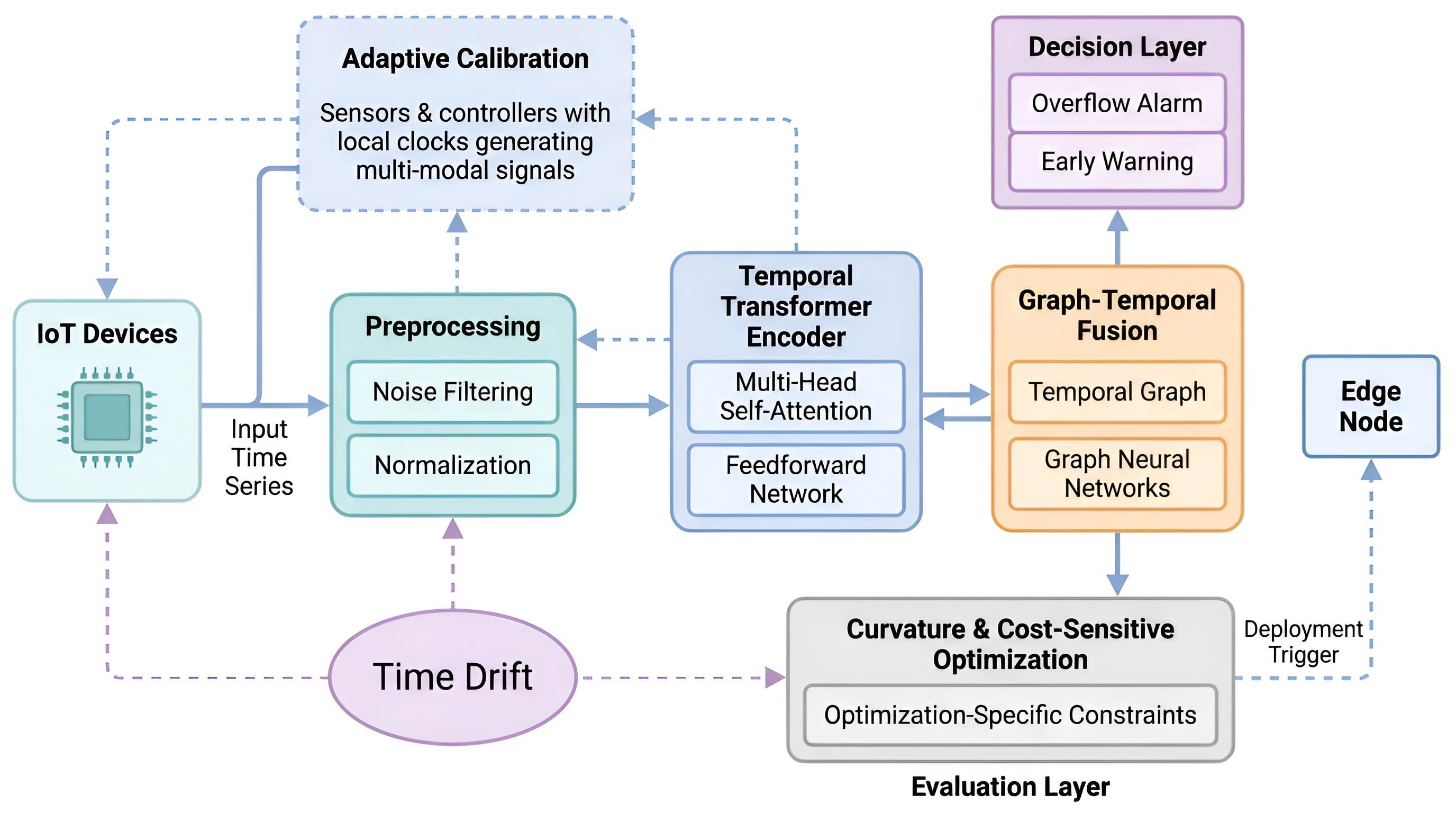
核心思路:论文的核心思路是利用时空图注意力网络(STGAT)同时建模设备内部的时间演变和设备之间的空间关系。通过学习设备的时钟漂移模式和设备间的依赖关系,STGAT能够更准确地识别和定位时间异常。
技术框架:STGAT框架主要包含以下几个模块:1) 漂移感知的时序嵌入:用于捕获单个设备上被破坏的时间演变;2) 时序自注意力:进一步提取时间序列中的关键信息;3) 图注意力网络:用于建模时间错误在设备间的空间传播;4) 曲率正则化的潜在表示:用于区分正常时钟演变和异常。
关键创新:STGAT的关键创新在于其同时考虑了时间维度和空间维度上的信息。传统的异常检测方法通常只关注单个设备的时间序列数据,而忽略了设备之间的关联。STGAT通过图注意力网络将设备之间的关系纳入考虑,从而能够更准确地检测和定位时间异常。
关键设计:在漂移感知的时序嵌入中,论文可能使用了循环神经网络(RNN)或Transformer等模型来学习时钟漂移模式。图注意力网络的设计可能采用了多头注意力机制,以便从不同的角度学习设备之间的关系。曲率正则化可能通过添加额外的损失函数来实现,以鼓励潜在表示具有更好的几何特性。
🖼️ 关键图片
📊 实验亮点
实验结果表明,STGAT在能源物联网遥测数据上实现了95.7%的准确率,显著优于循环神经网络、Transformer和基于图的基线模型(d > 1.8, p < 0.001)。此外,STGAT还将检测延迟降低了26%,实现了2.3个时间步的延迟,同时在溢出、漂移和物理不一致的情况下保持了稳定的性能。
🎯 应用场景
该研究成果可应用于智能电网、微电网等能源网络的安全监控,能够有效防御针对时间同步协议的攻击,保障能源基础设施的可靠运行。此外,该方法还可扩展到其他对时间敏感的分布式物联网系统,如工业控制系统、交通运输系统等。
📄 摘要(原文)
The integrity of time in distributed Internet of Things (IoT) devices is crucial for reliable operation in energy cyber-physical systems, such as smart grids and microgrids. However, IoT systems are vulnerable to clock drift, time-synchronization manipulation, and timestamp discontinuities, such as the Year 2038 (Y2K38) Unix overflow, all of which disrupt temporal ordering. Conventional anomaly-detection models, which assume reliable timestamps, fail to capture temporal inconsistencies. This paper introduces STGAT (Spatio-Temporal Graph Attention Network), a framework that models both temporal distortion and inter-device consistency in energy IoT systems. STGAT combines drift-aware temporal embeddings and temporal self-attention to capture corrupted time evolution at individual devices, and uses graph attention to model spatial propagation of timing errors. A curvature-regularized latent representation geometrically separates normal clock evolution from anomalies caused by drift, synchronization offsets, and overflow events. Experimental results on energy IoT telemetry with controlled timing perturbations show that STGAT achieves 95.7% accuracy, outperforming recurrent, transformer, and graph-based baselines with significant improvements (d > 1.8, p < 0.001). Additionally, STGAT reduces detection delay by 26%, achieving a 2.3-time-step delay while maintaining stable performance under overflow, drift, and physical inconsistencies.