GenDA: Generative Data Assimilation on Complex Urban Areas via Classifier-Free Diffusion Guidance
作者: Francisco Giral, Álvaro Manzano, Ignacio Gómez, Ricardo Vinuesa, Soledad Le Clainche
分类: cs.LG, cs.AI, cs.CE
发布日期: 2026-01-16
💡 一句话要点
提出GenDA框架以解决城市风流重建问题
🎯 匹配领域: 支柱四:生成式动作 (Generative Motion) 支柱六:视频提取与匹配 (Video Extraction)
关键词: 城市风流重建 生成数据同化 图基扩散 计算流体动力学 环境监测 机器学习 风场重建
📋 核心要点
- 城市风流重建面临传感器数据稀疏的问题,现有方法难以准确重建高分辨率风场。
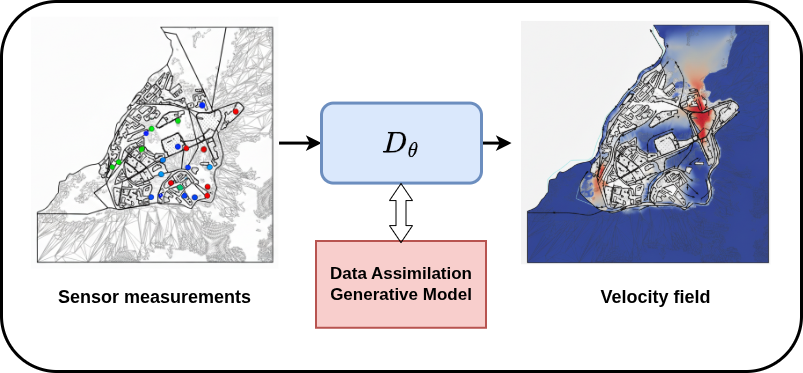
- GenDA框架通过多尺度图基扩散架构,结合无分类器引导,实现了从有限观测数据中重建风场的能力。
- 实验结果表明,GenDA在RANS模拟的城市环境中,相较于传统方法显著降低了RRMSE和提高了SSIM。
📝 摘要(中文)
城市风流重建对于评估空气质量、热量扩散和行人舒适度至关重要,但在传感器数据稀疏的情况下仍然具有挑战性。我们提出了GenDA,一个生成数据同化框架,能够从有限的观测数据中重建高分辨率的风场。该模型采用多尺度图基扩散架构,经过计算流体动力学(CFD)模拟训练,并将无分类器引导视为一种学习后的重建机制。无条件分支学习几何感知的流动先验,而传感器条件分支在采样过程中注入观测约束。这种方法使得在未见几何体、风向和网格分辨率下的障碍感知重建和泛化成为可能。与监督图神经网络(GNN)基线和经典的降阶数据同化方法相比,GenDA在测试的网格上将相对均方根误差(RRMSE)降低了25-57%,并将结构相似性指数(SSIM)提高了23-33%。
🔬 方法详解
问题定义:本论文旨在解决城市环境中风流重建的具体问题,尤其是在传感器数据稀疏的情况下,现有方法难以提供高分辨率的风场重建,导致空气质量和热量扩散评估的准确性不足。
核心思路:论文提出的GenDA框架利用多尺度图基扩散架构,通过无分类器引导机制进行学习,能够在不需要重新训练的情况下,实现对未见几何体和风向的泛化重建。
技术框架:GenDA的整体架构包括两个主要分支:无条件分支用于学习几何感知的流动先验,传感器条件分支则在采样过程中注入观测约束。该框架支持稀疏固定传感器和基于轨迹的观测。
关键创新:GenDA的主要创新在于其无分类器引导的重建机制,使得模型能够在复杂城市环境中进行障碍感知的风流重建,这与传统方法依赖于大量标注数据的方式有本质区别。
关键设计:在模型设计中,采用了多尺度图基扩散网络结构,结合特定的损失函数以优化重建效果,同时确保模型在不同网格分辨率和风向下的泛化能力。具体的参数设置和网络结构细节在实验部分进行了详细描述。
🖼️ 关键图片
📊 实验亮点
实验结果显示,GenDA在与监督图神经网络(GNN)基线和传统降阶数据同化方法的比较中,RRMSE降低了25-57%,SSIM提高了23-33%。这些结果表明,GenDA在复杂城市环境中的风流重建能力显著优于现有方法。
🎯 应用场景
该研究的潜在应用领域包括城市空气质量监测、热量分布分析以及行人舒适度评估等。通过提供高分辨率的风场重建,GenDA能够为城市规划和环境监测提供重要的数据支持,未来可能在智能城市建设中发挥重要作用。
📄 摘要(原文)
Urban wind flow reconstruction is essential for assessing air quality, heat dispersion, and pedestrian comfort, yet remains challenging when only sparse sensor data are available. We propose GenDA, a generative data assimilation framework that reconstructs high-resolution wind fields on unstructured meshes from limited observations. The model employs a multiscale graph-based diffusion architecture trained on computational fluid dynamics (CFD) simulations and interprets classifier-free guidance as a learned posterior reconstruction mechanism: the unconditional branch learns a geometry-aware flow prior, while the sensor-conditioned branch injects observational constraints during sampling. This formulation enables obstacle-aware reconstruction and generalization across unseen geometries, wind directions, and mesh resolutions without retraining. We consider both sparse fixed sensors and trajectory-based observations using the same reconstruction procedure. When evaluated against supervised graph neural network (GNN) baselines and classical reduced-order data assimilation methods, GenDA reduces the relative root-mean-square error (RRMSE) by 25-57% and increases the structural similarity index (SSIM) by 23-33% across the tested meshes. Experiments are conducted on Reynolds-averaged Navier-Stokes (RANS) simulations of a real urban neighbourhood in Bristol, United Kingdom, at a characteristic Reynolds number of $\mathrm{Re}\approx2\times10^{7}$, featuring complex building geometry and irregular terrain. The proposed framework provides a scalable path toward generative, geometry-aware data assimilation for environmental monitoring in complex domains.