Integrated Sensing, Communication, and Computation for Over-the-Air Federated Edge Learning
作者: Dingzhu Wen, Sijing Xie, Xiaowen Cao, Yuanhao Cui, Jie Xu, Yuanming Shi, Shuguang Cui
分类: cs.IT, cs.LG
发布日期: 2025-08-21
备注: The paper has been accepted for publication in IEEE Transactions on Wireless Communications
💡 一句话要点
提出面向无线联邦边缘学习的集成感知、通信与计算框架,优化模型训练性能。
🎯 匹配领域: 支柱七:动作重定向 (Motion Retargeting) 支柱八:物理动画 (Physics-based Animation)
关键词: 联邦学习 边缘计算 无线感知 空中计算 资源分配
📋 核心要点
- 现有联邦学习方法通常忽略了边缘设备感知数据质量和无线传输引入的噪声,导致模型训练性能下降。
- 论文提出Air-FEEL框架,集成感知、通信和计算,通过AirComp实现高效的模型聚合,并优化资源分配。
- 实验结果表明,所提出的ISCC算法能够有效协调感知、通信和计算资源,显著提升联邦学习的性能。
📝 摘要(中文)
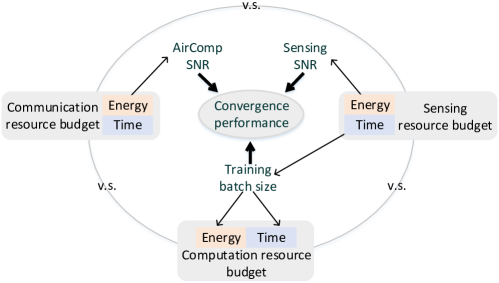
本文研究了一种集成感知、通信和计算(ISCC)的无线联邦边缘学习(Air-FEEL)系统。该系统中,边缘服务器协调多个边缘设备,无线感知目标对象,并利用感知数据协同训练用于识别任务的机器学习模型。系统采用空中计算(AirComp)实现边缘设备模型的一次性聚合。在此基础上,本文分析了ISCC赋能的Air-FEEL在损失函数退化方面的收敛行为,特别考虑了训练数据获取过程中的无线感知噪声和空中模型聚合过程中的AirComp失真。理论结果表明,感知、通信和计算竞争网络资源,共同决定收敛速度。基于此分析,本文设计了ISCC参数,目标是在保证每轮延迟和能量预算的前提下,最大化损失函数退化。挑战在于不同设备间感知、通信和计算的紧密耦合。为应对这一挑战,本文通过交替优化批大小控制和网络资源分配,推导出一种低复杂度的ISCC算法。研究发现,对于每个设备,如果获得更大的数据样本批次,则应消耗更少的感知功率,反之亦然。此外,在给定批大小的情况下,一个设备的最优计算速度是满足延迟约束的最小值。基于人体运动识别任务的数值结果验证了理论收敛分析,并表明所提出的ISCC算法能够很好地协调感知、通信和计算之间的批大小控制和资源分配,从而提高学习性能。
🔬 方法详解
问题定义:本文旨在解决无线联邦边缘学习(Air-FEEL)系统中,由于无线感知噪声和空中计算(AirComp)失真导致的模型训练性能下降问题。现有方法通常独立考虑感知、通信和计算,忽略了它们之间的相互影响,导致资源利用率不高,模型收敛速度慢。
核心思路:论文的核心思路是将感知、通信和计算集成到一个统一的框架中,通过联合优化感知功率、通信资源和计算速度,最大化损失函数退化,从而提高模型训练的收敛速度和精度。同时,考虑到AirComp的特性,利用其一次性聚合的优势,减少通信开销。
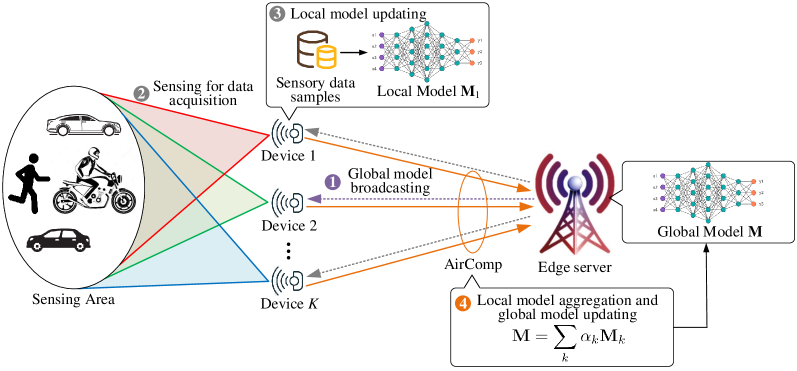
技术框架:Air-FEEL系统包含一个边缘服务器和多个边缘设备。边缘设备负责无线感知数据,并将本地模型通过AirComp发送到边缘服务器进行聚合。边缘服务器将聚合后的全局模型广播给边缘设备。整个流程包括以下阶段:1)边缘设备无线感知数据;2)边缘设备利用本地数据训练模型;3)边缘设备通过AirComp将模型发送到边缘服务器;4)边缘服务器聚合模型;5)边缘服务器将全局模型广播给边缘设备。
关键创新:论文的关键创新在于提出了一个集成的感知、通信和计算框架,并设计了一种低复杂度的ISCC算法,能够交替优化批大小控制和网络资源分配。该算法能够根据感知数据质量和通信信道状况,动态调整感知功率、通信资源和计算速度,从而实现资源的最优利用。
关键设计:论文的关键设计包括:1) 损失函数退化分析,考虑了无线感知噪声和AirComp失真;2) 基于延迟和能量预算的ISCC参数优化目标;3) 交替优化批大小控制和网络资源分配的低复杂度算法。具体而言,算法首先固定网络资源分配,优化批大小控制;然后固定批大小,优化网络资源分配。对于每个设备,算法根据数据样本批次大小调整感知功率,并根据延迟约束确定最优计算速度。
🖼️ 关键图片

📊 实验亮点
实验结果表明,所提出的ISCC算法能够有效协调感知、通信和计算资源,显著提升联邦学习的性能。具体而言,在人体运动识别任务中,与传统方法相比,所提出的算法能够提高模型精度,并降低训练时间。
🎯 应用场景
该研究成果可应用于智能交通、智慧城市、工业物联网等领域。例如,在智能交通中,可以通过车载传感器感知交通状况,利用联邦学习训练交通流量预测模型,从而优化交通调度。在工业物联网中,可以通过传感器感知设备状态,利用联邦学习训练故障诊断模型,从而实现设备维护。
📄 摘要(原文)
This paper studies an over-the-air federated edge learning (Air-FEEL) system with integrated sensing, communication, and computation (ISCC), in which one edge server coordinates multiple edge devices to wirelessly sense the objects and use the sensing data to collaboratively train a machine learning model for recognition tasks. In this system, over-the-air computation (AirComp) is employed to enable one-shot model aggregation from edge devices. Under this setup, we analyze the convergence behavior of the ISCC-enabled Air-FEEL in terms of the loss function degradation, by particularly taking into account the wireless sensing noise during the training data acquisition and the AirComp distortions during the over-the-air model aggregation. The result theoretically shows that sensing, communication, and computation compete for network resources to jointly decide the convergence rate. Based on the analysis, we design the ISCC parameters under the target of maximizing the loss function degradation while ensuring the latency and energy budgets in each round. The challenge lies on the tightly coupled processes of sensing, communication, and computation among different devices. To tackle the challenge, we derive a low-complexity ISCC algorithm by alternately optimizing the batch size control and the network resource allocation. It is found that for each device, less sensing power should be consumed if a larger batch of data samples is obtained and vice versa. Besides, with a given batch size, the optimal computation speed of one device is the minimum one that satisfies the latency constraint. Numerical results based on a human motion recognition task verify the theoretical convergence analysis and show that the proposed ISCC algorithm well coordinates the batch size control and resource allocation among sensing, communication, and computation to enhance the learning performance.