Social Processes: Probabilistic Meta-learning for Adaptive Multiparty Interaction Forecasting
作者: Augustinas Jučas, Chirag Raman
分类: cs.LG
发布日期: 2025-01-03
备注: This is an extension paper to "Social Processes: Self-Supervised Meta-Learning over Conversational Groups for Forecasting Nonverbal Social Cues", by Raman et al. (arXiv:2107.13576)
💡 一句话要点
提出基于概率元学习的Social Process模型,用于自适应多人交互预测。
🎯 匹配领域: 支柱九:具身大模型 (Embodied Foundation Models)
关键词: 社交互动预测 群体行为 元学习 多模态融合 概率模型
📋 核心要点
- 现有社交预测方法忽略了群体互动的重要性,难以捕捉群体内部的动态变化。
- 提出Social Process模型,采用元学习方法,使模型能够适应未见过的群体。
- 通过合成数据集验证了SP模型在群体互动预测方面的泛化能力。
📝 摘要(中文)
本文旨在解决群体(对话)层面的社交互动预测问题,这是实现通用人工智能的重要一步。现有社交预测研究主要集中在非聚焦互动或个体/两人行为预测,忽略了群体互动在理解复杂社会动态中的重要性。为此,本文提出Social Process (SP)模型,采用元学习方法,将每个群体视为独立的元学习任务,根据群体内的特定行为来预测所有成员未来多模态线索的分布,从而泛化到未见过的群体。通过逼真的合成数据集,分析了SP模型在输出和潜在空间中的泛化能力。
🔬 方法详解
问题定义:论文旨在解决群体层面的社交互动预测问题。现有方法主要关注个体或两人互动,忽略了群体互动中复杂的社会动态。此外,现有模型难以适应训练时未见过的群体,因为即使同一个人在不同群体中的行为也会有所不同。
核心思路:论文的核心思路是将每个群体视为一个独立的元学习任务。通过元学习,模型可以学习到不同群体的独特动态,并根据群体内的特定行为来预测未来的互动。这种方法使得模型能够泛化到未见过的群体。
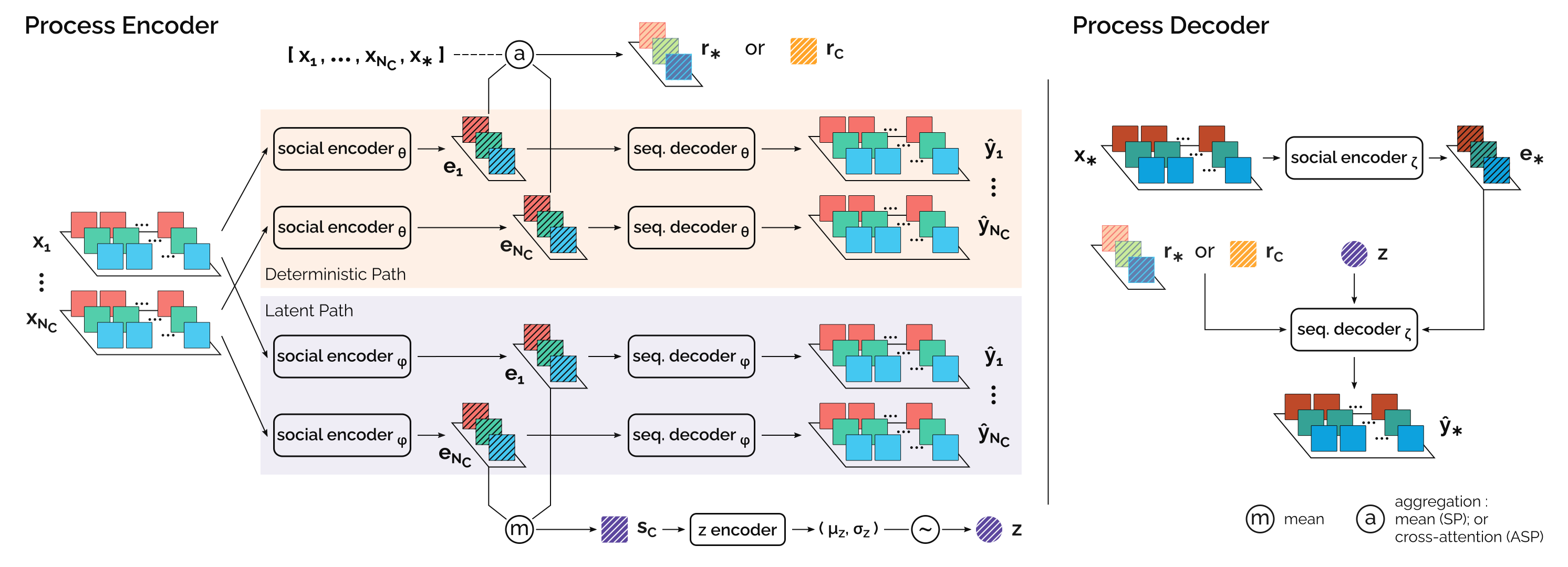
技术框架:Social Process (SP)模型基于群体成员先前的多模态线索,联合预测所有成员未来多模态线索的分布。模型同时考虑了同一群体过去互动序列的信息。整体框架包含编码器、元学习模块和解码器。编码器将多模态线索编码为潜在表示,元学习模块学习群体动态,解码器基于潜在表示和群体动态预测未来互动。
关键创新:关键创新在于将元学习应用于群体互动预测,使得模型能够自适应地学习不同群体的动态。通过将每个群体视为一个独立的元学习任务,模型能够更好地泛化到未见过的群体。
关键设计:模型使用概率模型来预测未来互动,输出的是一个分布而非单一预测值,从而更好地捕捉互动的不确定性。损失函数的设计考虑了多模态线索之间的相关性。具体的网络结构和参数设置在论文中未详细说明,属于未知信息。
🖼️ 关键图片


📊 实验亮点
论文通过合成数据集验证了SP模型的泛化能力。实验结果表明,SP模型能够有效地学习不同群体的动态,并在未见过的群体上取得良好的预测效果。具体的性能数据和提升幅度在摘要中未提及,属于未知信息。
🎯 应用场景
该研究可应用于社交机器人、虚拟助手、智能会议系统等领域。通过预测群体互动,机器人可以更好地理解人类行为,从而做出更自然、更有效的反应。例如,在智能会议系统中,可以预测参与者的发言顺序和内容,从而更好地组织会议流程。
📄 摘要(原文)
Adaptively forecasting human behavior in social settings is an important step toward achieving Artificial General Intelligence. Most existing research in social forecasting has focused either on unfocused interactions, such as pedestrian trajectory prediction, or on monadic and dyadic behavior forecasting. In contrast, social psychology emphasizes the importance of group interactions for understanding complex social dynamics. This creates a gap that we address in this paper: forecasting social interactions at the group (conversation) level. Additionally, it is important for a forecasting model to be able to adapt to groups unseen at train time, as even the same individual behaves differently across different groups. This highlights the need for a forecasting model to explicitly account for each group's unique dynamics. To achieve this, we adopt a meta-learning approach to human behavior forecasting, treating every group as a separate meta-learning task. As a result, our method conditions its predictions on the specific behaviors within the group, leading to generalization to unseen groups. Specifically, we introduce Social Process (SP) models, which predict a distribution over future multimodal cues jointly for all group members based on their preceding low-level multimodal cues, while incorporating other past sequences of the same group's interactions. In this work we also analyze the generalization capabilities of SP models in both their outputs and latent spaces through the use of realistic synthetic datasets.