BEFL: Balancing Energy Consumption in Federated Learning for Mobile Edge IoT
作者: Zehao Ju, Tongquan Wei, Fuke Shen
分类: cs.LG, cs.DC
发布日期: 2024-12-05
🔗 代码/项目: GITHUB
💡 一句话要点
提出BEFL框架以解决移动边缘物联网中的能耗不平衡问题
🎯 匹配领域: 支柱二:RL算法与架构 (RL & Architecture)
关键词: 联邦学习 移动边缘物联网 能耗管理 启发式算法 强化学习 模型优化 通信资源分配
📋 核心要点
- 现有方法主要集中于降低整体能耗,可能导致能耗不平衡,影响能量敏感设备的稳定性。
- 本文提出BEFL框架,通过合理分配通信资源和启发式客户端选择算法,平衡模型精度与能耗。
- 实验结果显示,BEFL在提高模型精度和降低能耗方面表现优异,显著优于现有方法。
📝 摘要(中文)
联邦学习(FL)是一种保护隐私的分布式学习范式,旨在构建高精度的全球模型。在移动边缘物联网(MEIoT)中,训练和通信过程会显著消耗设备的有限电池资源。现有研究主要关注减少整体能耗,但这可能导致能耗不平衡,导致能量敏感设备的过早掉线。为了解决这些挑战,本文提出了BEFL,一个联合优化框架,旨在平衡三个目标:提高全球模型精度、最小化总能耗以及减少设备间的能耗差异。我们采用顺序最小二乘规划(SLSQP)算法合理分配通信资源,并引入结合聚类分区和效用驱动的方法的启发式客户端选择算法,以缓解所有设备的总能耗及能耗差异。实验结果表明,与现有方法相比,BEFL提高了全球模型精度1.6%,减少了能耗方差72.7%,并降低了总能耗28.2%。
🔬 方法详解
问题定义:本文解决的是移动边缘物联网中联邦学习的能耗不平衡问题。现有方法往往只关注降低总能耗,导致能量敏感设备的过早掉线,影响整体学习效果。
核心思路:BEFL框架的核心思路是通过联合优化模型精度、总能耗和设备间能耗差异,来实现更高效的联邦学习。该框架结合了通信资源的合理分配和启发式客户端选择,以确保各设备的能耗均衡。
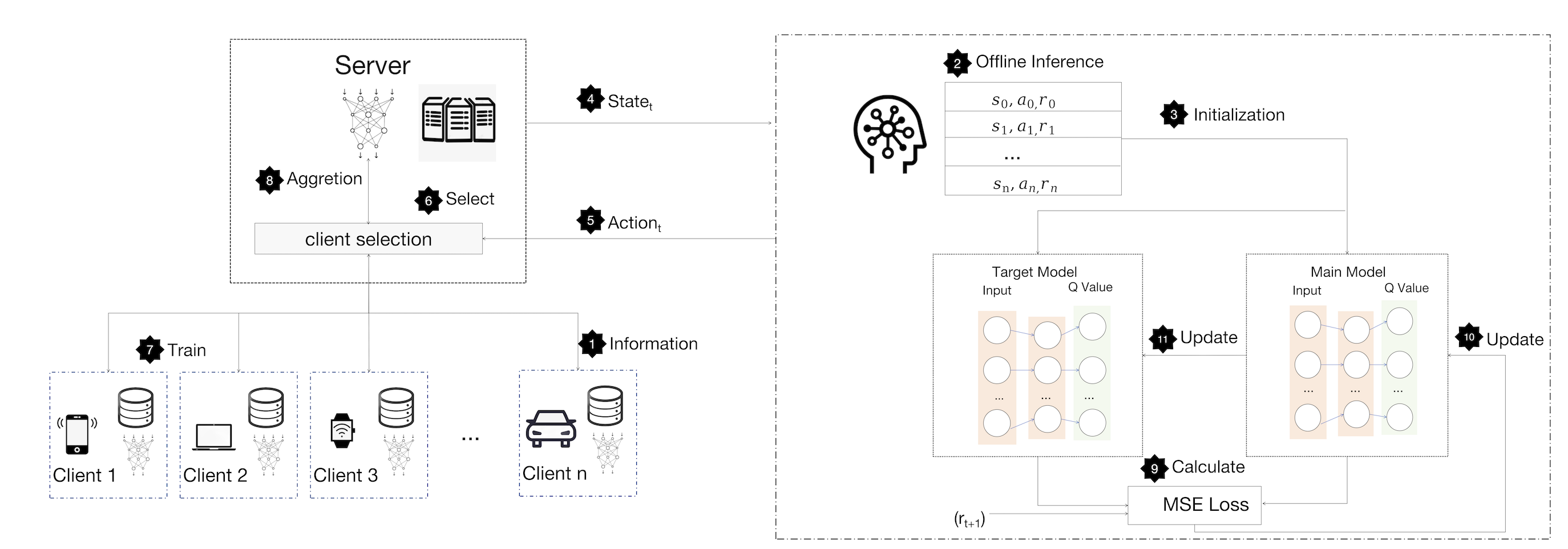
技术框架:BEFL的整体架构包括三个主要模块:1) 通信资源分配模块,采用顺序最小二乘规划(SLSQP)算法;2) 启发式客户端选择模块,结合聚类分区和效用驱动的方法;3) 在线强化学习模块,用于进一步提升训练效率。
关键创新:BEFL的创新在于其联合优化框架,能够同时考虑模型精度和能耗平衡,显著改善了现有方法的不足之处。与传统方法相比,BEFL在能耗管理上更具灵活性和有效性。
关键设计:在参数设置上,BEFL采用了动态的通信资源分配策略,并在客户端选择中引入了效用函数,以确保能耗的合理分配。此外,在线强化学习的引入进一步提升了训练效率,优化了学习过程。
🖼️ 关键图片

📊 实验亮点
实验结果表明,BEFL框架在全球模型精度上提高了1.6%,能耗方差减少了72.7%,总能耗降低了28.2%。这些结果显示出BEFL在提升模型性能和优化能耗方面的显著优势,远超现有方法。
🎯 应用场景
该研究的潜在应用领域包括智能家居、工业物联网和智能城市等场景,能够有效提升移动边缘设备在联邦学习中的能效和稳定性。通过优化能耗管理,BEFL框架有助于延长设备的使用寿命,降低维护成本,推动物联网技术的广泛应用。
📄 摘要(原文)
Federated Learning (FL) is a privacy-preserving distributed learning paradigm designed to build a highly accurate global model. In Mobile Edge IoT (MEIoT), the training and communication processes can significantly deplete the limited battery resources of devices. Existing research primarily focuses on reducing overall energy consumption, but this may inadvertently create energy consumption imbalances, leading to the premature dropout of energy-sensitive devices.To address these challenges, we propose BEFL, a joint optimization framework aimed at balancing three objectives: enhancing global model accuracy, minimizing total energy consumption, and reducing energy usage disparities among devices. First, taking into account the communication constraints of MEIoT and the heterogeneity of devices, we employed the Sequential Least Squares Programming (SLSQP) algorithm for the rational allocation of communication resources. Based on this, we introduce a heuristic client selection algorithm that combines cluster partitioning with utility-driven approaches to alleviate both the total energy consumption of all devices and the discrepancies in energy usage.Furthermore, we utilize the proposed heuristic client selection algorithm as a template for offline imitation learning during pre-training, while adopting a ranking-based reinforcement learning approach online to further boost training efficiency. Our experiments reveal that BEFL improves global model accuracy by 1.6\%, reduces energy consumption variance by 72.7\%, and lowers total energy consumption by 28.2\% compared to existing methods. The relevant code can be found at \href{URL}{https://github.com/juzehao/BEFL}.