CloudCast -- Total Cloud Cover Nowcasting with Machine Learning
作者: Mikko Partio, Leila Hieta, Anniina Kokkonen
分类: physics.ao-ph, cs.LG
发布日期: 2024-10-27 (更新: 2025-05-17)
备注: 27 pages, 12 figures
🔗 代码/项目: GITHUB
💡 一句话要点
CloudCast:一种基于U-Net的卷积神经网络,用于云量短期预测。
🎯 匹配领域: 支柱二:RL算法与架构 (RL & Architecture) 支柱三:空间感知与语义 (Perception & Semantics)
关键词: 云量预测 卷积神经网络 U-Net 卫星图像 临近预报
📋 核心要点
- 传统数值天气预报模型在预测总云量方面存在挑战,因为云的形成过程具有小尺度特性。
- CloudCast利用U-Net卷积神经网络,通过卫星数据训练,直接预测未来五个小时的总云量。
- 实验结果表明,CloudCast显著优于传统数值天气预报模型,平均绝对误差降低24%,多类别预测误差降低46%。
📝 摘要(中文)
云量在天气预测中起着关键作用,并影响农业、太阳能发电和航空等多个领域。尽管数值天气预报(NWP)模型取得了进展,但由于云形成过程的小尺度特性,预测总云量仍然具有挑战性。本研究介绍CloudCast,一种基于U-Net架构的卷积神经网络(CNN),旨在预测未来五个小时的总云量(TCC)。CloudCast在五年卫星数据上进行训练,显著优于传统的NWP模型和光流方法。与参考NWP模型相比,CloudCast的平均绝对误差降低了24%,多类别预测误差降低了46%。该模型表现出强大的性能,尤其是在捕捉前几个预测小时的云量大尺度结构方面,但后期的预测会出现模糊和低估云形成的情况。一项消融研究确定了最佳输入特征和损失函数,其中基于MAE的模型表现最佳。CloudCast已集成到芬兰气象研究所的业务临近预报系统中,提高了公共和私营部门客户使用的云量预报。虽然CloudCast受到大约三个小时的相对较短的有效预测时间的限制,但未来的工作旨在通过更复杂的网络架构和更高分辨率的数据来延长这一时间。CloudCast代码可在https://github.com/fmidev/cloudcast获得。
🔬 方法详解
问题定义:论文旨在解决总云量(Total Cloud Cover, TCC)的短期预测问题。现有数值天气预报(NWP)模型在预测总云量方面存在局限性,尤其是在捕捉小尺度云形成过程时表现不佳,导致预测精度不高。
核心思路:论文的核心思路是利用深度学习方法,特别是卷积神经网络(CNN),直接从卫星图像数据中学习云的演变模式,从而实现更准确的云量预测。这种方法避免了传统NWP模型中复杂的物理过程建模,而是通过数据驱动的方式来捕捉云的动态变化。
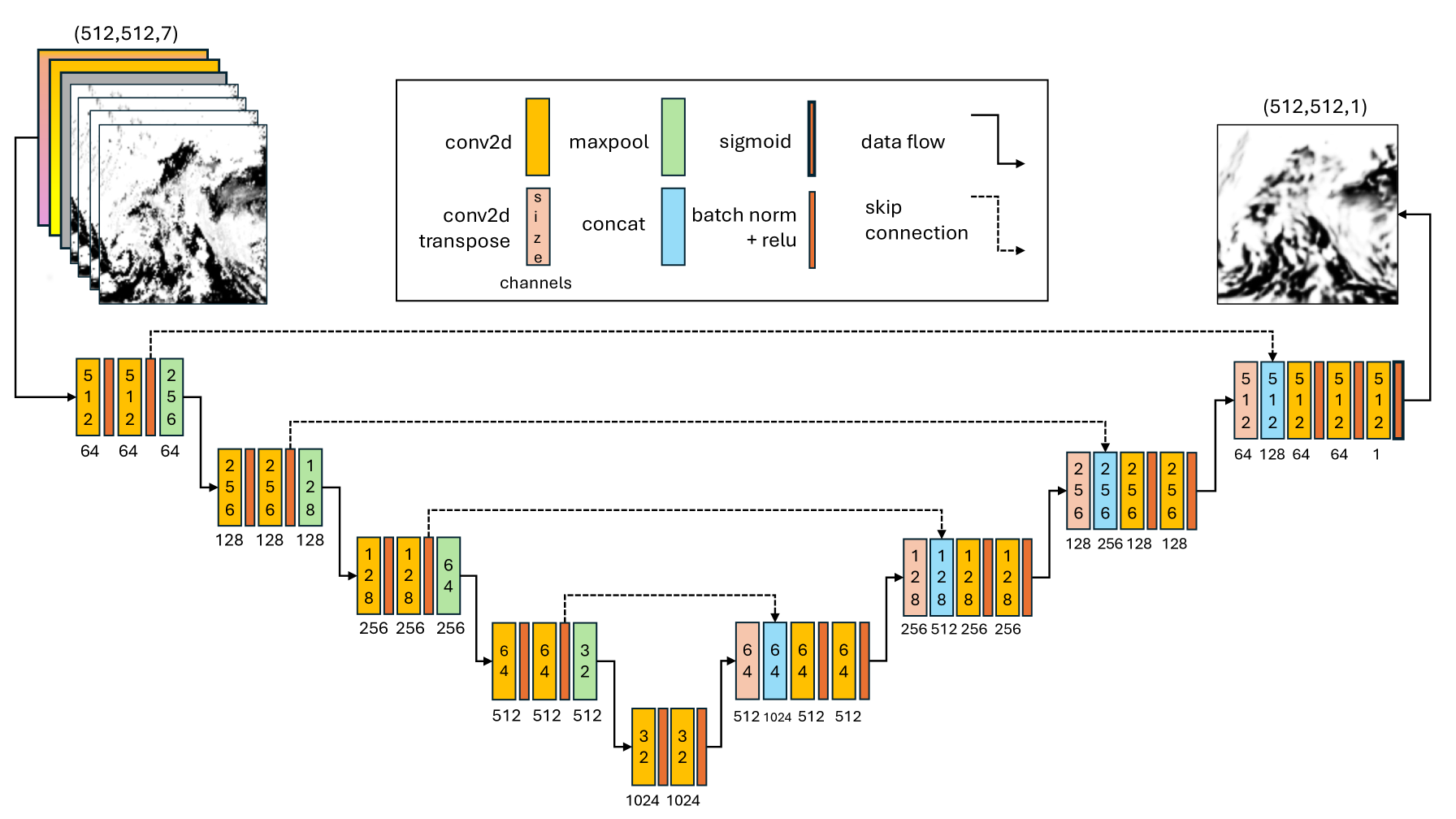
技术框架:CloudCast采用基于U-Net架构的卷积神经网络。整体流程包括:1) 数据预处理:收集和清洗卫星图像数据;2) 模型训练:使用历史卫星数据训练U-Net模型,使其学习云量变化的模式;3) 预测:输入当前卫星图像,模型输出未来一段时间内的云量预测;4) 评估:将模型预测结果与实际观测数据进行比较,评估模型性能。
关键创新:CloudCast的关键创新在于将U-Net架构应用于云量预测任务,并直接从卫星图像数据中学习云的演变模式。与传统的NWP模型相比,CloudCast能够更好地捕捉小尺度云形成过程,从而提高预测精度。此外,通过消融实验确定了最佳的输入特征和损失函数,进一步优化了模型性能。
关键设计:CloudCast使用U-Net作为基础网络架构,这是一种专门为图像分割任务设计的网络,具有编码器-解码器结构,能够有效地捕捉图像中的上下文信息。模型使用五年历史卫星数据进行训练,输入特征包括卫星图像的多个通道。损失函数方面,论文比较了多种损失函数,最终发现基于平均绝对误差(MAE)的损失函数表现最佳。模型预测未来五个小时的云量,并以小时为单位进行预测。
🖼️ 关键图片


📊 实验亮点
CloudCast在云量预测方面表现出色,与参考NWP模型相比,平均绝对误差降低了24%,多类别预测误差降低了46%。消融研究表明,基于MAE的损失函数能获得最佳性能。该模型能够较好地捕捉云量的大尺度结构,尤其是在预测的前几个小时内表现突出。CloudCast已成功集成到芬兰气象研究所的业务系统中,证明了其在实际应用中的价值。
🎯 应用场景
CloudCast可应用于多个领域,包括农业(优化灌溉计划)、太阳能发电(预测发电量)、航空(规划飞行路线)等。通过提供更准确的云量预测,CloudCast可以帮助这些行业做出更明智的决策,提高效率,降低成本。该研究的成果已集成到芬兰气象研究所的业务临近预报系统中,为公共和私营部门客户提供更好的云量预报服务。
📄 摘要(原文)
Cloud cover plays a critical role in weather prediction and impacts several sectors, including agriculture, solar power generation, and aviation. Despite advancements in numerical weather prediction (NWP) models, forecasting total cloud cover remains challenging due to the small-scale nature of cloud formation processes. In this study, we introduce CloudCast, a convolutional neural network (CNN) based on the U-Net architecture, designed to predict total cloud cover (TCC) up to five hours ahead. Trained on five years of satellite data, CloudCast significantly outperforms traditional NWP models and optical flow methods. Compared to a reference NWP model, CloudCast achieves a 24% lower mean absolute error and reduces multi-category prediction errors by 46%. The model demonstrates strong performance, particularly in capturing the large-scale structure of cloud cover in the first few forecast hours, though later predictions are subject to blurring and underestimation of cloud formation. An ablation study identified the optimal input features and loss functions, with MAE-based models performing the best. CloudCast has been integrated into the Finnish Meteorological Institute's operational nowcasting system, where it improves cloud cover forecasts used by public and private sector clients. While CloudCast is limited by a relatively short skillful lead time of about three hours, future work aims to extend this through more complex network architectures and higher-resolution data. CloudCast code is available at https://github.com/fmidev/cloudcast.