Autonomous Robotic Reinforcement Learning with Asynchronous Human Feedback
作者: Max Balsells, Marcel Torne, Zihan Wang, Samedh Desai, Pulkit Agrawal, Abhishek Gupta
分类: cs.LG, cs.AI, cs.RO
发布日期: 2023-10-31
备注: Project website https://guided-exploration-autonomous-rl.github.io/GEAR/
🔗 代码/项目: PROJECT_PAGE
💡 一句话要点
提出一种基于人类反馈的自主机器人强化学习方法
🎯 匹配领域: 支柱二:RL算法与架构 (RL & Architecture)
关键词: 自主机器人 强化学习 人类反馈 无重置训练 自监督学习 探索策略 信息性距离函数
📋 核心要点
- 现有的自主机器人学习方法在样本复杂度和奖励设计上存在显著挑战,导致实际应用受限。
- 本文提出的GEAR系统通过利用非专家人类反馈,简化了奖励函数设计,并实现了无重置的持续训练。
- 实验结果表明,GEAR在多种机器人任务中表现出色,能够有效学习行为,且在真实环境中也取得了良好效果。
📝 摘要(中文)
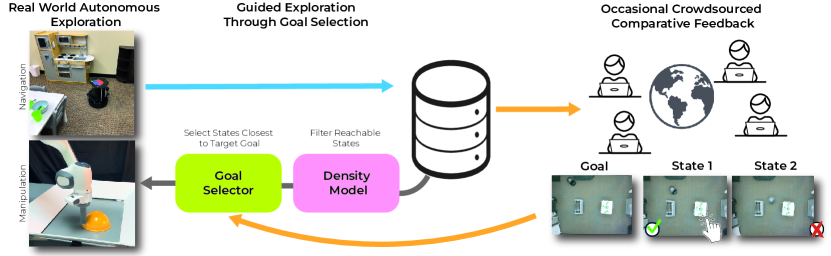
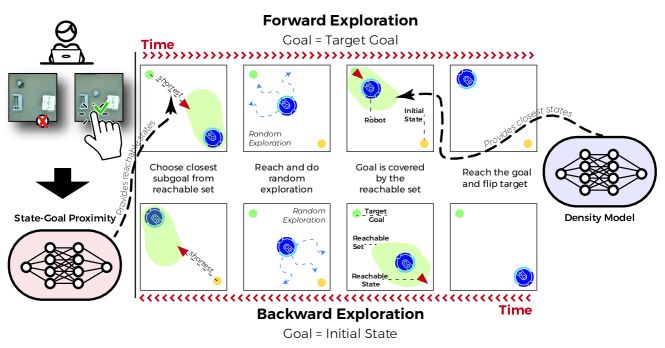
理想情况下,我们希望将机器人放置在真实环境中,让其通过自主收集经验不断改进。然而,现实中自主机器人学习的算法实现面临诸多挑战,主要包括奖励函数设计困难和持续无重置训练的难题。本文提出了一种系统,允许代理在真实世界中直接训练,利用偶尔的非专家人类反馈来学习信息性距离函数,从而指导探索,并结合简单的自监督学习算法进行目标导向的策略学习。我们展示了在没有重置的情况下,考虑探索策略的当前“可达性”对于选择探索区域的重要性。基于这一见解,我们实现了一个实用的学习系统GEAR,使机器人能够在真实环境中自主训练而无需中断。
🔬 方法详解
问题定义:本文旨在解决自主机器人学习中的奖励函数设计和持续无重置训练的挑战。现有方法往往需要手动设计复杂的奖励机制,限制了其在真实环境中的应用。
核心思路:论文提出通过偶尔的非专家人类反馈来学习信息性距离函数,指导探索并结合自监督学习进行策略学习,避免了繁琐的手动设计。
技术框架:GEAR系统的整体架构包括经验流式传输、反馈收集和策略学习三个主要模块。机器人在真实环境中自主收集经验,并将其传输至网络接口,接收远程人类的反馈。
关键创新:最重要的技术创新在于引入了非专家人类反馈来优化探索过程,并在无重置的情况下实现了有效的策略学习,这与传统方法有本质区别。
关键设计:系统设计中使用了简单的自监督学习算法,损失函数通过人类反馈进行调整,确保策略学习的有效性。
🖼️ 关键图片

📊 实验亮点
实验结果显示,GEAR系统在多种模拟和真实环境中的机器人任务中表现优异,能够有效学习复杂行为。与基线方法相比,学习效率显著提高,尤其是在无重置训练的情况下,表现出更好的适应性和灵活性。
🎯 应用场景
该研究的潜在应用领域包括自主机器人、智能家居、工业自动化等。通过减少对专家设计的依赖,GEAR系统能够加速机器人在复杂环境中的学习过程,提升其自主决策能力,具有广泛的实际价值和未来影响。
📄 摘要(原文)
Ideally, we would place a robot in a real-world environment and leave it there improving on its own by gathering more experience autonomously. However, algorithms for autonomous robotic learning have been challenging to realize in the real world. While this has often been attributed to the challenge of sample complexity, even sample-efficient techniques are hampered by two major challenges - the difficulty of providing well "shaped" rewards, and the difficulty of continual reset-free training. In this work, we describe a system for real-world reinforcement learning that enables agents to show continual improvement by training directly in the real world without requiring painstaking effort to hand-design reward functions or reset mechanisms. Our system leverages occasional non-expert human-in-the-loop feedback from remote users to learn informative distance functions to guide exploration while leveraging a simple self-supervised learning algorithm for goal-directed policy learning. We show that in the absence of resets, it is particularly important to account for the current "reachability" of the exploration policy when deciding which regions of the space to explore. Based on this insight, we instantiate a practical learning system - GEAR, which enables robots to simply be placed in real-world environments and left to train autonomously without interruption. The system streams robot experience to a web interface only requiring occasional asynchronous feedback from remote, crowdsourced, non-expert humans in the form of binary comparative feedback. We evaluate this system on a suite of robotic tasks in simulation and demonstrate its effectiveness at learning behaviors both in simulation and the real world. Project website https://guided-exploration-autonomous-rl.github.io/GEAR/.