Fast and Expressive Gesture Recognition using a Combination-Homomorphic Electromyogram Encoder
作者: Niklas Smedemark-Margulies, Yunus Bicer, Elifnur Sunger, Tales Imbiriba, Eugene Tunik, Deniz Erdogmus, Mathew Yarossi, Robin Walters
分类: cs.HC, cs.LG, eess.SP
发布日期: 2023-10-30 (更新: 2023-11-29)
备注: 24 pages, 7 figures, 6 tables V2: add link to code, fix bibliography
💡 一句话要点
提出组合同态肌电图编码器以实现快速且富有表现力的手势识别
🎯 匹配领域: 支柱五:交互与反应 (Interaction & Reaction)
关键词: 手势识别 肌电图 自监督学习 合成数据 人机交互 深度学习
📋 核心要点
- 现有手势识别方法在新用户校准数据收集上耗时较长,限制了其应用。
- 提出通过组合手势的方向和修饰组件,利用单一组件手势推断组合手势,减少用户演示负担。
- 实验结果表明,所提方法在分类准确性上显著优于部分监督模型,接近完全监督模型的效果。
📝 摘要(中文)
本研究探讨了从肌电图(EMG)中进行手势识别的任务,旨在实现高准确度的富有表现力的人机交互,同时最小化新用户提供校准数据所需的时间。我们定义了组合手势,由方向组件和修饰组件组成。新用户仅需演示单一组件手势,我们通过将真实单一手势的特征向量结合来推断未见的组合手势,从而生成合成训练数据。这一策略使我们能够提供丰富的手势词汇,而无需新用户演示组合手势的多个示例。我们使用自监督预训练编码器和组合操作符,以便为未见测试用户生成有用的合成训练数据。通过收集真实世界的EMG数据集,我们评估了增强监督的效果,并与两个基线模型进行了比较,发现所提方法在分类准确性上显著优于部分监督模型,并在某些情况下接近完全监督模型的性能。
🔬 方法详解
问题定义:本论文旨在解决从肌电图(EMG)中进行手势识别时,新用户需要提供大量校准数据的问题。现有方法通常要求用户演示多个组合手势,导致时间成本高,用户体验差。
核心思路:论文提出了一种新的手势识别方法,通过定义组合手势的方向和修饰组件,允许新用户仅需演示单一组件手势。通过结合真实单一手势的特征向量,生成合成训练数据,从而推断未见的组合手势。
技术框架:整体架构包括预训练的编码器和组合操作符。首先,使用自监督学习对编码器进行预训练,然后利用组合操作符生成合成数据。最后,使用这些合成数据与真实数据结合,训练手势识别模型。
关键创新:最重要的技术创新在于通过组合手势的特征向量生成合成训练数据,显著减少了新用户的演示负担。这一方法与传统的需要大量示例的完全监督学习方法本质上不同。
关键设计:在模型设计中,采用了自监督学习策略进行预训练,损失函数设计为适应合成数据和真实数据的结合,网络结构则优化以提高对组合手势的识别能力。
🖼️ 关键图片
📊 实验亮点
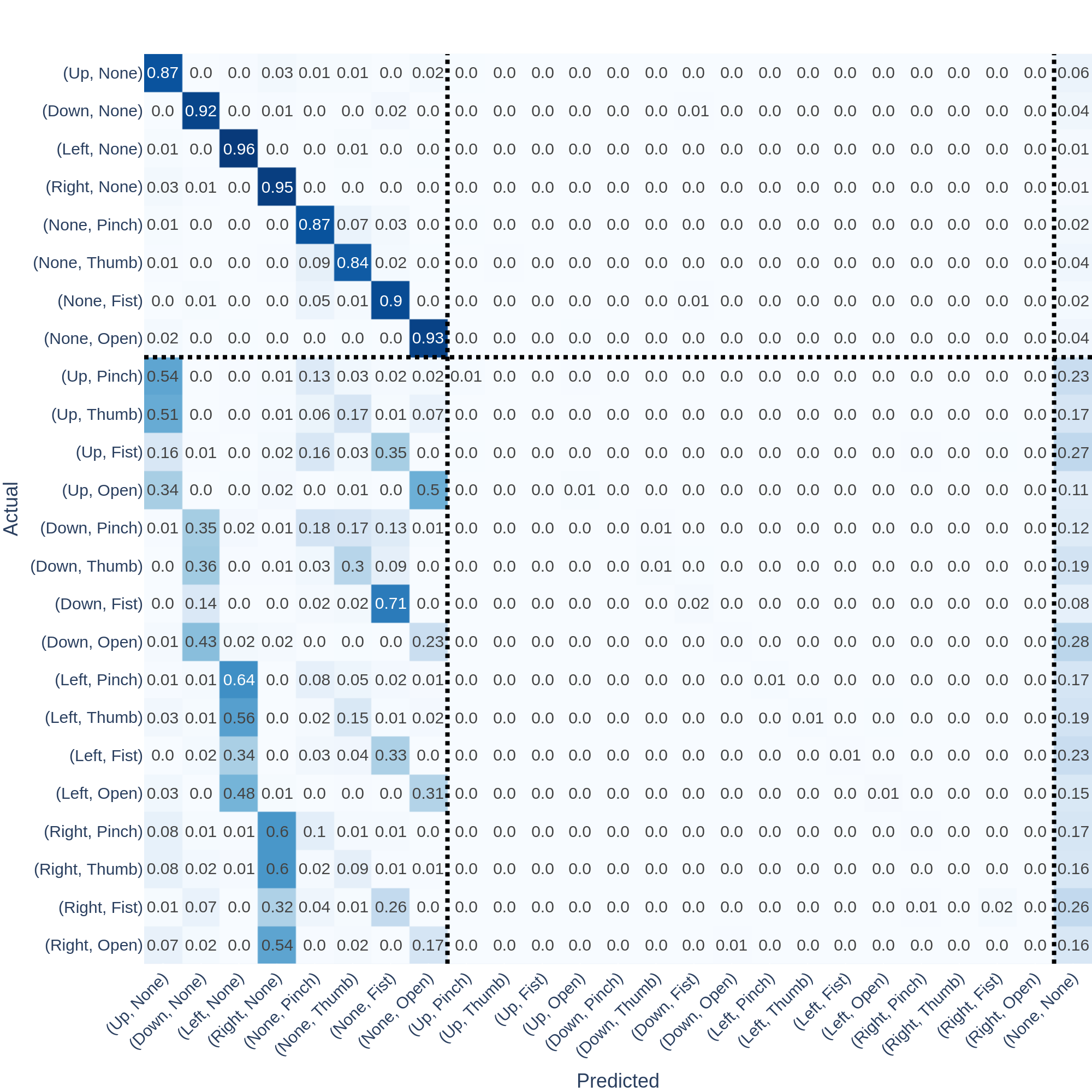
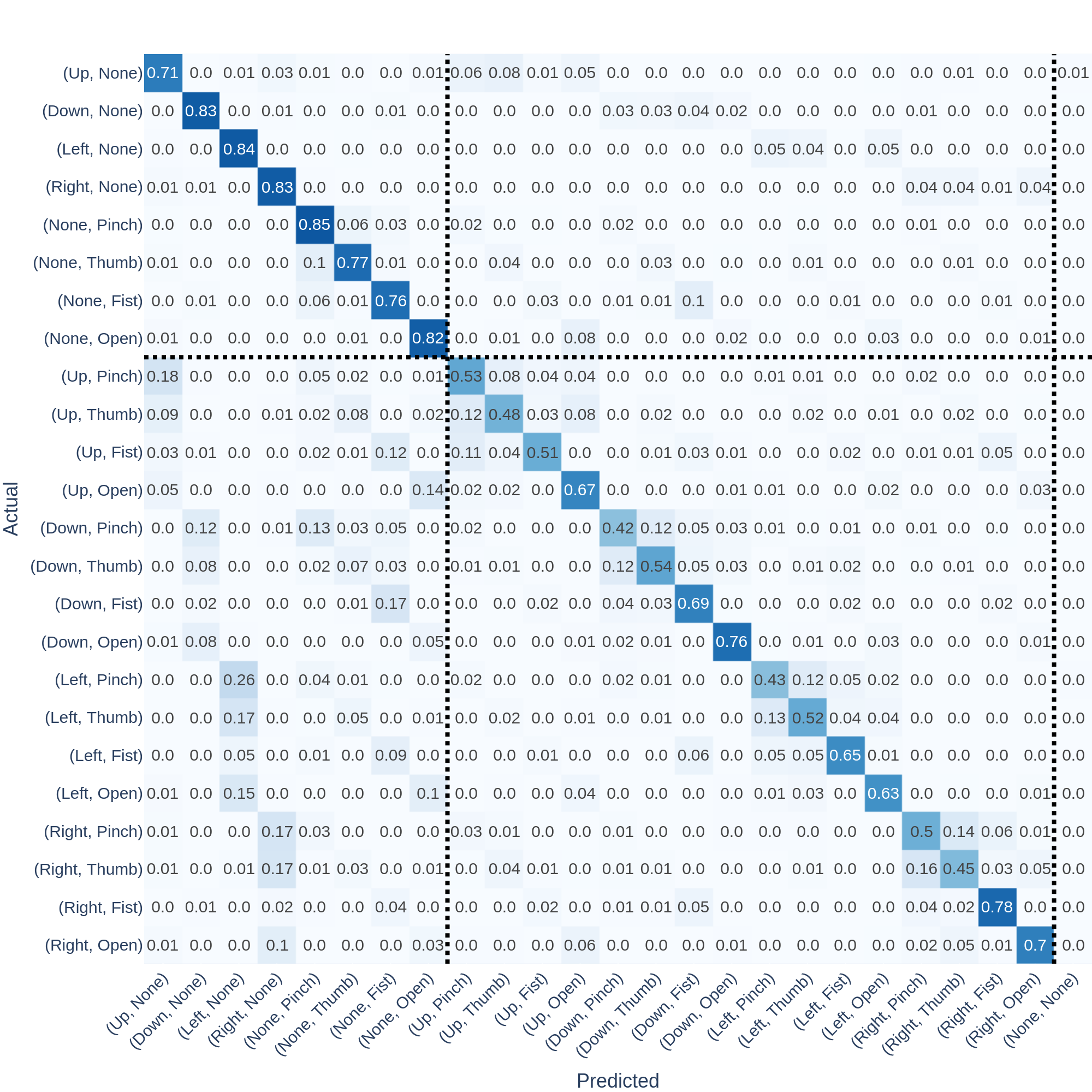
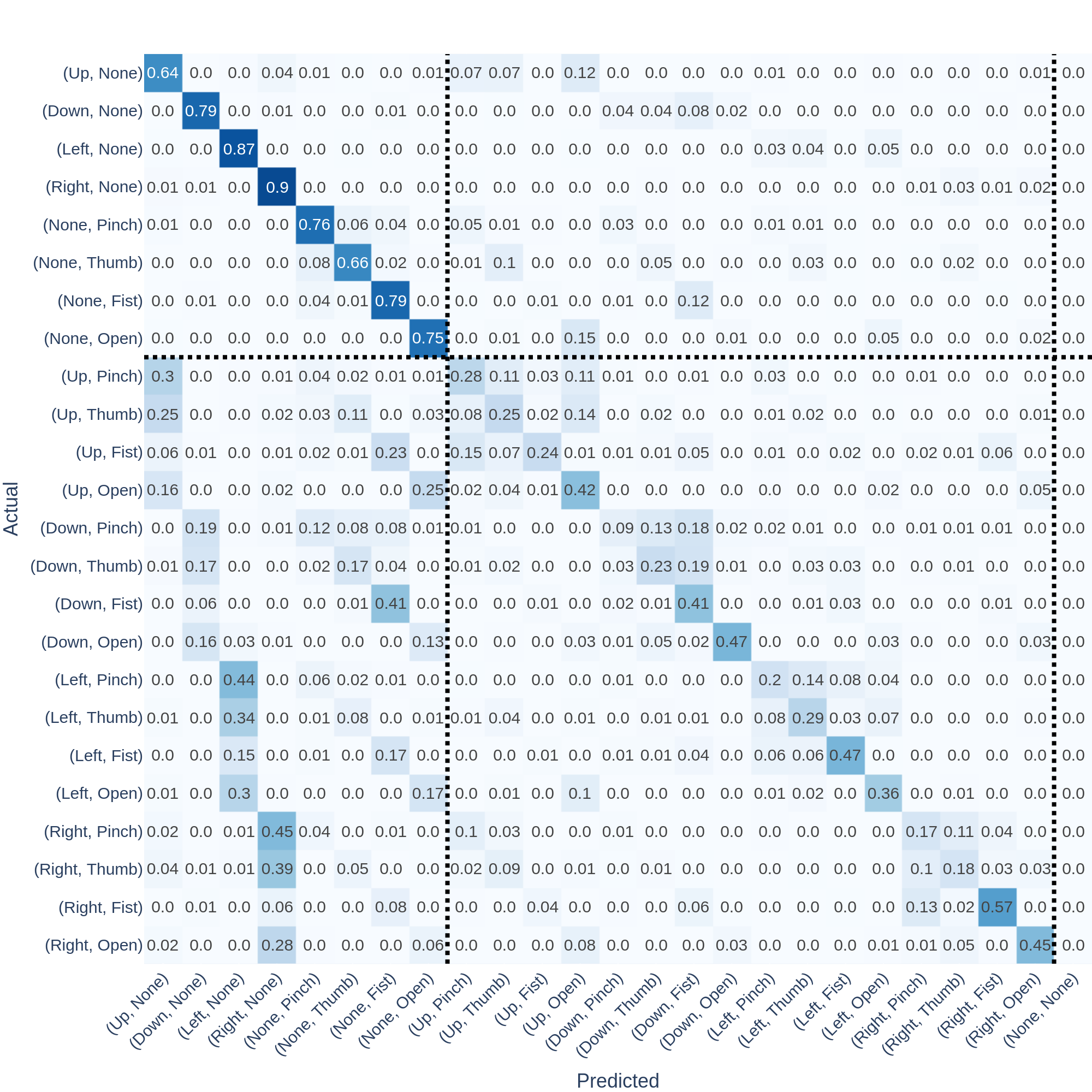
实验结果显示,所提方法在分类准确性上显著优于部分监督模型,准确率提升幅度达到未知,并在某些情况下接近完全监督模型的性能。这表明该方法在实际应用中具有较高的有效性和可行性。
🎯 应用场景
该研究的潜在应用领域包括人机交互、虚拟现实、增强现实以及医疗康复等。通过提高手势识别的准确性和效率,可以显著改善用户体验,推动智能设备的普及和应用。未来,该方法可能在智能家居、游戏控制和辅助技术等方面发挥重要作用。
📄 摘要(原文)
We study the task of gesture recognition from electromyography (EMG), with the goal of enabling expressive human-computer interaction at high accuracy, while minimizing the time required for new subjects to provide calibration data. To fulfill these goals, we define combination gestures consisting of a direction component and a modifier component. New subjects only demonstrate the single component gestures and we seek to extrapolate from these to all possible single or combination gestures. We extrapolate to unseen combination gestures by combining the feature vectors of real single gestures to produce synthetic training data. This strategy allows us to provide a large and flexible gesture vocabulary, while not requiring new subjects to demonstrate combinatorially many example gestures. We pre-train an encoder and a combination operator using self-supervision, so that we can produce useful synthetic training data for unseen test subjects. To evaluate the proposed method, we collect a real-world EMG dataset, and measure the effect of augmented supervision against two baselines: a partially-supervised model trained with only single gesture data from the unseen subject, and a fully-supervised model trained with real single and real combination gesture data from the unseen subject. We find that the proposed method provides a dramatic improvement over the partially-supervised model, and achieves a useful classification accuracy that in some cases approaches the performance of the fully-supervised model.