TempME: Towards the Explainability of Temporal Graph Neural Networks via Motif Discovery
作者: Jialin Chen, Rex Ying
分类: cs.LG, cs.AI
发布日期: 2023-10-30
备注: Accepted at NeurIPS 2023, Camera Ready Version
💡 一句话要点
提出TempME以解决TGNN可解释性问题
🎯 匹配领域: 支柱八:物理动画 (Physics-based Animation)
关键词: 时间图神经网络 可解释性 时间图样 信息瓶颈 动态系统 模型透明度 预测性能
📋 核心要点
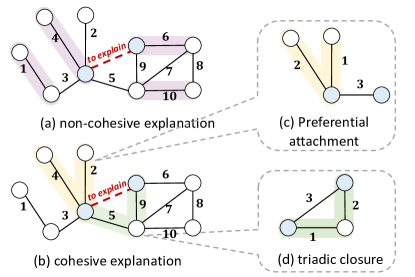
- 现有的时间图神经网络在可解释性方面存在不足,无法明确识别影响预测的关键时间图样。
- 本文提出的TempME方法通过信息瓶颈原理提取最重要的时间图样,以提高TGNN的可解释性。
- 实验结果显示,TempME在六个真实数据集上的解释准确率提高了8.21%,并且提升了TGNN的平均精度达22.96%。
📝 摘要(中文)
时间图广泛用于建模具有时变交互的动态系统。在实际场景中,未来交互的生成机制通常由图中的一组重复子结构(称为时间图样)所主导。尽管当前的时间图神经网络(TGNN)取得了成功,但仍不确定哪些时间图样是触发模型特定预测的重要指示,这对TGNN的可解释性和可信度构成了挑战。为了解决这一问题,本文提出了一种新方法——时间图样解释器(TempME),旨在揭示指导TGNN预测的关键时间图样。TempME基于信息瓶颈原理提取与交互相关的最重要图样,同时最小化包含的信息量,以保持解释的稀疏性和简洁性。实验结果表明,TempME生成的事件在时空相关性上优于现有方法,提供了更易理解的见解。
🔬 方法详解
问题定义:本文旨在解决时间图神经网络(TGNN)可解释性不足的问题。现有方法无法有效识别影响模型预测的关键时间图样,导致模型的透明度和可信度不足。
核心思路:TempME方法的核心思想是基于信息瓶颈原理,提取与交互相关的最重要时间图样,同时最小化信息量,以保持解释的简洁性和稀疏性。
技术框架:TempME的整体架构包括数据预处理、时间图样提取和解释生成三个主要模块。首先对输入的时间图进行处理,然后识别出关键的时间图样,最后生成可解释的预测结果。
关键创新:TempME的主要创新在于其通过信息瓶颈原理优化时间图样的提取过程,使得生成的解释在时空相关性上显著优于现有方法,提供了更清晰的模型理解。
关键设计:在设计上,TempME采用了特定的损失函数以平衡信息量与稀疏性,同时在网络结构上引入了适应性参数设置,以提高模型的灵活性和准确性。
🖼️ 关键图片


📊 实验亮点
实验结果表明,TempME在六个真实数据集上的解释准确率提高了8.21%,同时在提升TGNN的预测平均精度方面,提升幅度达22.96%。这些结果显示了TempME在可解释性和预测性能上的显著优势。
🎯 应用场景
该研究的潜在应用领域包括社交网络分析、交通流量预测和金融市场动态建模等。通过提高TGNN的可解释性,TempME能够帮助研究人员和决策者更好地理解动态系统的行为,从而做出更为精准的决策,具有重要的实际价值和未来影响。
📄 摘要(原文)
Temporal graphs are widely used to model dynamic systems with time-varying interactions. In real-world scenarios, the underlying mechanisms of generating future interactions in dynamic systems are typically governed by a set of recurring substructures within the graph, known as temporal motifs. Despite the success and prevalence of current temporal graph neural networks (TGNN), it remains uncertain which temporal motifs are recognized as the significant indications that trigger a certain prediction from the model, which is a critical challenge for advancing the explainability and trustworthiness of current TGNNs. To address this challenge, we propose a novel approach, called Temporal Motifs Explainer (TempME), which uncovers the most pivotal temporal motifs guiding the prediction of TGNNs. Derived from the information bottleneck principle, TempME extracts the most interaction-related motifs while minimizing the amount of contained information to preserve the sparsity and succinctness of the explanation. Events in the explanations generated by TempME are verified to be more spatiotemporally correlated than those of existing approaches, providing more understandable insights. Extensive experiments validate the superiority of TempME, with up to 8.21% increase in terms of explanation accuracy across six real-world datasets and up to 22.96% increase in boosting the prediction Average Precision of current TGNNs.