Transfer Learning in Transformer-Based Demand Forecasting For Home Energy Management System
作者: Gargya Gokhale, Jonas Van Gompel, Bert Claessens, Chris Develder
分类: cs.LG, eess.SY
发布日期: 2023-10-29
备注: 7 pages, 2 figures, workshop article at BALANCES, BuildSys'23
💡 一句话要点
通过迁移学习提升家庭能源管理系统的需求预测精度
🎯 匹配领域: 支柱一:机器人控制 (Robot Control) 支柱二:RL算法与架构 (RL & Architecture)
关键词: 迁移学习 家庭能源管理 电力消费预测 时间融合变换器 智能控制 可再生能源 数据高效性
📋 核心要点
- 现有方法在家庭电力消费预测中面临数据不足和短时间分辨率预测精度低的挑战。
- 论文提出通过迁移学习,利用多个家庭的数据训练模型,并在新家庭上进行微调,以提高预测准确性。
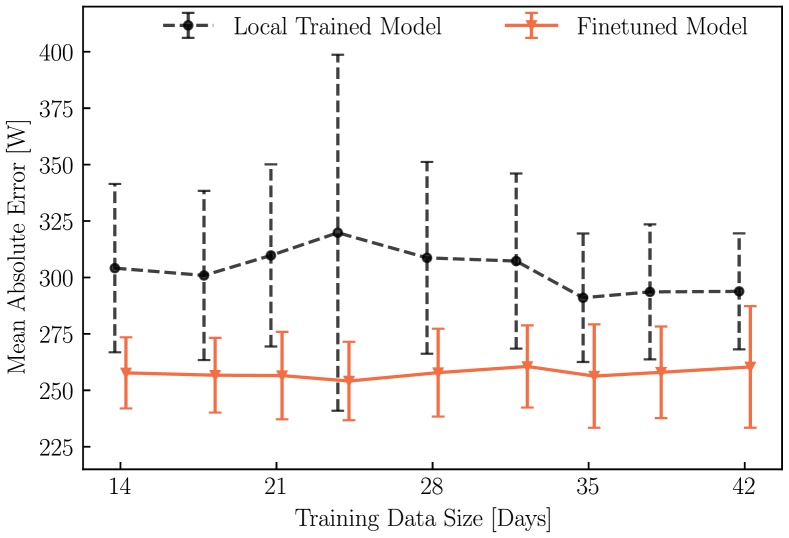
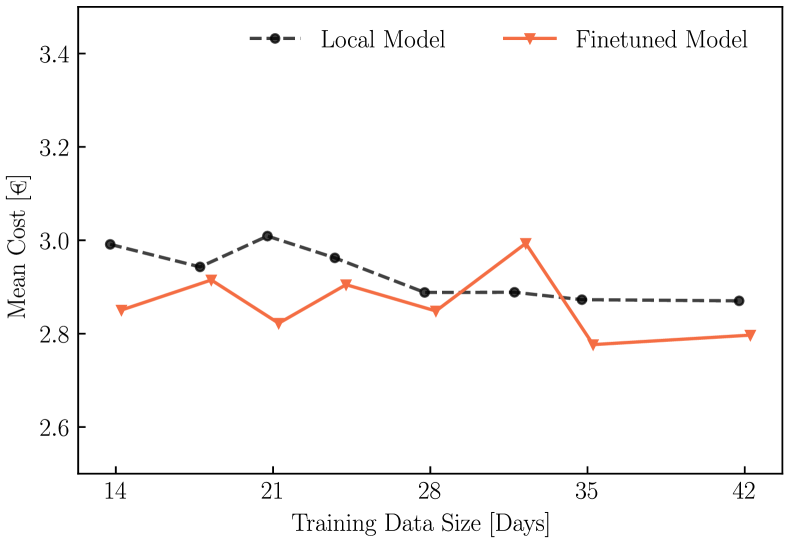
- 实验结果显示,迁移学习方法在预测准确性上减少了约15%的平均绝对误差,控制性能上降低了约2%的能源成本。
📝 摘要(中文)
随着越来越多的家庭选择光伏系统和电池存储以降低能源费用和最大化可再生能源的使用,开发先进的控制算法成为了重要任务。然而,家庭电力消费的准确预测,尤其是在短时间分辨率(15分钟)和数据高效性方面,仍然是一个普遍挑战。本文分析了如何通过迁移学习利用多个家庭的数据来改善单个家庭的负载预测。我们使用来自不同家庭的数据训练一个先进的预测模型(时间融合变换器),然后在数据有限的新家庭上对该全局模型进行微调。实验结果表明,与仅使用新家庭数据相比,这种迁移学习设置在预测准确性(约15%的MAE减少)和控制性能(约2%的能源成本减少)方面均有显著提升。
🔬 方法详解
问题定义:本文旨在解决家庭电力消费预测中的数据不足问题,尤其是在短时间分辨率下的预测准确性不足。现有方法往往依赖于单一家庭的数据,导致预测效果不佳。
核心思路:通过迁移学习,利用多个家庭的历史数据训练一个全局模型,然后在新家庭上进行微调,从而提高预测精度和控制性能。这样的设计可以有效利用已有数据,减少对新数据的依赖。
技术框架:整体架构包括数据收集、全局模型训练和微调三个主要阶段。首先,从多个家庭收集历史电力消费数据;其次,使用时间融合变换器训练全局模型;最后,在新家庭的有限数据上进行微调。
关键创新:最重要的技术创新在于将迁移学习应用于家庭电力消费预测,通过跨家庭数据共享来提升模型性能。这与传统方法依赖单一家庭数据的本质区别在于,前者能够更好地捕捉到家庭用电模式的多样性。
关键设计:在模型训练中,采用时间融合变换器作为基础架构,结合适当的损失函数以优化预测精度。模型的超参数设置经过多次实验调整,以确保在不同家庭数据上的适应性和泛化能力。
🖼️ 关键图片
📊 实验亮点
实验结果表明,采用迁移学习的预测模型在准确性上较传统方法减少了约15%的平均绝对误差(MAE),同时在控制性能上实现了约2%的能源成本降低。这一成果展示了迁移学习在家庭能源管理中的有效性和实用性。
🎯 应用场景
该研究的潜在应用领域包括家庭能源管理系统、智能电网和可再生能源集成等。通过提高家庭电力消费的预测精度,能够更有效地管理能源使用,降低能源成本,并促进可再生能源的使用,具有重要的实际价值和社会影响。
📄 摘要(原文)
Increasingly, homeowners opt for photovoltaic (PV) systems and/or battery storage to minimize their energy bills and maximize renewable energy usage. This has spurred the development of advanced control algorithms that maximally achieve those goals. However, a common challenge faced while developing such controllers is the unavailability of accurate forecasts of household power consumption, especially for shorter time resolutions (15 minutes) and in a data-efficient manner. In this paper, we analyze how transfer learning can help by exploiting data from multiple households to improve a single house's load forecasting. Specifically, we train an advanced forecasting model (a temporal fusion transformer) using data from multiple different households, and then finetune this global model on a new household with limited data (i.e. only a few days). The obtained models are used for forecasting power consumption of the household for the next 24 hours~(day-ahead) at a time resolution of 15 minutes, with the intention of using these forecasts in advanced controllers such as Model Predictive Control. We show the benefit of this transfer learning setup versus solely using the individual new household's data, both in terms of (i) forecasting accuracy ($\sim$15\% MAE reduction) and (ii) control performance ($\sim$2\% energy cost reduction), using real-world household data.