Remaining useful life prediction of Lithium-ion batteries using spatio-temporal multimodal attention networks
作者: Sungho Suh, Dhruv Aditya Mittal, Hymalai Bello, Bo Zhou, Mayank Shekhar Jha, Paul Lukowicz
分类: cs.LG
发布日期: 2023-10-29 (更新: 2024-06-06)
💡 一句话要点
提出时空多模态注意力网络以解决锂离子电池剩余寿命预测问题
🎯 匹配领域: 支柱二:RL算法与架构 (RL & Architecture) 支柱九:具身大模型 (Embodied Foundation Models)
关键词: 锂离子电池 剩余寿命预测 时空多模态 注意力网络 机器学习 电动车 可再生能源
📋 核心要点
- 现有的锂离子电池剩余寿命预测方法在迭代预测循环次数时存在局限性,且常常忽略重要特征。
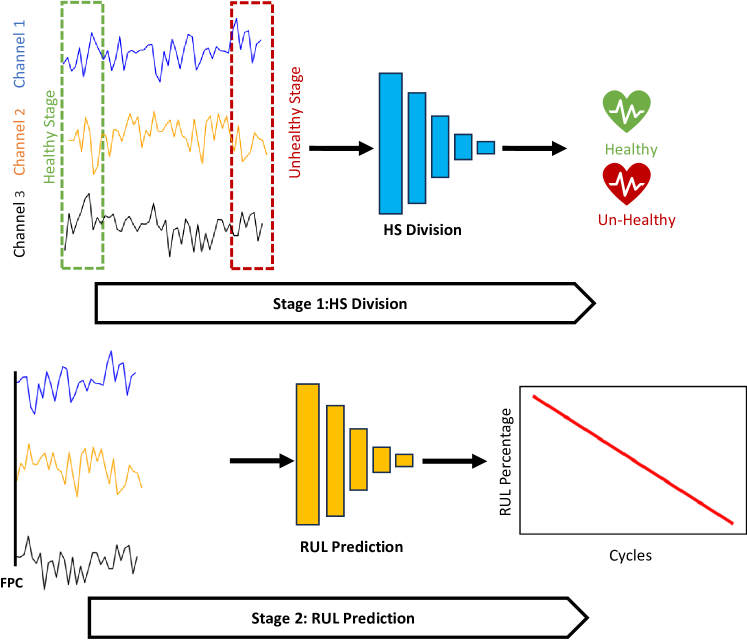
- 本文提出了一种基于时空多模态注意力网络的两阶段RUL预测方案,旨在捕捉复杂的时空依赖关系。
- 实验结果表明,该方法在MAE和MSE上分别达到0.0275和0.0014,显著优于现有的CNN和LSTM方法。
📝 摘要(中文)
锂离子电池广泛应用于电动车和可再生能源存储中,其剩余寿命(RUL)预测对确保可靠高效的操作及降低维护成本至关重要。然而,现实场景中电池生命周期的确定存在挑战,现有方法在迭代预测循环次数时存在局限性,且往往忽视温度、内阻和材料类型等重要特征。为解决这些问题,本文提出了一种基于时空多模态注意力网络(ST-MAN)的两阶段RUL预测方案。该方法能够捕捉电池数据中的复杂时空依赖关系,尽管不依赖于已知的寿命终止事件,依然在均方误差(MSE)和平均绝对误差(MAE)上表现出色,分别为0.0014和0.0275,优于现有的卷积神经网络(CNN)和长短期记忆(LSTM)方法。该方法有望提升电池操作的可靠性和效率,适用于多个行业。
🔬 方法详解
问题定义:本文旨在解决锂离子电池剩余寿命预测中的挑战,现有方法往往忽视温度、内阻等重要特征,导致预测准确性不足。
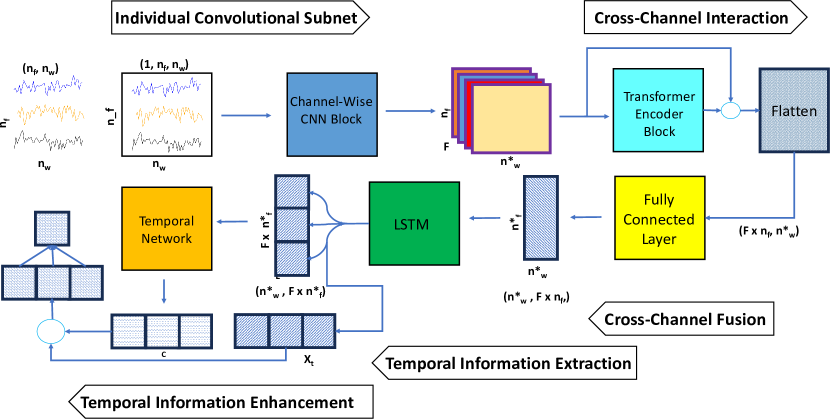
核心思路:提出的时空多模态注意力网络(ST-MAN)通过捕捉电池数据中的复杂时空依赖关系,克服了传统方法的局限性,能够更全面地考虑电池的多种特征。
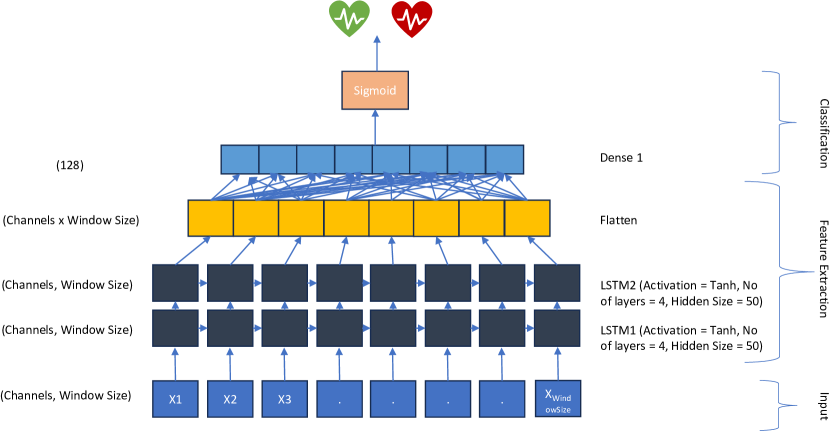
技术框架:该方法分为两个阶段,首先通过多模态输入获取电池的多种特征,然后利用注意力机制聚焦于重要的时空信息,最终输出RUL预测结果。
关键创新:ST-MAN的核心创新在于其能够在没有已知寿命终止事件的情况下,依然实现较低的预测误差,显著优于现有的CNN和LSTM方法。
关键设计:在网络结构上,ST-MAN结合了多模态输入和注意力机制,采用了特定的损失函数以优化预测精度,确保模型能够有效学习电池的时空特征。
🖼️ 关键图片
📊 实验亮点
实验结果显示,提出的ST-MAN方法在均方误差(MSE)和平均绝对误差(MAE)上分别达到了0.0014和0.0275,显著低于现有的卷积神经网络(CNN)和长短期记忆(LSTM)方法,展示了其在电池剩余寿命预测中的优越性能。
🎯 应用场景
该研究的潜在应用领域包括电动车、可再生能源存储及其他依赖锂离子电池的设备。通过提高电池的剩余寿命预测精度,能够有效降低维护成本,提升设备的可靠性和效率,具有重要的实际价值和广泛的行业影响。
📄 摘要(原文)
Lithium-ion batteries are widely used in various applications, including electric vehicles and renewable energy storage. The prediction of the remaining useful life (RUL) of batteries is crucial for ensuring reliable and efficient operation, as well as reducing maintenance costs. However, determining the life cycle of batteries in real-world scenarios is challenging, and existing methods have limitations in predicting the number of cycles iteratively. In addition, existing works often oversimplify the datasets, neglecting important features of the batteries such as temperature, internal resistance, and material type. To address these limitations, this paper proposes a two-stage RUL prediction scheme for Lithium-ion batteries using a spatio-temporal multimodal attention network (ST-MAN). The proposed ST-MAN is to capture the complex spatio-temporal dependencies in the battery data, including the features that are often neglected in existing works. Despite operating without prior knowledge of end-of-life (EOL) events, our method consistently achieves lower error rates, boasting mean absolute error (MAE) and mean square error (MSE) of 0.0275 and 0.0014, respectively, compared to existing convolutional neural networks (CNN) and long short-term memory (LSTM)-based methods. The proposed method has the potential to improve the reliability and efficiency of battery operations and is applicable in various industries.