Efficient kernel surrogates for neural network-based regression
作者: Saad Qadeer, Andrew Engel, Amanda Howard, Adam Tsou, Max Vargas, Panos Stinis, Tony Chiang
分类: cs.LG
发布日期: 2023-10-28 (更新: 2024-01-24)
备注: 35 pages. software used to reach results available upon request, approved for release by Pacific Northwest National Laboratory
💡 一句话要点
提出高效核代理以解决深度神经网络回归问题
🎯 匹配领域: 支柱九:具身大模型 (Embodied Foundation Models)
关键词: 深度神经网络 核机器 神经切线核 共轭核 回归分析 分类任务 计算效率 理论分析
📋 核心要点
- 现有深度神经网络在理论理解和泛化性能研究上存在挑战,尤其是无法确定学习函数的封闭形式。
- 本文提出共轭核(CK)作为神经切线核(NTK)的高效近似,旨在降低计算成本并保持性能。
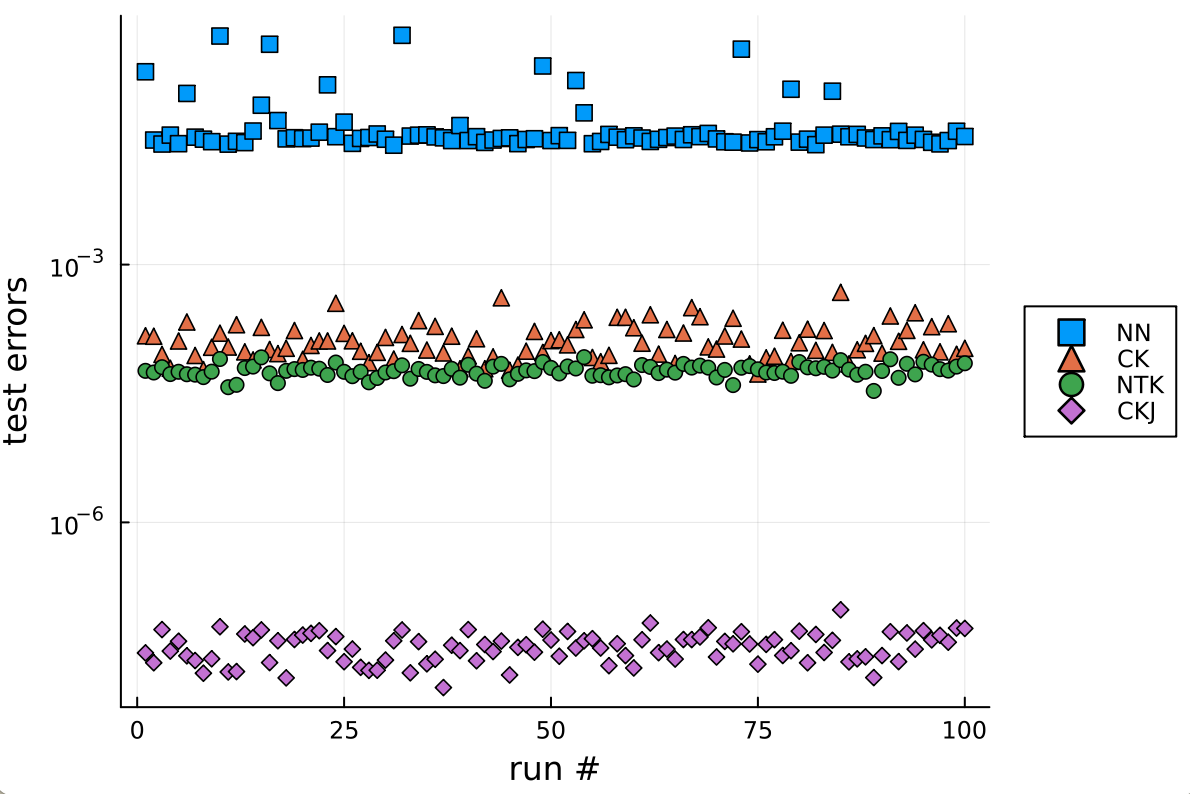
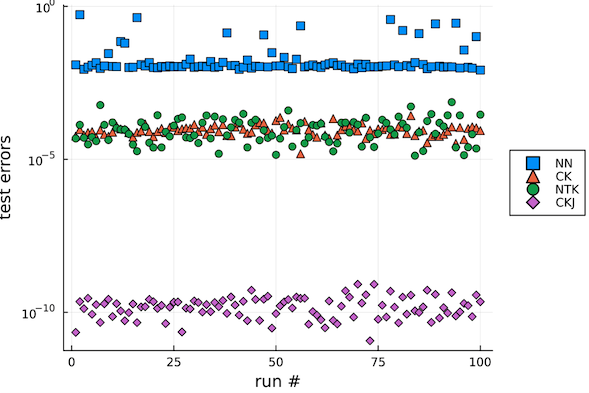
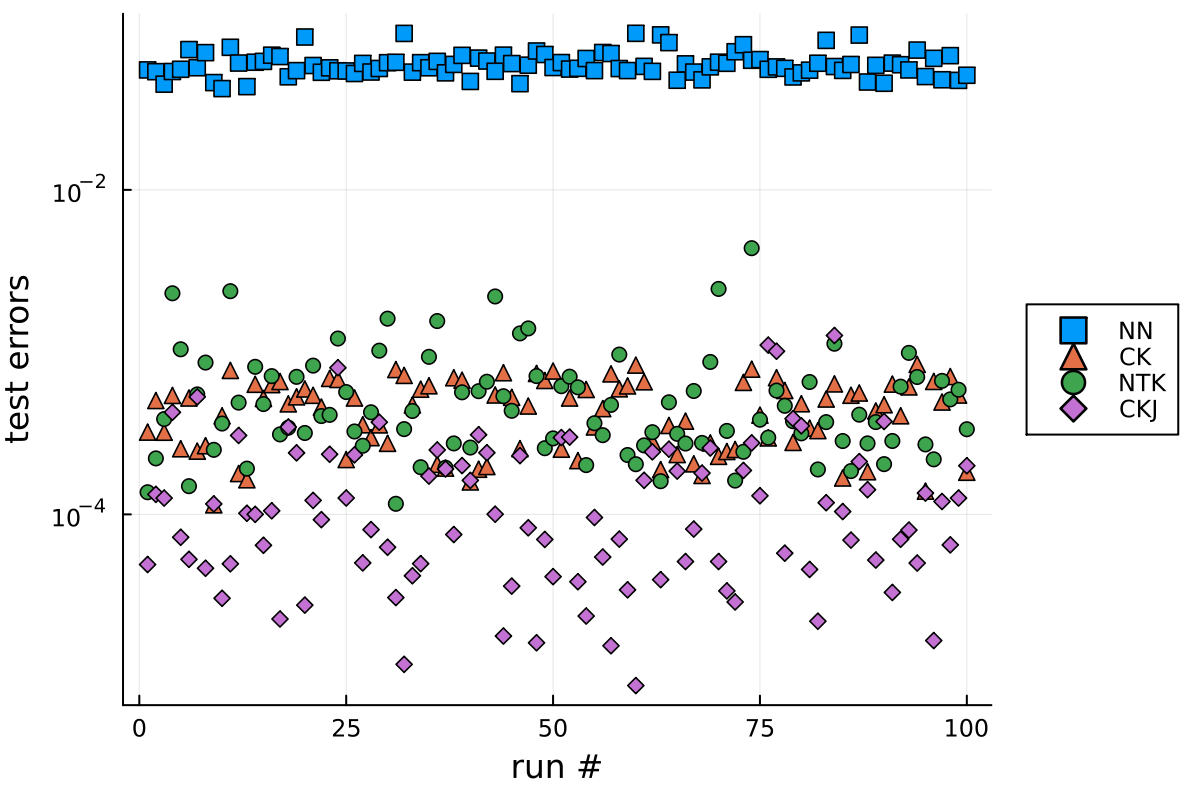
- 实验结果表明,CK在平滑函数回归和逻辑回归分类任务中的表现与NTK相似,甚至在某些情况下更优。
📝 摘要(中文)
尽管深度神经网络(DNN)在多种学习任务中展现出巨大潜力,但其理论限制尚未被充分理解。现有方法难以确定学习函数的封闭形式,导致对其在未见数据集上的泛化性能研究困难。近期研究表明,在无限宽度极限下,随机初始化的DNN收敛于依赖神经切线核(NTK)的核机器。本文研究了共轭核(CK),作为NTK的高效近似,展示其在平滑函数回归和逻辑回归分类问题上的性能与NTK相近,甚至在某些情况下优于NTK。我们建立了相对测试损失的界限,并通过数值测试验证,识别出核的规则性是性能的关键决定因素。
🔬 方法详解
问题定义:本文旨在解决深度神经网络在回归任务中的高计算成本和理论理解不足的问题。现有方法在处理有限宽度DNN时,难以有效利用NTK的优势。
核心思路:提出共轭核(CK)作为NTK的高效近似,利用CK的计算效率和相似性能,提供一种低成本的替代方案。通过理论分析和实验验证,CK在多种任务中表现出色。
技术框架:研究框架包括理论推导、数值实验和应用示例。首先,建立CK与NTK的关系,接着在回归和分类任务中进行性能比较,最后展示CK在实际应用中的效果。
关键创新:最重要的创新在于提出CK作为NTK的有效替代,提供了理论基础和实证支持,表明CK在特定条件下的优越性。与传统方法相比,CK在计算效率和性能上均有显著提升。
关键设计:在设计CK时,关注核的规则性和参数设置,采用适当的损失函数和网络结构,以确保在不同任务中均能保持较高的准确性和效率。
🖼️ 关键图片
📊 实验亮点
实验结果显示,共轭核(CK)在平滑函数回归和逻辑回归分类任务中的性能与神经切线核(NTK)相近,且在某些情况下优于NTK。具体而言,CK在相对测试损失上的表现仅略逊于NTK,验证了其作为高效替代的潜力。
🎯 应用场景
该研究的潜在应用领域包括机器学习中的回归分析、分类任务以及物理信息驱动的网络训练。通过提高深度神经网络的准确性和效率,CK可以在实际应用中显著降低计算成本,推动相关领域的技术进步。
📄 摘要(原文)
Despite their immense promise in performing a variety of learning tasks, a theoretical understanding of the limitations of Deep Neural Networks (DNNs) has so far eluded practitioners. This is partly due to the inability to determine the closed forms of the learned functions, making it harder to study their generalization properties on unseen datasets. Recent work has shown that randomly initialized DNNs in the infinite width limit converge to kernel machines relying on a Neural Tangent Kernel (NTK) with known closed form. These results suggest, and experimental evidence corroborates, that empirical kernel machines can also act as surrogates for finite width DNNs. The high computational cost of assembling the full NTK, however, makes this approach infeasible in practice, motivating the need for low-cost approximations. In the current work, we study the performance of the Conjugate Kernel (CK), an efficient approximation to the NTK that has been observed to yield fairly similar results. For the regression problem of smooth functions and logistic regression classification, we show that the CK performance is only marginally worse than that of the NTK and, in certain cases, is shown to be superior. In particular, we establish bounds for the relative test losses, verify them with numerical tests, and identify the regularity of the kernel as the key determinant of performance. In addition to providing a theoretical grounding for using CKs instead of NTKs, our framework suggests a recipe for improving DNN accuracy inexpensively. We present a demonstration of this on the foundation model GPT-2 by comparing its performance on a classification task using a conventional approach and our prescription. We also show how our approach can be used to improve physics-informed operator network training for regression tasks as well as convolutional neural network training for vision classification tasks.