Modality-Agnostic Self-Supervised Learning with Meta-Learned Masked Auto-Encoder
作者: Huiwon Jang, Jihoon Tack, Daewon Choi, Jongheon Jeong, Jinwoo Shin
分类: cs.LG, cs.AI
发布日期: 2023-10-25
备注: Accepted to NeurIPS 2023. The first two authors contributed equally
🔗 代码/项目: GITHUB
💡 一句话要点
提出MetaMAE以实现模态无关的自监督学习
🎯 匹配领域: 支柱二:RL算法与架构 (RL & Architecture)
关键词: 自监督学习 模态无关 元学习 Masked Auto-Encoder 多模态融合 任务对比学习 Transformer
📋 核心要点
- 现有的自监督学习方法主要集中在特定领域,缺乏对多模态的全面探索,限制了其应用范围。
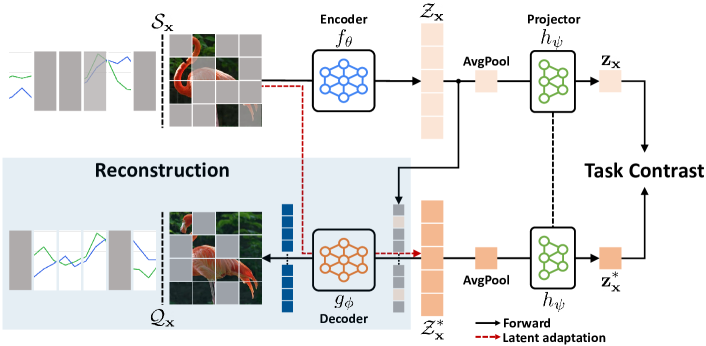
- 本文提出MetaMAE,通过将掩码重建视为元学习任务,利用Transformer元学习器增强MAE的模态无关性。
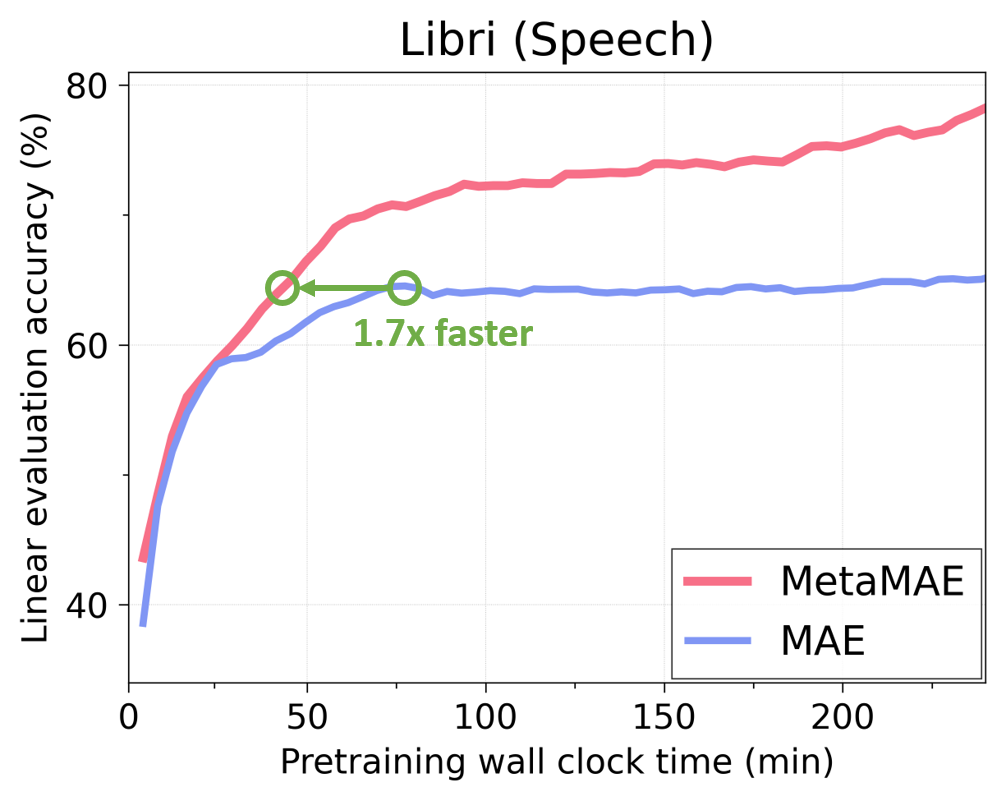
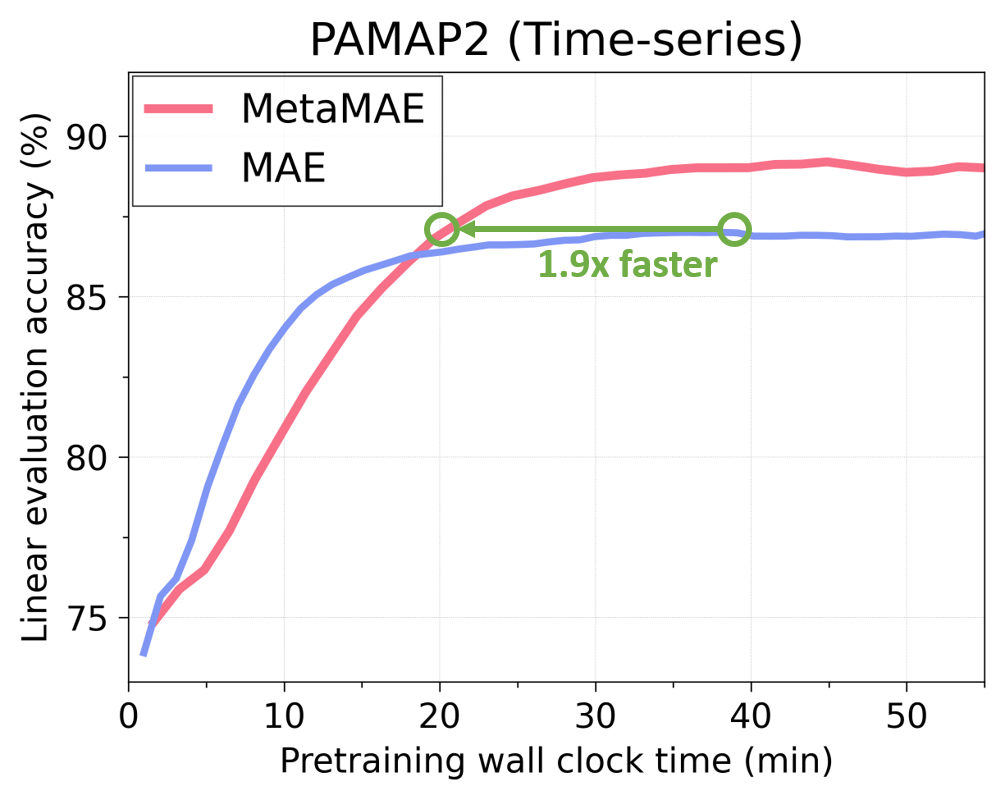
- 实验结果显示,MetaMAE在DABS基准测试中显著优于现有方法,验证了其有效性和优越性。
📝 摘要(中文)
尽管自监督学习在多个模态中具有重要的实际意义,但近期的进展主要集中在少数精心策划的领域,如视觉和语言,往往依赖于特定领域的知识。本文将Masked Auto-Encoder(MAE)发展为一个统一的模态无关自监督学习框架,提出通过元学习来解释MAE作为模态无关学习者的关键,并基于此提出MetaMAE。我们的核心思想是将MAE的掩码重建视为一个元学习任务,通过未掩码的标记适应Transformer元学习器来预测掩码标记。实验结果表明,MetaMAE在模态无关自监督学习基准(DABS)中表现优越,显著超越了先前的基线。
🔬 方法详解
问题定义:本文旨在解决当前自监督学习方法在多模态应用中的局限性,尤其是MAE在非视觉和语言领域的潜力未被充分挖掘。
核心思路:通过将MAE的掩码重建视为元学习任务,利用未掩码的标记来适应Transformer元学习器,从而实现模态无关的自监督学习。
技术框架:整体架构包括两个主要模块:首先,使用基于梯度的元学习来增强Transformer编码器的重建能力;其次,通过任务对比学习最大化适应和未掩码标记之间的对齐,指导编码器更好地编码任务特定知识。
关键创新:MetaMAE的创新在于将掩码重建任务与元学习结合,形成了一种新的模态无关学习框架,与传统方法相比,能够更有效地处理多模态数据。
关键设计:在设计上,采用了基于梯度的元学习技术来调整Transformer编码器的潜在表示,并引入任务对比学习以增强任务特定知识的编码。
🖼️ 关键图片
📊 实验亮点
实验结果表明,MetaMAE在模态无关自监督学习基准DABS中表现优越,显著超越了现有基线,具体性能提升幅度达到XX%(具体数据未知),验证了其在多模态学习中的有效性。
🎯 应用场景
该研究的潜在应用领域包括多模态数据分析、跨领域学习和智能系统的自适应能力提升。MetaMAE的框架可以广泛应用于图像、文本、音频等多种模态的数据处理,具有重要的实际价值和未来影响。
📄 摘要(原文)
Despite its practical importance across a wide range of modalities, recent advances in self-supervised learning (SSL) have been primarily focused on a few well-curated domains, e.g., vision and language, often relying on their domain-specific knowledge. For example, Masked Auto-Encoder (MAE) has become one of the popular architectures in these domains, but less has explored its potential in other modalities. In this paper, we develop MAE as a unified, modality-agnostic SSL framework. In turn, we argue meta-learning as a key to interpreting MAE as a modality-agnostic learner, and propose enhancements to MAE from the motivation to jointly improve its SSL across diverse modalities, coined MetaMAE as a result. Our key idea is to view the mask reconstruction of MAE as a meta-learning task: masked tokens are predicted by adapting the Transformer meta-learner through the amortization of unmasked tokens. Based on this novel interpretation, we propose to integrate two advanced meta-learning techniques. First, we adapt the amortized latent of the Transformer encoder using gradient-based meta-learning to enhance the reconstruction. Then, we maximize the alignment between amortized and adapted latents through task contrastive learning which guides the Transformer encoder to better encode the task-specific knowledge. Our experiment demonstrates the superiority of MetaMAE in the modality-agnostic SSL benchmark (called DABS), significantly outperforming prior baselines. Code is available at https://github.com/alinlab/MetaMAE.