Deep Reinforcement Learning with Explicit Context Representation
作者: Francisco Munguia-Galeano, Ah-Hwee Tan, Ze Ji
分类: cs.LG
发布日期: 2023-10-15
备注: Manuscript accepted for publication as regular paper in IEEE Transactions on Neural Networks and Learning Systems
💡 一句话要点
提出Iota显式上下文表示框架以解决强化学习中的上下文学习问题
🎯 匹配领域: 支柱二:RL算法与架构 (RL & Architecture) 支柱三:空间感知与语义 (Perception & Semantics)
关键词: 强化学习 上下文学习 深度Q网络 算法优化 机器人导航 智能决策
📋 核心要点
- 现有强化学习算法缺乏有效的上下文学习机制,导致学习效率低下,特别是在复杂环境中。
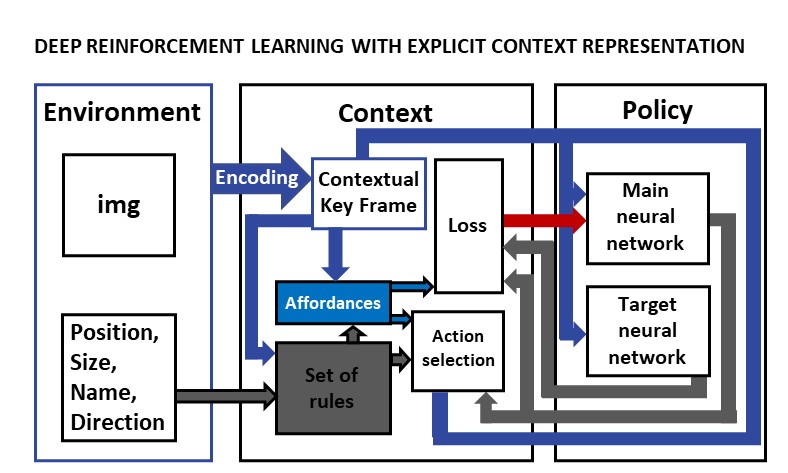
- 本文提出的Iota显式上下文表示框架通过上下文关键帧来提取状态信息,从而增强学习过程的上下文理解能力。
- 实验结果表明,使用上下文信息的四种新算法在训练步骤上显著收敛,性能超越了现有的最先进算法。
📝 摘要(中文)
强化学习(RL)在解决复杂计算问题方面展现了卓越的能力,但大多数RL算法缺乏从上下文信息中学习的显式方法。人类利用上下文识别环境中元素之间的模式和关系,并避免错误决策。本文提出了一种名为Iota显式上下文表示(IECR)的框架,通过使用上下文关键帧(CKFs)来表示每个状态,从而提取状态的可供性函数。此外,论文引入了与状态可供性相关的两个损失函数。IECR框架的创新之处在于其从环境中提取上下文信息并从CKFs表示中学习的能力。我们通过开发四种新算法(IDQN、IDDQN、IDuDQN和IDDDQN)来验证该框架,并在五个离散环境中进行评估,结果显示所有使用上下文信息的算法在约40,000个训练步骤内收敛,显著优于现有的最先进算法。
🔬 方法详解
问题定义:本文旨在解决强化学习中缺乏显式上下文学习的问题。现有方法在复杂环境中往往需要大量步骤才能避免明显错误的决策。
核心思路:提出Iota显式上下文表示(IECR)框架,通过上下文关键帧(CKFs)来表示每个状态,从而提取状态的可供性函数,增强学习的上下文感知能力。
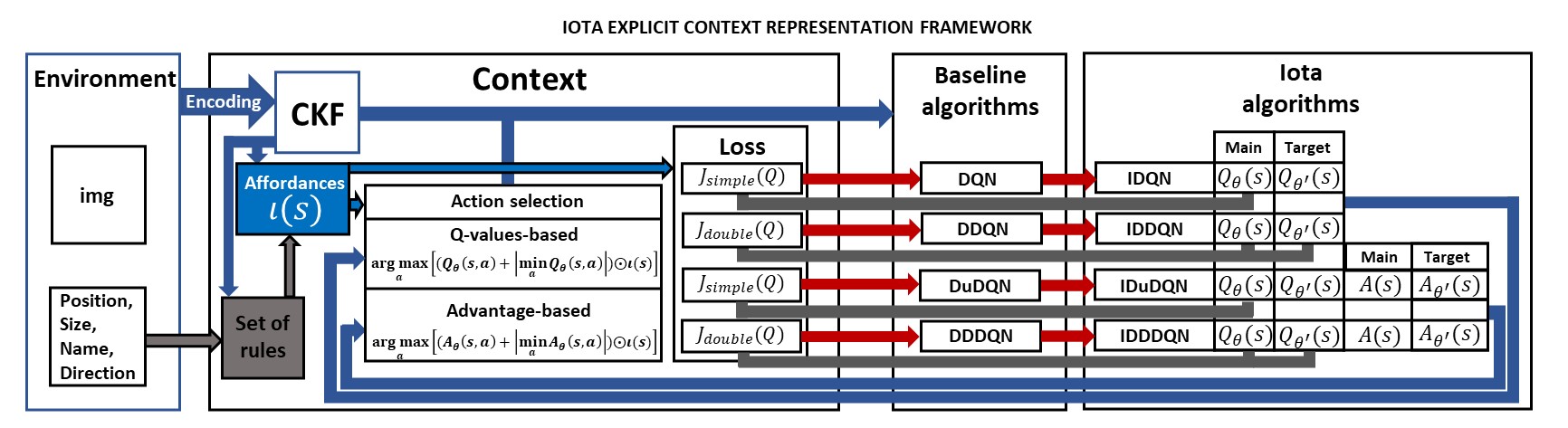
技术框架:IECR框架包括状态表示模块、上下文提取模块和损失函数模块。状态表示模块使用CKFs来捕捉环境信息,上下文提取模块则负责从CKFs中提取可供性信息。
关键创新:IECR框架的核心创新在于其能够显式提取和利用上下文信息,显著提高了强化学习算法在复杂环境中的学习效率,与传统方法相比,能够更快地识别和避免错误决策。
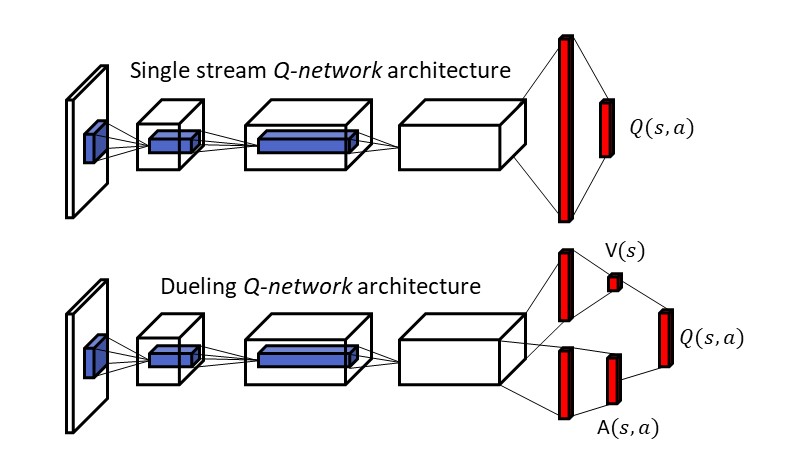
关键设计:论文设计了两个与状态可供性相关的损失函数,以优化学习过程。此外,四种新算法(IDQN、IDDQN、IDuDQN、IDDDQN)在网络结构上进行了调整,以更好地利用上下文信息。
🖼️ 关键图片
📊 实验亮点
实验结果显示,所有使用上下文信息的算法在约40,000个训练步骤内收敛,性能显著优于现有的最先进算法,展示了IECR框架在强化学习中的有效性和优势。
🎯 应用场景
该研究的潜在应用领域包括机器人导航、游戏智能体、自动驾驶等需要在复杂环境中进行决策的场景。通过增强算法的上下文学习能力,可以提高智能体的决策质量和效率,具有重要的实际价值和广泛的应用前景。
📄 摘要(原文)
Reinforcement learning (RL) has shown an outstanding capability for solving complex computational problems. However, most RL algorithms lack an explicit method that would allow learning from contextual information. Humans use context to identify patterns and relations among elements in the environment, along with how to avoid making wrong actions. On the other hand, what may seem like an obviously wrong decision from a human perspective could take hundreds of steps for an RL agent to learn to avoid. This paper proposes a framework for discrete environments called Iota explicit context representation (IECR). The framework involves representing each state using contextual key frames (CKFs), which can then be used to extract a function that represents the affordances of the state; in addition, two loss functions are introduced with respect to the affordances of the state. The novelty of the IECR framework lies in its capacity to extract contextual information from the environment and learn from the CKFs' representation. We validate the framework by developing four new algorithms that learn using context: Iota deep Q-network (IDQN), Iota double deep Q-network (IDDQN), Iota dueling deep Q-network (IDuDQN), and Iota dueling double deep Q-network (IDDDQN). Furthermore, we evaluate the framework and the new algorithms in five discrete environments. We show that all the algorithms, which use contextual information, converge in around 40,000 training steps of the neural networks, significantly outperforming their state-of-the-art equivalents.