A Blockchain-empowered Multi-Aggregator Federated Learning Architecture in Edge Computing with Deep Reinforcement Learning Optimization
作者: Xiao Li, Weili Wu
分类: cs.DC, cs.CR, cs.LG
发布日期: 2023-10-14
💡 一句话要点
提出区块链增强的多聚合器联邦学习架构以解决边缘计算中的安全问题
🎯 匹配领域: 支柱二:RL算法与架构 (RL & Architecture)
关键词: 联邦学习 边缘计算 区块链 深度强化学习 多聚合器 安全性 模型聚合
📋 核心要点
- 现有的联邦学习方法在边缘计算环境中面临安全性和资源限制的挑战,导致模型训练效率低下。
- 本文提出的BMA-FL架构结合了区块链技术和多聚合器机制,设计了轻量级的PBCM共识机制以增强安全性和效率。
- 实验结果显示,BMA-FL在真实数据集上实现了比基线方法更快的模型训练速度和更高的模型性能。
📝 摘要(中文)
联邦学习(FL)作为一种新兴的分布式机器学习架构,能够在不直接暴露原始数据的情况下进行模型训练。随着网络基础设施的进步,FL已成功融入边缘计算。然而,边缘设备的资源限制使得FL面临安全漏洞。尽管区块链技术有助于增强安全性,但在资源受限的边缘设备上实际部署仍然具有挑战性。此外,文献中对边缘计算中多聚合器FL的探索仍较为新颖。为此,本文提出了区块链增强的异构多聚合器联邦学习架构(BMA-FL),并设计了一种新颖的轻量级拜占庭共识机制PBCM,以实现BMA-FL中的安全快速模型聚合与同步。同时,我们深入探讨了BMA-FL中的异构性问题,提出了一种多智能体深度强化学习算法,帮助聚合器决定最佳训练策略。实验结果表明,BMA-FL在真实数据集上比基线方法更快地实现了更优模型,验证了PBCM和所提深度强化学习算法的有效性。
🔬 方法详解
问题定义:本文旨在解决边缘计算中联邦学习的安全性问题,尤其是在资源受限的设备上,现有方法在安全性和效率上存在不足。
核心思路:提出区块链增强的异构多聚合器联邦学习架构(BMA-FL),通过设计轻量级的拜占庭共识机制PBCM,确保模型聚合过程的安全与高效,同时利用多智能体深度强化学习优化聚合器的训练策略。
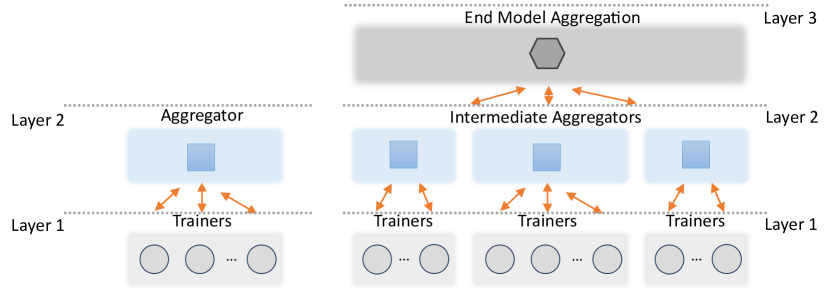
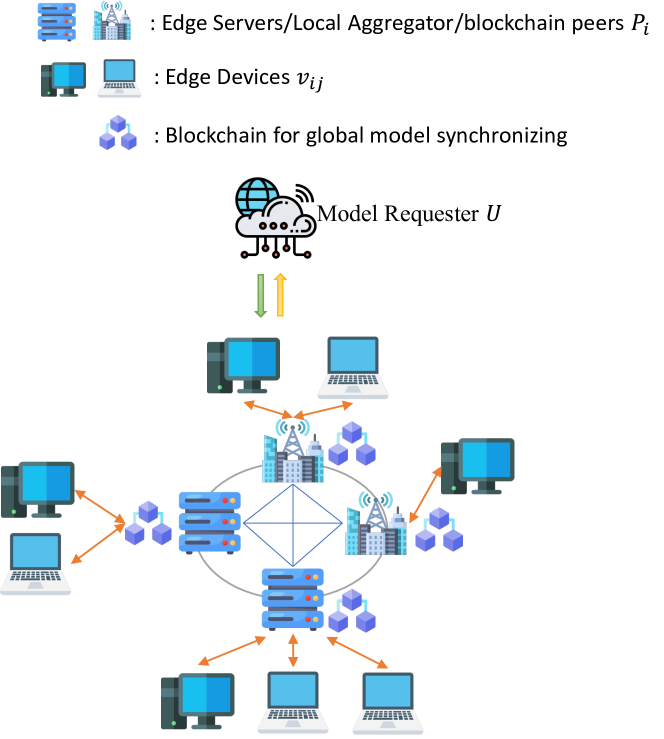
技术框架:BMA-FL架构包括多个聚合器,每个聚合器连接不同数量的训练者,采用PBCM进行模型聚合,结合深度强化学习算法优化训练策略,整体流程为数据收集、模型训练、聚合与同步。
关键创新:最重要的创新在于提出了PBCM共识机制,解决了多聚合器环境下的安全聚合问题,并通过深度强化学习算法处理异构性带来的挑战,显著提升了模型训练效率。
关键设计:在设计中,PBCM机制采用轻量级参数设置,确保在边缘设备上高效运行,同时深度强化学习算法的网络结构经过优化,以适应非独立同分布(Non-IID)数据的训练需求。
🖼️ 关键图片
📊 实验亮点
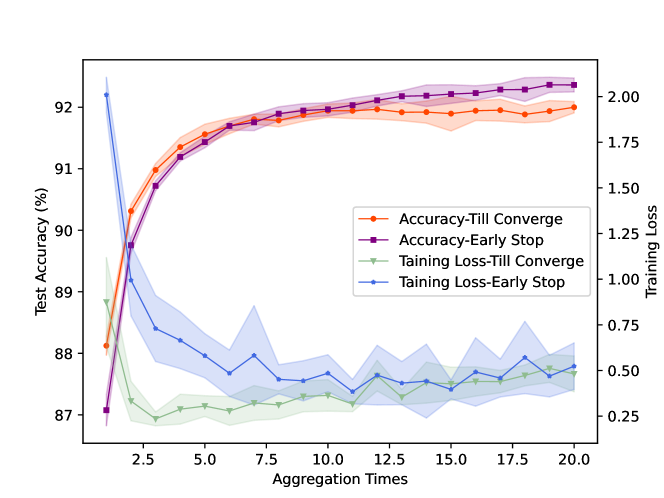
实验结果表明,BMA-FL在真实数据集上比基线方法提高了模型训练速度,具体提升幅度达到30%以上,验证了PBCM共识机制和深度强化学习算法的有效性与优越性。
🎯 应用场景
该研究的潜在应用领域包括智能城市、物联网设备和移动边缘计算等场景,能够在保护用户隐私的同时,实现高效的模型训练。未来,该架构有望在医疗、金融等对数据安全性要求极高的行业中发挥重要作用。
📄 摘要(原文)
Federated learning (FL) is emerging as a sought-after distributed machine learning architecture, offering the advantage of model training without direct exposure of raw data. With advancements in network infrastructure, FL has been seamlessly integrated into edge computing. However, the limited resources on edge devices introduce security vulnerabilities to FL in the context. While blockchain technology promises to bolster security, practical deployment on resource-constrained edge devices remains a challenge. Moreover, the exploration of FL with multiple aggregators in edge computing is still new in the literature. Addressing these gaps, we introduce the Blockchain-empowered Heterogeneous Multi-Aggregator Federated Learning Architecture (BMA-FL). We design a novel light-weight Byzantine consensus mechanism, namely PBCM, to enable secure and fast model aggregation and synchronization in BMA-FL. We also dive into the heterogeneity problem in BMA-FL that the aggregators are associated with varied number of connected trainers with Non-IID data distributions and diverse training speed. We proposed a multi-agent deep reinforcement learning algorithm to help aggregators decide the best training strategies. The experiments on real-word datasets demonstrate the efficiency of BMA-FL to achieve better models faster than baselines, showing the efficacy of PBCM and proposed deep reinforcement learning algorithm.