LLaMA Rider: Spurring Large Language Models to Explore the Open World
作者: Yicheng Feng, Yuxuan Wang, Jiazheng Liu, Sipeng Zheng, Zongqing Lu
分类: cs.LG
发布日期: 2023-10-13
备注: 18 pages
💡 一句话要点
提出LLaMA Rider以提升大语言模型在开放世界中的探索能力
🎯 匹配领域: 支柱二:RL算法与架构 (RL & Architecture) 支柱九:具身大模型 (Embodied Foundation Models)
关键词: 大型语言模型 开放世界 反馈机制 任务规划 子任务标记
📋 核心要点
- 现有方法在开放世界中,LLMs的知识获取和适应能力存在不确定性,限制了其决策和规划的有效性。
- 本文提出LLaMA Rider,通过多轮反馈修正机制和子任务重新标记,促使LLMs主动探索环境并提升任务解决能力。
- 实验结果表明,LLaMA Rider在Minecraft中显著提高了LLM的探索效率,且通过微调仅需1.3k实例即可完成更多任务,训练成本低于基线方法。
📝 摘要(中文)
近年来,许多研究利用大型语言模型(LLMs)帮助决策和规划,并试图将LLMs的知识与世界条件对齐。然而,LLMs在开放世界中持续获取环境知识和适应能力的能力仍不确定。本文提出了一种方法,促使LLMs探索开放世界、收集经验并学习以提高任务解决能力。该方法利用多轮反馈修正机制,鼓励LLMs根据环境反馈信息主动选择适当的修正动作,从而促进探索并提升模型性能。此外,我们整合了子任务重新标记,以帮助LLMs在子任务规划中保持一致性,并帮助模型学习任务之间的组合特性,使其能够通过基于探索经验的训练完成更广泛的任务。通过在Minecraft这一开放式沙盒世界中的评估,我们展示了LLaMA-Rider在环境探索效率上的提升,并有效提高了LLM通过仅1.3k实例的微调完成更多任务的能力,相较于使用强化学习的基线,训练成本最低。
🔬 方法详解
问题定义:本文旨在解决大型语言模型在开放世界中持续获取环境知识和适应能力不足的问题。现有方法未能有效促进LLMs的环境探索与任务解决能力。
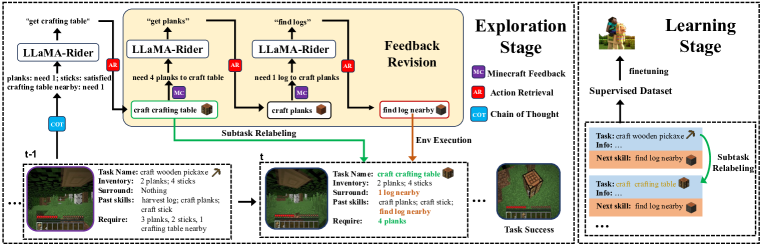
核心思路:我们提出了一种多轮反馈修正机制,鼓励LLMs根据环境反馈主动选择修正动作,从而增强其探索能力和任务解决能力。
技术框架:整体架构包括环境反馈收集、修正动作选择和子任务重新标记三个主要模块。首先,模型通过与环境交互收集反馈信息;其次,基于反馈信息选择适当的修正动作;最后,通过子任务重新标记保持任务规划的一致性。
关键创新:最重要的技术创新在于引入多轮反馈修正机制和子任务重新标记,这与现有方法的单一反馈机制和固定任务标记方式有本质区别,能够更好地促进模型的自我学习和适应能力。
关键设计:在参数设置上,我们采用了适应性学习率和动态任务标记策略,损失函数设计为结合探索奖励和任务完成度的复合损失,以优化模型的学习过程。
🖼️ 关键图片

📊 实验亮点
实验结果显示,LLaMA Rider在Minecraft环境中显著提升了LLM的探索效率,且通过仅1.3k实例的微调,模型完成更多任务的能力得到了有效提高,相较于基线方法,训练成本显著降低,展现出良好的实用性。
🎯 应用场景
该研究的潜在应用领域包括智能机器人、自动化决策系统和游戏AI等。通过提升LLMs在开放世界中的探索能力,能够使其在复杂环境中更有效地执行任务,具有重要的实际价值和广泛的应用前景。
📄 摘要(原文)
Recently, various studies have leveraged Large Language Models (LLMs) to help decision-making and planning in environments, and try to align the LLMs' knowledge with the world conditions. Nonetheless, the capacity of LLMs to continuously acquire environmental knowledge and adapt in an open world remains uncertain. In this paper, we propose an approach to spur LLMs to explore the open world, gather experiences, and learn to improve their task-solving capabilities. In this approach, a multi-round feedback-revision mechanism is utilized to encourage LLMs to actively select appropriate revision actions guided by feedback information from the environment. This facilitates exploration and enhances the model's performance. Besides, we integrate sub-task relabeling to assist LLMs in maintaining consistency in sub-task planning and help the model learn the combinatorial nature between tasks, enabling it to complete a wider range of tasks through training based on the acquired exploration experiences. By evaluation in Minecraft, an open-ended sandbox world, we demonstrate that our approach LLaMA-Rider enhances the efficiency of the LLM in exploring the environment, and effectively improves the LLM's ability to accomplish more tasks through fine-tuning with merely 1.3k instances of collected data, showing minimal training costs compared to the baseline using reinforcement learning.