Beyond Traditional DoE: Deep Reinforcement Learning for Optimizing Experiments in Model Identification of Battery Dynamics
作者: Gokhan Budan, Francesca Damiani, Can Kurtulus, N. Kemal Ure
分类: cs.LG, cs.AI
发布日期: 2023-10-12
💡 一句话要点
提出基于深度强化学习的实验优化方法以解决电池动态建模问题
🎯 匹配领域: 支柱二:RL算法与架构 (RL & Architecture)
关键词: 电池动态建模 深度强化学习 实验设计 资源优化 能源管理系统
📋 核心要点
- 现有的电池动态建模方法依赖传统的实验设计,过程耗时且资源消耗大。
- 本文提出了一种基于深度强化学习的动态实验优化方法,能够实时调整实验配置。
- 实验结果显示,该方法在模型准确性上与传统方法相当,但资源使用效率提高了85%。
📝 摘要(中文)
电池动态建模是能源研究中的核心问题,许多能源管理系统和设计过程依赖于准确的电池模型以优化效率。传统的实验设计方法(DoE)虽然能够获得有用的模型,但由于需要遍历多种电流配置,过程既耗时又昂贵。本文提出了一种基于深度强化学习的新型DoE方法,该方法根据过去实验的统计数据动态调整实验配置,避免了使用预定义的电流配置库。通过仿真和实际实验,结果表明该方法在模型准确性上与传统DoE相当,但资源消耗减少了85%。
🔬 方法详解
问题定义:本文旨在解决电池动态建模中的实验设计效率低下问题。传统的实验设计方法需要遍历多种电流配置,导致时间和资源的浪费。
核心思路:通过引入深度强化学习,本文提出了一种动态调整实验配置的方法。该方法根据历史实验的统计数据,实时修改电流配置,从而只应用对未来实验有信息量的配置。
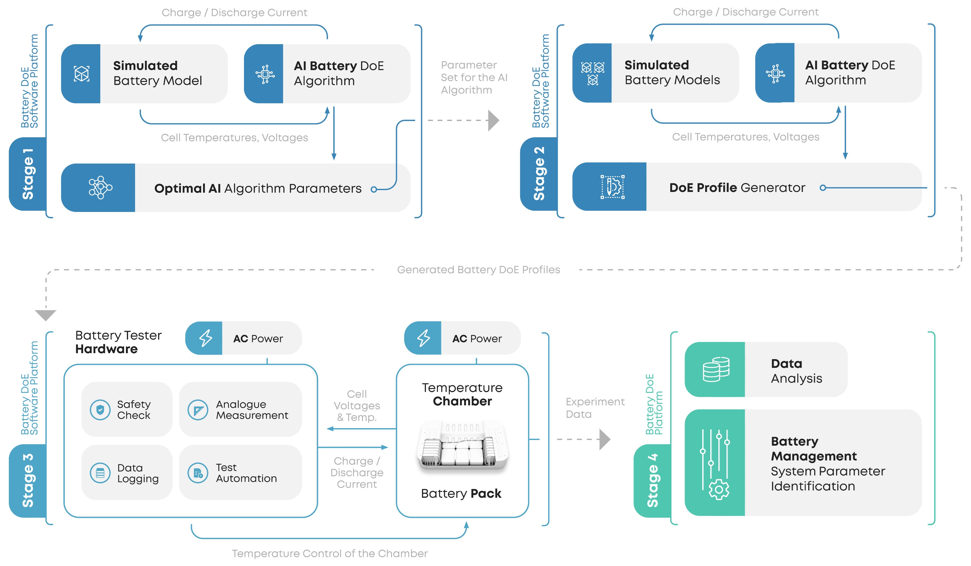
技术框架:整体流程包括数据收集、模型训练和实验调整三个主要模块。首先,通过初步实验收集数据,然后利用深度强化学习算法训练模型,最后根据模型输出动态调整后续实验的电流配置。
关键创新:最重要的创新在于动态调整实验配置的能力,区别于传统方法的静态配置库。这种方法能够显著提高实验效率和资源利用率。
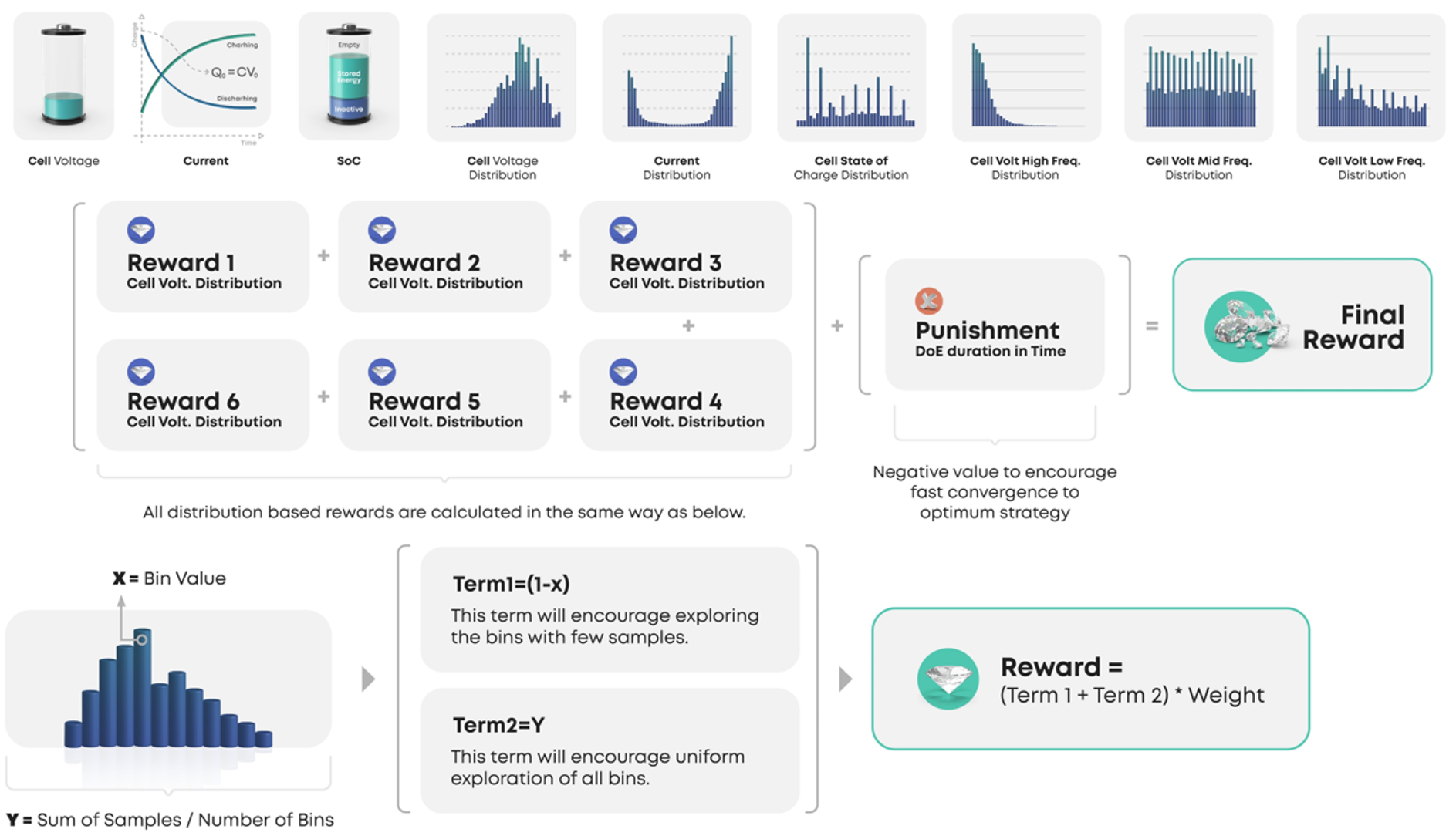
关键设计:关键参数包括强化学习的奖励函数设计,确保模型能够有效学习哪些电流配置最具信息量。此外,网络结构采用深度神经网络,以捕捉复杂的电池动态特征。
🖼️ 关键图片
📊 实验亮点
实验结果表明,基于深度强化学习的方法在模型准确性上与传统实验设计相当,但资源消耗减少了85%。这一显著的提升展示了新方法在实验优化中的潜力,能够有效降低实验成本和时间。
🎯 应用场景
该研究的潜在应用领域包括电池管理系统、能源存储优化和电动汽车设计等。通过提高电池动态建模的效率和准确性,能够显著提升能源系统的整体性能,降低成本,并推动可再生能源的应用与发展。未来,该方法还可能扩展到其他领域的实验优化问题。
📄 摘要(原文)
Model identification of battery dynamics is a central problem in energy research; many energy management systems and design processes rely on accurate battery models for efficiency optimization. The standard methodology for battery modelling is traditional design of experiments (DoE), where the battery dynamics are excited with many different current profiles and the measured outputs are used to estimate the system dynamics. However, although it is possible to obtain useful models with the traditional approach, the process is time consuming and expensive because of the need to sweep many different current-profile configurations. In the present work, a novel DoE approach is developed based on deep reinforcement learning, which alters the configuration of the experiments on the fly based on the statistics of past experiments. Instead of sticking to a library of predefined current profiles, the proposed approach modifies the current profiles dynamically by updating the output space covered by past measurements, hence only the current profiles that are informative for future experiments are applied. Simulations and real experiments are used to show that the proposed approach gives models that are as accurate as those obtained with traditional DoE but by using 85\% less resources.