In-Context Unlearning: Language Models as Few Shot Unlearners
作者: Martin Pawelczyk, Seth Neel, Himabindu Lakkaraju
分类: cs.LG, cs.AI, cs.CR
发布日期: 2023-10-11 (更新: 2024-06-06)
备注: Accepted at ICML 2024
💡 一句话要点
提出上下文去学习方法以解决大语言模型的去学习问题
🎯 匹配领域: 支柱九:具身大模型 (Embodied Foundation Models)
关键词: 机器去学习 大语言模型 数据隐私 上下文学习 模型更新
📋 核心要点
- 现有的去学习方法通常需要重训练模型,计算成本高且不适用于大型语言模型。
- 本文提出的上下文去学习方法通过在推理时提供特定输入来实现去学习,无需更新模型参数。
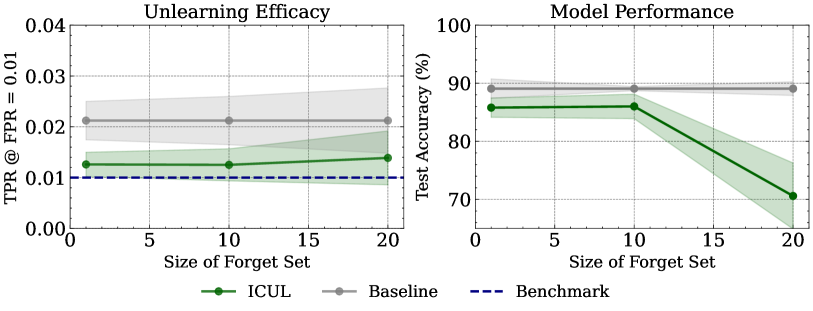
- 实验结果显示,该方法在去除特定实例影响的同时,测试准确性得以保持,甚至在某些情况下优于传统方法。
📝 摘要(中文)
机器去学习是高效移除特定训练实例对模型影响的研究,近年来因法规如“被遗忘权”受到关注。传统的精确去学习通常需要完全重训练模型,对于大型模型如大语言模型(LLMs)而言,计算成本不可行。现有算法依赖于对模型参数的访问以进行更新,但在实际应用中可能因计算限制或仅有查询访问而不成立。本文提出了一种新的去学习方法“上下文去学习”,通过在推理时提供特定输入而无需更新模型参数,从而实现对特定训练实例的去学习。实验结果表明,上下文去学习在去除特定实例影响的同时,保持了测试准确性,并在某些情况下超越了其他需要访问模型参数的最先进方法。
🔬 方法详解
问题定义:本文旨在解决如何高效地从大型语言模型中去除特定训练实例的影响。现有方法通常需要重训练模型,计算成本高且不适用于大型模型。
核心思路:提出的上下文去学习方法通过在推理阶段提供特定的输入和标签,来实现对特定训练实例的去学习,而无需对模型参数进行更新。这种设计使得去学习过程更加高效且易于实现。
技术框架:整体架构包括输入准备、推理阶段和结果评估三个主要模块。在推理阶段,模型接收特定的输入和标签,并根据这些信息进行去学习。
关键创新:最重要的技术创新在于提出了上下文去学习的概念,通过输入特定的上下文信息来实现去学习,这与传统方法依赖于模型参数更新的方式本质上不同。
关键设计:在实现过程中,关键设计包括如何选择特定的输入和标签,以及如何评估去学习的效果。这些设计确保了方法的有效性和准确性。
🖼️ 关键图片


📊 实验亮点
实验结果表明,上下文去学习方法在去除特定实例影响方面表现出色,测试准确性保持在高水平。在与其他最先进方法的对比中,该方法在某些情况下实现了显著的性能提升,展示了其有效性和实用性。
🎯 应用场景
该研究的潜在应用领域包括数据隐私保护、合规性要求以及机器学习模型的动态更新等。通过提供一种高效的去学习方法,能够帮助企业和组织更好地应对法规要求,保护用户隐私,同时保持模型的性能和准确性。未来,该方法可能在更多实际场景中得到应用,推动机器学习技术的合规发展。
📄 摘要(原文)
Machine unlearning, the study of efficiently removing the impact of specific training instances on a model, has garnered increased attention in recent years due to regulatory guidelines such as the \emph{Right to be Forgotten}. Achieving precise unlearning typically involves fully retraining the model and is computationally infeasible in case of very large models such as Large Language Models (LLMs). To this end, recent work has proposed several algorithms which approximate the removal of training data without retraining the model. These algorithms crucially rely on access to the model parameters in order to update them, an assumption that may not hold in practice due to computational constraints or having only query access to the LLMs. In this work, we propose a new class of unlearning methods for LLMs called ``In-Context Unlearning.'' This method unlearns instances from the model by simply providing specific kinds of inputs in context, without the need to update model parameters. To unlearn specific training instances, we present these instances to the LLMs at inference time along with labels that differ from their ground truth. Our experimental results demonstrate that in-context unlearning performs on par with, or in some cases outperforms other state-of-the-art methods that require access to model parameters, effectively removing the influence of specific instances on the model while preserving test accuracy.