Reward-Consistent Dynamics Models are Strongly Generalizable for Offline Reinforcement Learning
作者: Fan-Ming Luo, Tian Xu, Xingchen Cao, Yang Yu
分类: cs.LG
发布日期: 2023-10-09
💡 一句话要点
提出奖励一致性动态模型以解决离线强化学习的泛化问题
🎯 匹配领域: 支柱二:RL算法与架构 (RL & Architecture)
关键词: 离线强化学习 动态模型 奖励一致性 泛化能力 模型基础方法 深度学习 机器人控制
📋 核心要点
- 现有的动态模型在学习历史过渡时,往往难以泛化到未见过的过渡,限制了离线强化学习的效果。
- 本研究提出了奖励一致性动态模型,确保生成的轨迹能够最大化动态奖励,从而提高模型的泛化能力。
- 在多个基准测试中,MOREC方法在21个离线任务中显著提升了性能,部分任务的在线强化学习表现超过95%。
📝 摘要(中文)
精确的动态模型学习对于离线强化学习至关重要,但现有方法在泛化未见过的过渡时面临挑战。本研究识别出一个重要因素——动态奖励,该因素在不同过渡中保持一致,提供了更好泛化的途径。我们提出了奖励一致性动态模型的概念,确保由动态模型生成的任何轨迹都能最大化从数据中获得的动态奖励。我们实现了MOREC方法,该方法可以无缝集成到现有的离线模型基础强化学习方法中。在合成任务中,MOREC展示了强大的泛化能力,并能恢复一些远距离的未见过的过渡。在D4RL和NeoRL基准的21个离线任务中,MOREC显著提升了之前的最优性能,D4RL任务提升4.6%,NeoRL任务提升25.9%。
🔬 方法详解
问题定义:本论文旨在解决离线强化学习中动态模型泛化能力不足的问题。现有方法在处理未见过的过渡时,往往无法有效利用历史数据,导致性能下降。
核心思路:论文提出了奖励一致性动态模型的概念,强调动态奖励在不同过渡中的一致性。通过最大化动态奖励,模型能够更好地泛化到未见过的状态和动作。
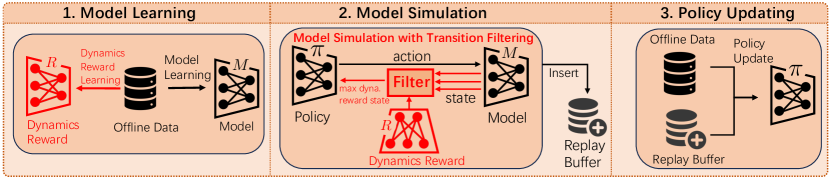
技术框架:MOREC方法的整体架构包括动态奖励函数的学习和过渡选择两个主要模块。首先,从离线数据中学习动态奖励函数,然后在生成过渡时,选择具有最高动态奖励的过渡进行训练。
关键创新:该研究的核心创新在于引入动态奖励这一概念,使得模型在生成轨迹时能够更好地利用历史数据,从而显著提升泛化能力。这一方法与传统的动态模型学习方法有本质区别。
关键设计:MOREC方法在参数设置上采用了适应性学习率,并设计了特定的损失函数以优化动态奖励的学习。此外,网络结构上采用了深度神经网络,以提高动态奖励函数的表达能力。
🖼️ 关键图片
📊 实验亮点
MOREC方法在21个离线任务中显著提升了性能,其中在D4RL任务上提升了4.6%,在NeoRL任务上提升了25.9%。特别是在6个D4RL任务和3个NeoRL任务中,MOREC首次实现了超过95%的在线强化学习性能,展示了其强大的泛化能力。
🎯 应用场景
该研究的成果在多个领域具有潜在应用价值,包括机器人控制、自动驾驶、游戏智能体等。通过提高离线强化学习的泛化能力,MOREC方法能够在实际应用中更好地处理未见过的状态,提高决策的准确性和效率。未来,该方法可能推动更多复杂任务的离线学习研究。
📄 摘要(原文)
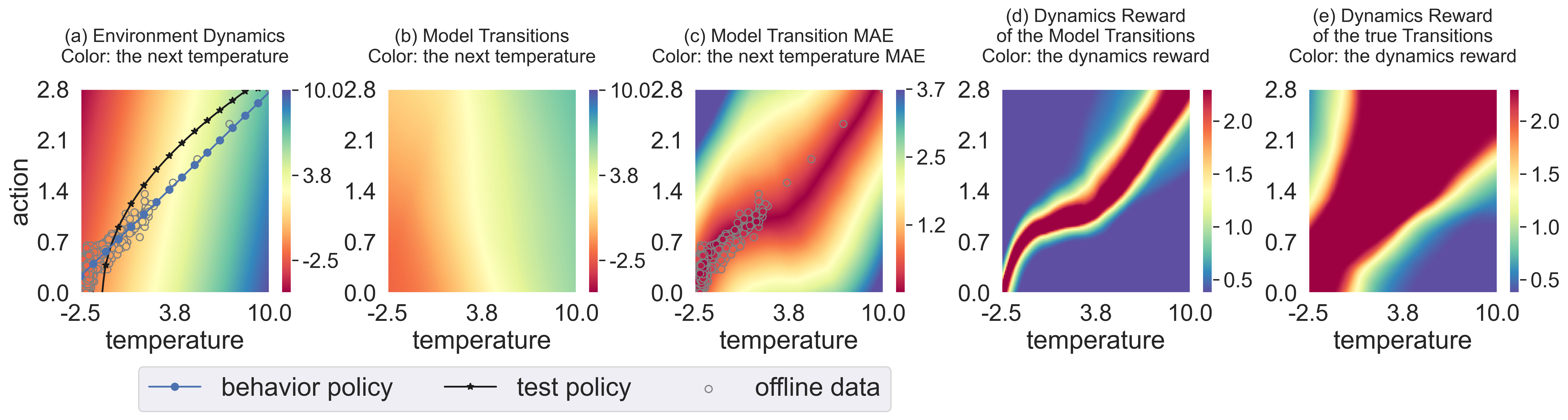
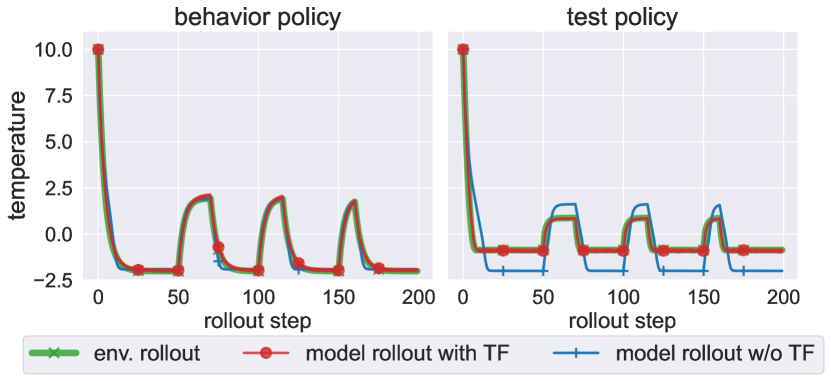
Learning a precise dynamics model can be crucial for offline reinforcement learning, which, unfortunately, has been found to be quite challenging. Dynamics models that are learned by fitting historical transitions often struggle to generalize to unseen transitions. In this study, we identify a hidden but pivotal factor termed dynamics reward that remains consistent across transitions, offering a pathway to better generalization. Therefore, we propose the idea of reward-consistent dynamics models: any trajectory generated by the dynamics model should maximize the dynamics reward derived from the data. We implement this idea as the MOREC (Model-based Offline reinforcement learning with Reward Consistency) method, which can be seamlessly integrated into previous offline model-based reinforcement learning (MBRL) methods. MOREC learns a generalizable dynamics reward function from offline data, which is subsequently employed as a transition filter in any offline MBRL method: when generating transitions, the dynamics model generates a batch of transitions and selects the one with the highest dynamics reward value. On a synthetic task, we visualize that MOREC has a strong generalization ability and can surprisingly recover some distant unseen transitions. On 21 offline tasks in D4RL and NeoRL benchmarks, MOREC improves the previous state-of-the-art performance by a significant margin, i.e., 4.6% on D4RL tasks and 25.9% on NeoRL tasks. Notably, MOREC is the first method that can achieve above 95% online RL performance in 6 out of 12 D4RL tasks and 3 out of 9 NeoRL tasks.