Understanding, Predicting and Better Resolving Q-Value Divergence in Offline-RL
作者: Yang Yue, Rui Lu, Bingyi Kang, Shiji Song, Gao Huang
分类: cs.LG
发布日期: 2023-10-06 (更新: 2023-11-07)
备注: 31 pages, 20 figures
期刊: NeurIPS 2023
💡 一句话要点
提出自激励特征度量以解决离线强化学习中的Q值发散问题
🎯 匹配领域: 支柱二:RL算法与架构 (RL & Architecture)
关键词: 离线强化学习 Q值估计 自激励特征度量 神经切线核 LayerNorm 模型架构优化 发散预测
📋 核心要点
- 离线强化学习中,Q值估计的发散问题严重影响了模型的稳定性,现有方法未能有效解决这一挑战。
- 本文提出了一种新的自激励特征度量(SEEM),通过神经切线核来分析Q网络的演变,提供了对发散机制的深入理解。
- 实验表明,使用LayerNorm可以有效避免Q值发散,并在仅使用1个数据集过渡的情况下仍能取得优异的性能,超越了许多现有方法。
📝 摘要(中文)
Q值估计的发散是离线强化学习中的一个突出问题,传统观点认为这是由于在引导价值目标时查询了分布外的动作所致。本文首次识别出自激励模式作为Q值估计发散的主要原因,并提出了一种基于神经切线核的自激励特征度量(SEEM)来衡量Q网络在训练过程中的演变特性。通过理论分析,我们能够在早期阶段可靠地判断训练是否会发散,并预测估计Q值的增长顺序及其崩溃步骤。实验结果与理论分析完美一致,表明改进模型架构(如使用LayerNorm)可以有效避免发散,且在极具挑战性的设置中仍能取得优异表现。
🔬 方法详解
问题定义:本文聚焦于离线强化学习中的Q值估计发散问题,现有方法主要依赖于策略约束和保守Q估计,但缺乏对发散机制的理论理解。
核心思路:我们首次识别出自激励模式为Q值发散的根本原因,并提出自激励特征度量(SEEM)来量化Q网络在训练过程中的演变特性,以此为基础进行改进。
技术框架:整体架构包括Q网络的训练过程、SEEM度量的计算以及基于该度量的模型架构改进。主要模块包括Q值估计、发散预测和模型优化。
关键创新:最重要的技术创新在于提出了SEEM度量,使得我们能够在训练早期阶段判断发散风险,并预测Q值的增长趋势,与传统方法相比具有更高的可靠性和准确性。
关键设计:在模型设计中,LayerNorm被引入以改善模型的架构,避免了发散现象的发生,且未引入有害的偏差,确保了模型在极具挑战性的环境中的有效性。实验中展示了该设计的优越性。
🖼️ 关键图片
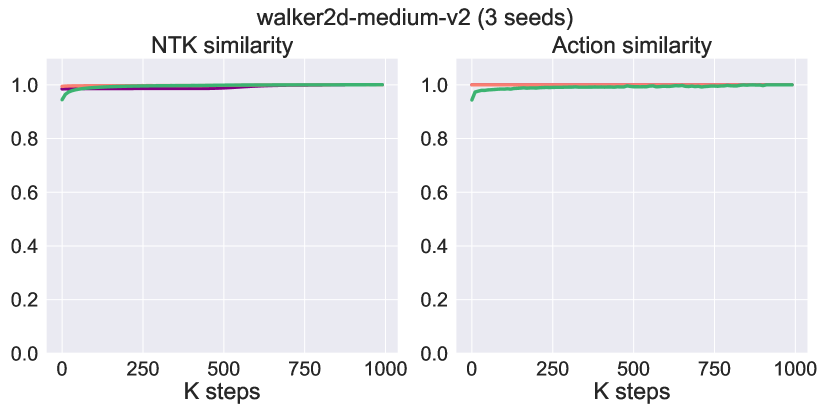
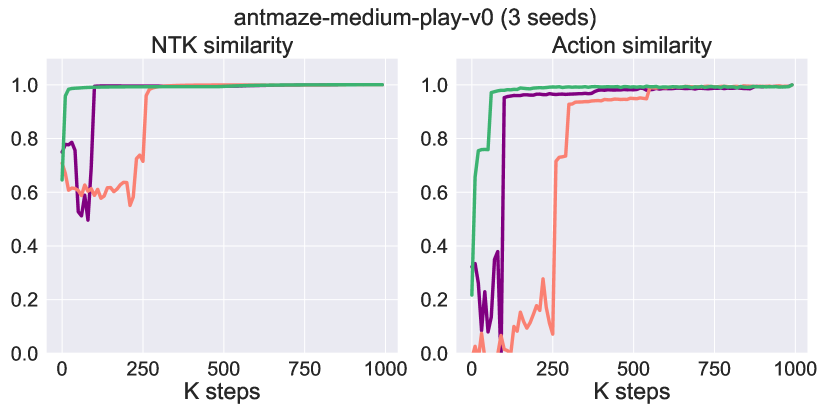
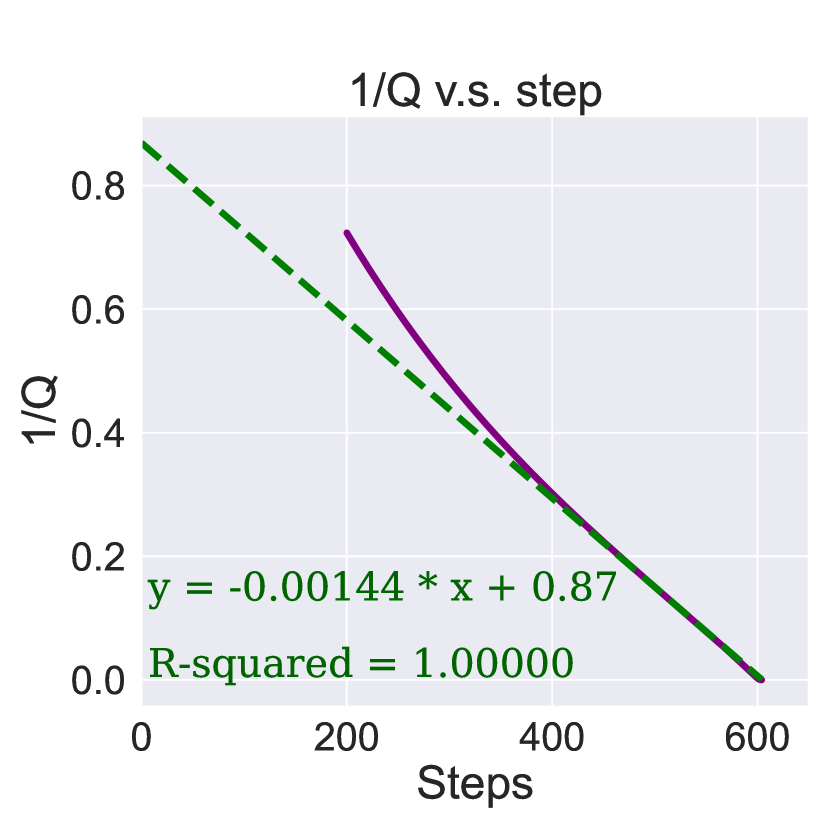
📊 实验亮点
实验结果显示,使用LayerNorm的模型在仅依赖1个数据集过渡的情况下,成功避免了Q值发散,且在多个挑战性任务上达到了最新的性能标准,相较于传统方法有显著提升,验证了理论分析的有效性。
🎯 应用场景
该研究在离线强化学习领域具有广泛的应用潜力,尤其是在需要利用有限数据进行决策的场景,如自动驾驶、机器人控制和金融决策等。通过改进模型架构,可以在实际应用中提高系统的稳定性和性能,推动智能系统的进一步发展。
📄 摘要(原文)
The divergence of the Q-value estimation has been a prominent issue in offline RL, where the agent has no access to real dynamics. Traditional beliefs attribute this instability to querying out-of-distribution actions when bootstrapping value targets. Though this issue can be alleviated with policy constraints or conservative Q estimation, a theoretical understanding of the underlying mechanism causing the divergence has been absent. In this work, we aim to thoroughly comprehend this mechanism and attain an improved solution. We first identify a fundamental pattern, self-excitation, as the primary cause of Q-value estimation divergence in offline RL. Then, we propose a novel Self-Excite Eigenvalue Measure (SEEM) metric based on Neural Tangent Kernel (NTK) to measure the evolving property of Q-network at training, which provides an intriguing explanation of the emergence of divergence. For the first time, our theory can reliably decide whether the training will diverge at an early stage, and even predict the order of the growth for the estimated Q-value, the model's norm, and the crashing step when an SGD optimizer is used. The experiments demonstrate perfect alignment with this theoretic analysis. Building on our insights, we propose to resolve divergence from a novel perspective, namely improving the model's architecture for better extrapolating behavior. Through extensive empirical studies, we identify LayerNorm as a good solution to effectively avoid divergence without introducing detrimental bias, leading to superior performance. Experimental results prove that it can still work in some most challenging settings, i.e. using only 1 transitions of the dataset, where all previous methods fail. Moreover, it can be easily plugged into modern offline RL methods and achieve SOTA results on many challenging tasks. We also give unique insights into its effectiveness.